
Public-sector tender guide · East and Southern Africa
The short answer
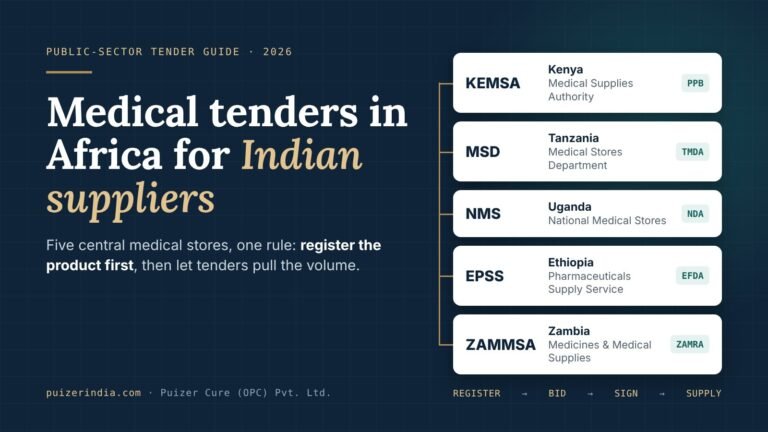
Medical tenders in Africa for Indian suppliers are mostly decided before the bid opens. The five central buyers covered here — KEMSA (Kenya), MSD (Tanzania), NMS (Uganda), EPSS (Ethiopia) and ZAMMSA (Zambia) — buy products that hold a local marketing authorisation. KEMSA and MSD tender documents let a bidder show registration proof by contract signing[1][2], but a national review takes months and a bid window takes weeks.
So the working rule is: register the product first, then let tenders pull the volume. Each agency then adds its own conditions — a portal, a bid security format, a local-partner rule — set out below in one table per agency.
Open as of mid-October 2026
A tender listing dated 6 October 2026 shows KEMSA inviting bids on 12 tenders for the Ministry of Health: adult and paediatric ARVs, medicines for opportunistic infections, anti-malarials, rapid diagnostic tests and condoms. Closing dates run from 27 October to 3 November 2026, and five of the lots carry Global Fund references.[3] This is an aggregator listing; download documents only from KEMSA’s official site, kemsa.go.ke, or the PPIP portal.[4]
Domain warning: when we checked on 17 October 2026, the old address kemsa.co.ke showed a domain-auction page. It is not KEMSA’s site. Do not download tender documents or send bid papers to it.
Five public-sector routes at a glance
Each country has one central medical store that buys for its public hospitals and clinics. The registration that counts is always the national one; a WHO-GMP certificate or an Indian licence does not replace it.
| Agency | Country | Registration that counts | Where bids go | Rule to read first |
|---|---|---|---|---|
| KEMSA | Kenya | Pharmacy and Poisons Board (PPB) | Documents on kemsa.go.ke and tenders.go.ke; submission mode set per tender | Foreign tenderers must source 40% of contract inputs locally[1] |
| MSD | Tanzania | TMDA | NeST only[5] | Framework lots can require a bid on every lot[2] |
| NMS | Uganda | National Drug Authority (NDA) | NMS Bids and Tenders page; eGP 2.0 registration required[6] | Price preference for local producers (2012 policy)[7] |
| EPSS | Ethiopia | EFDA | Federal eGP system[8] | Donor-funded lots add the funder’s quality policy[9] |
| ZAMMSA | Zambia | ZAMRA | ZPPA e-GP[10] | Foreign bidders must partner with a Zambian citizen bidder[10] |
On a phone, scroll the table sideways.
Why registration comes before the bid
- 1Register the product with the national regulator
- 2Register as a supplier on the agency’s e-procurement portal
- 3Bid on lots that match registered products
- 4Show registration proof at contract signing
- 5Deliver under the contract’s Incoterm and shelf-life rules
Step 4 is where the timing bites. KEMSA’s standard international tender requires goods to be registered with the PPB and accepts the proof at contract signing.[1] MSD does the same for TMDA registration.[2] Neither window is long enough to take a product through a national review from scratch — our country guides document reviews of roughly 90 days to 18 months depending on the route: PPB Kenya, TMDA Tanzania, NDA Uganda, EFDA Ethiopia and ZAMRA Zambia.
Demand also runs the other way. A study of Uganda’s register found that procurement staff limited supplies to NDA-registered products, and that companies rarely registered a product when public procurement looked unlikely.[7] Registration and tenders feed each other: the tender list tells you which molecules to register, and the registration decides whether you can bid.
India’s starting position. In 2012, 1,799 of the 3,130 products on Uganda’s national drug register — about 60% — were made in India.[7] Indian manufacturers are not newcomers to these registers; the gap is usually the specific molecule, strength and pack that the next tender asks for.
Which agency should you bid with first?
Answer three questions. The result names the agency your registration already opens, and the condition most likely to stop you there.
1. Where is the product registered today?
2. Is the product WHO-prequalified or approved by a stringent regulator?
3. Do you have a local partner in that country?
Answer all three questions to see your starting point.
The result is a starting point drawn from the tables below, not a legal opinion. The bid data sheet of each tender always overrides it.
Kenya
KEMSA tenders: Kenya Medical Supplies Authority
KEMSA buys for Kenya’s public health programmes, from both government and donor budgets. The figures below come from its standard open international tender (OIT) document; check the data sheet of the tender you bid on, because amounts and submission rules change tender by tender.
| Legal mandate | KEMSA Act (Cap. 260), s. 4(1)(a): procure, warehouse and distribute drugs and medical supplies for prescribed public health programmes, including the national strategic stock reserve.[11] |
|---|---|
| Procurement law | Public Procurement and Asset Disposal Act, 2015.[1] |
| Where tenders appear | Free download from kemsa.go.ke and the PPIP portal, tenders.go.ke. Bidders register their bid documents with KEMSA’s procurement office or by email.[4] |
| Submission | The sample OIT took sealed physical bids in the tender box at KEMSA’s Embakasi supply chain centre; electronic submission applies only if the data sheet says so.[1] |
| Product registration | Goods must be registered with the Pharmacy and Poisons Board (TDS, ITT 16.4). A bidder not yet registered may submit proof by contract signing (ITT 16.3).[1] |
| Who counts as foreign | Any tenderer not registered in Kenya, or less than 51% owned by Kenyan citizens (ITT 4.12). An India-registered exporter is a foreign tenderer.[1] |
| Foreign-bidder conditions | Source at least 40% of contract inputs locally, or face automatic disqualification (ITT 4.11). Be represented by a local service provider in Kenya for warranty obligations (ITT 17.2(b)).[1] Ask KEMSA in writing how the 40% is measured for finished imported medicines before you price. |
| Bid security (example) | KES 2,600,000, valid 210 days from tender opening; tender validity 180 days.[1] |
| Delivery and currency | DDP to KEMSA’s Nairobi warehouse under Incoterms 2020. Foreign bidders may quote in any freely convertible currency.[1] |
| Domestic preference | The sample tender’s data sheet said a margin of domestic preference would not apply.[1] |
| Current buyer signal | KEMSA reported an order fill rate of about 90% in August 2026.[12] |
Your first move: PPB registration through a Kenyan local technical representative. Start with our PPB Kenya drug registration guide.
Tanzania
MSD tenders: Medical Stores Department, Tanzania
MSD tenders much of its supply as multi-year framework agreements on Tanzania’s national e-procurement system, NeST. The rows below draw on MSD’s procurement page and two of its 2026 framework notices.
| Legal mandate | Established by Parliamentary Act No. 13 of 1993 for the production, procurement, storage and distribution of approved medicines and medical supplies; ten zonal stores.[13] |
|---|---|
| Procurement law | Public Procurement Act, 2023, as amended in 2024 (Cap. 410).[14][5] |
| Where tenders appear and go | NeST only. Tenders not received through NeST are not evaluated.[5] Bidders register on NeST and pay the participation fee shown there.[2] |
| Method | Restricted international competitive tendering under framework agreements of 1,095 days; MSD may invite new bidders during the term.[2][5] |
| Product registration | MSD buys only items approved or fully registered by the national authorities — TMDA for medicines.[14] The January 2026 framework required a TMDA certificate of registration, or evidence of it before contract signing.[2] |
| Bid security | A Tender Securing Declaration in the tender’s own form; no other form of security was accepted.[2] |
| Validity and pricing | 120-day tender validity; imported goods priced in US dollars under Incoterms 2020.[2] |
| Lot rules | One 2026 framework required a bid for all 64 lots. Read the lot clause before deciding to bid.[2] |
| Manufacturer or dealer | MSD prioritises manufacturers, local and international, with some room for authorised dealers.[14] A dealer needs the manufacturer’s written authorisation; a manufacturer bidding its own goods faces GMP certification and minimum marketing-period requirements.[5] |
Your first move: TMDA registration, then a NeST supplier account before the next framework opens. See our Tanzania TMDA registration guide.
Uganda
NMS tenders: National Medical Stores, Uganda
When we checked, NMS’s public tender page carried no medicines tenders. That makes NDA registration and an eGP account the things to have in place, so you can respond when a medicines notice does appear.
| Legal mandate | Autonomous body under the National Medical Stores Act, 1993 (Cap. 207): procures, stores and distributes essential medicines and health supplies to public health facilities.[15] |
|---|---|
| Procurement law | Public Procurement and Disposal of Public Assets (PPDA) Act; bid results and awards are posted on the PPDA portal.[16] |
| What NMS buys | Products on Uganda’s essential medicines and health supplies list, prioritised as vital, essential or necessary when budgets are tight.[7] |
| Product registration | Procurement staff reported limiting supplies to NDA-registered products. Unregistered medicines need a special import licence, a slow channel meant for exceptional cases.[7] |
| Where tenders appear | The Bids and Tenders page on nms.go.ug. On 17 October 2026 it listed 12 tenders, none for medicines.[16] |
| E-procurement | Uganda is rolling out eGP 2.0; firms not registered on it will not be eligible to bid for public contracts (reported August 2026).[6] |
| Local preference | A 15% price preference for local producers was introduced in 2012; later assessments found its impact limited.[7] |
| Bid security | Not verified for a current NMS medicines tender — take it from the bidding document. |
Your first move: NDA registration through a local technical representative, then an eGP 2.0 account. See our Uganda NDA registration guide.
Ethiopia
EPSS tenders: Ethiopian Pharmaceuticals Supply Service
EPSS is the federal public-sector supplier. Its lots split by funding source, and the funding source changes the quality bar. We cover the full Ethiopian route, including the private-importer alternative, in how to import medicines from India to Ethiopia.
| Where tenders appear and go | Listed on the EPSS portal; bids go through the federal electronic Government Procurement (eGP) system. Supplier registration is on the same portal.[8] |
|---|---|
| Recent notices | 2026 international competitive bidding (ICB) notices covered medical equipment and devices, plus an early market engagement notice that closed on 3 June 2026. On 17 October 2026 the portal showed no active tender.[8] |
| Product registration | Imported medicines must hold EFDA registration.[17] Exceptions run only through EFDA’s special import permit for documented need.[18] |
| Funding and quality bar | Government-funded lots follow EFDA registration and the bid documents. Donor-funded lots add the funder’s policy — for the Global Fund, WHO prequalification or stringent-authority approval, among other routes.[9] |
| Local preference | EPSS has run a scheme aimed at sourcing half of Ethiopia’s demand from local manufacturers (reported November 2023).[19] |
Your first move: EFDA marketing authorisation through a local agent. See our EFDA Ethiopia registration guide.
Zambia
ZAMMSA tenders: Zambia Medicines and Medical Supplies Agency
ZAMMSA took over from Medical Stores Limited under a 2019 Act. Zambia’s procurement law is the most explicit of the five about foreign bidders, so read it before anything else.
| Legal mandate | ZAMMSA Act No. 9 of 2019 (assented 6 November 2019) continued Medical Stores Limited as ZAMMSA (s. 3(1)); its first function is to procure, store and distribute medicines and medical supplies (s. 5(a)).[20] |
|---|---|
| Procurement law | Public Procurement Act No. 8 of 2020. Procuring entities must use the electronic government procurement system (s. 16(1)) — ZPPA’s e-GP platform.[10] |
| Product registration | The Medicines and Allied Substances Act, 2013, s. 39(1), bars importing, selling or supplying a medicine without a marketing authorisation. A ZAMRA authorisation is the gate.[21] |
| Foreign-bidder conditions | In open international bidding, a foreign bidder must partner with a citizen supplier or citizen bidder (s. 39(6)). Open national bidding is limited to citizen bidders (s. 39(2)).[10] |
| Domestic preference | Evaluation may apply a margin of preference for domestic suppliers (s. 66(2)); the Act sets no percentage.[10] |
| Funding streams | Government funds medicines through ZAMMSA; donor-funded procurement is consigned to the Ministry of Health and ZAMMSA or run through CHAZ.[22] |
| Demand signal | Zambia’s 2026 budget allocates K26.2 billion to health, and the government targets raising essential-drug availability at primary health centres from 35% to 70%.[23] |
Your first move: a ZAMRA marketing authorisation — check whether your product qualifies for the faster verification route — and a Zambian citizen partner. See our Zambia ZAMRA registration guide.
Tender-readiness checklist for Indian suppliers
Tick what you already hold for one target agency. Anything unticked is work to finish before the next tender opens, not after.
0 of 8 ready
Helpful next reads: the export documentation checklist (COA, WHO-GMP, CoPP, Free Sale Certificate), the landed-cost calculator for FOB-to-DDP pricing, and the 8-country registration fee comparison.
Five mistakes that lose African medical tenders
- Bidding to start a registration. The contract-signing window is weeks; a review is months. You forfeit the award and risk the bid security.
- Pricing CIF when the tender says DDP. KEMSA’s sample tender priced delivery to its Nairobi warehouse.[1] Duties, clearance and inland freight sit with you.
- Skipping the lot clause. An MSD framework that requires all 64 lots cannot be won with a five-product portfolio.[2]
- Treating a WHO-GMP certificate as eligibility. It is evidence for the regulator and the evaluator. Eligibility is national registration plus the bid documents. Our note on QC evidence behind every batch explains what buyers check.
- Downloading documents from look-alike sites. Use the agency’s own domain or the national portal only; KEMSA’s old .co.ke address is a live example.
Medical tenders in Africa for Indian suppliers: common questions
Yes, where the tender is international. KEMSA and MSD tenders are open to eligible foreign bidders, but KEMSA adds a 40% local-input condition and a local service provider, and Zambia requires a foreign bidder in international bidding to partner with a Zambian citizen bidder. Every route also needs the product registered with that country’s regulator.
Not always at bid submission. KEMSA and MSD tender documents accept registration proof by contract signing. In practice the product must already be registered or close to approval, because a national review takes months while the window between award and contract signing takes weeks.
It is a signed undertaking, in the form supplied with the tender, that takes the place of a cash or bank-guarantee bid security. MSD’s January 2026 framework accepted only this declaration. Read its terms before signing: it sets out the consequences of withdrawing a bid during its validity or refusing to sign an awarded contract.
KEMSA publishes on kemsa.go.ke and the PPIP portal, tenders.go.ke. MSD Tanzania uses NeST only. Uganda is moving public bidding to eGP 2.0, and NMS posts notices on nms.go.ug. EPSS takes bids through Ethiopia’s federal eGP system. Zambian procuring entities, including ZAMMSA, must use ZPPA’s e-GP platform.
Often, yes. Lots funded by donors such as the Global Fund follow the funder’s quality policy, which typically asks for WHO prequalification or approval by a stringent regulatory authority, among other routes. Government-funded lots usually ask for national registration and the bid’s own quality documents instead.
No. WHO-GMP certification and a CoPP support your registration file and your technical bid, but none of these agencies treats them as a substitute for national registration. Price, delivery terms, shelf-life at delivery and the lot structure then decide the award.
The one where your products are already registered. Registration is the slowest step and the one no bid can shortcut. If nothing is registered yet, choose the country by your molecule list and partner network, register there, and watch that agency’s portal from the day the dossier is filed.
Related on Puizer India
Preparing for a KEMSA, MSD, NMS, EPSS or ZAMMSA tender?
Puizer Cure (OPC) Pvt. Ltd. manufactures in a WHO-GMP facility in Sonipat, Haryana. Send us the agency, the lot list and your local partner’s role. We will tell you which products we can support and share the dossier, GMP and CoPP documents your registration agent needs.
This guide is technical and educational. It is not legal, procurement or investment advice. Tender data sheets, procurement statutes and regulator rules change, and a specific tender document always overrides the general position described here. Figures quoted from individual tenders are examples, not standing rules. Sources were checked on 17 October 2026.
Where we could not verify. We could not open a current NMS medicines bidding document, so NMS bid-security terms are not stated. The NMS registration finding comes from a study of 2011–2015 interviews. KEMSA figures come from a 2024–25 OIT document. The October 2026 KEMSA tender list comes from an aggregator, because kemsa.go.ke was not loading when we checked.
References
- Kenya Medical Supplies Authority. Tender document: Supply of nutrition health products, Tender No. KEMSA/GOK-MOH/OIT-03/2024-2025 (open international tender). Nairobi: KEMSA; 2025. Section II (TDS) ITT 14.7–14.8, 16.3–16.4, 19.1, 33.1; Section I ITT 4.11–4.12, 17.2. Available from: phdcci.in (copy circulated by PHD Chamber of Commerce and Industry). Accessed Oct 2026.
- Medical Stores Department, Tanzania. Invitation for tenders: Supply of medical supplies (physiotherapy items, category 1) from manufacturers under framework agreement, Tender No. FA/2025/2026/137/TR177/G/40. Dar es Salaam: MSD; 2026. Closing 29 Jan 2026. Available from: ikmib.org.tr (copy circulated by İKMİB). Accessed Oct 2026.
- Tenderyetu. Kenya Medical Supplies Authority (KEMSA) tender: supply of ARVs, medicines, test kits and condoms (12 tenders) [tender aggregator listing]. Nairobi; 6 Oct 2026. Available from: tenderyetu.com. Accessed Oct 2026.
- Kenya Medical Supplies Authority. Invitation for Tender (IFT) notice. Nairobi: KEMSA; 2025. Paras on document download (kemsa.go.ke and tenders.go.ke) and bid-document registration. Available from: gaa.go.ke. Accessed Oct 2026.
- Medical Stores Department, Tanzania. Invitation for tenders: Supply of radiology and imaging contrast agents and consumables from authorised dealers, Tender No. FA/2025/2026/137/TR177/G/96. Dar es Salaam: MSD; 2026. Closing 9 Mar 2026. Available from: akib.org.tr (copy circulated by AKİB). Accessed Oct 2026.
- Daily Monitor. Firms to lose out as govt procurement goes online [news]. Kampala; 5 Aug 2026. Available from: monitor.co.ug. Accessed Oct 2026.
- Brhlikova P, Maigetter K, Murison J, Agaba AG, Tusiimire J, Pollock AM. Registration and local production of essential medicines in Uganda. J Pharm Policy Pract. 2020;13:31. doi:10.1186/s40545-020-00234-2. Available from: doi.org. Accessed Oct 2026.
- Ethiopian Pharmaceuticals Supply Service. Tenders and supplier registration [portal]. Addis Ababa: EPSS. Available from: epss.gov.et. Accessed 17 Oct 2026.
- The Global Fund. Quality assurance: medicines. Geneva: The Global Fund. Available from: theglobalfund.org. Accessed Oct 2026.
- Government of the Republic of Zambia. The Public Procurement Act, No. 8 of 2020. Lusaka: Government Printer; 2020. Sections 16(1), 39(2), 39(6), 66(2). Available from: znphi.co.zm. Accessed Oct 2026.
- Republic of Kenya. Kenya Medical Supplies Authority Act (Cap. 260), sections 3 and 4. Nairobi: Kenya Law; revised edition 31 Dec 2022. Available from: kenyalaw.org. Accessed Oct 2026.
- The Star. KEMSA: digital reforms lift medicine order fill rate to 90 per cent [news]. Nairobi; 18 Aug 2026. Available from: the-star.co.ke. Accessed Oct 2026.
- Medical Stores Department, Tanzania. About Medical Stores Department. Dar es Salaam: MSD. Available from: msd.go.tz. Accessed Oct 2026.
- Medical Stores Department, Tanzania. Procurement. Dar es Salaam: MSD. Available from: msd.go.tz. Accessed Oct 2026.
- National Medical Stores, Uganda. Procurement. Entebbe: NMS. Available from: nms.go.ug. Accessed Oct 2026.
- National Medical Stores, Uganda. Bids and tenders [listing]. Entebbe: NMS. Available from: nms.go.ug. Accessed 17 Oct 2026.
- Ethiopian Food and Drug Authority. Medicine and Medical Device Import, Export and Wholesale Control Directive No. 872/2022. Addis Ababa: EFDA; 2022. Arts 2, 4, 15. Available from: efda.gov.et. Accessed Sep 2026.
- Ethiopian Food and Drug Authority. Guideline on Medical Products Special Import Permit. Addis Ababa: EFDA; May 2023. Sections 5–7. Available from: efda.gov.et. Accessed Sep 2026.
- The Reporter Ethiopia. New scheme drives state pharmaceuticals supplier to localize half of Ethiopia’s demand [news]. Addis Ababa; 11 Nov 2023. Available from: thereporterethiopia.com. Accessed Sep 2026.
- Government of the Republic of Zambia. The Zambia Medicines and Medical Supplies Agency Act, No. 9 of 2019. Lusaka: Government Printer; assented 6 Nov 2019. Sections 3(1) and 5. Available from: faolex.fao.org. Accessed Oct 2026.
- Government of the Republic of Zambia. The Medicines and Allied Substances Act, No. 3 of 2013. Lusaka: Government Printer; 2013. Section 39. Available from: commons.laws.africa. Accessed Oct 2026.
- USAID Global Health Supply Chain Program – Procurement and Supply Management. Zambia National Supply Chain Assessment 2024 report. Washington, DC: GHSC-PSM; 2024. p. 19. Available from: ghsupplychain.org. Accessed Oct 2026.
- Presidential Delivery Unit, Zambia. Drug supplies. Lusaka: PDU. Available from: pdu.gov.zm. Accessed Oct 2026.