

What the EFDA Ethiopia drug registration process actually requires
To sell a medicine in Ethiopia you need a marketing authorisation from the Ethiopian Food and Drug Authority (EFDA), granted under Article 20(1) of the Food and Medicine Administration Proclamation No. 1112/2019[2] and filed online through i-Register on the eRIS portal.[9] The dossier is submitted in CTD format, Modules 1 to 5, in editable PDF, in English.[1]
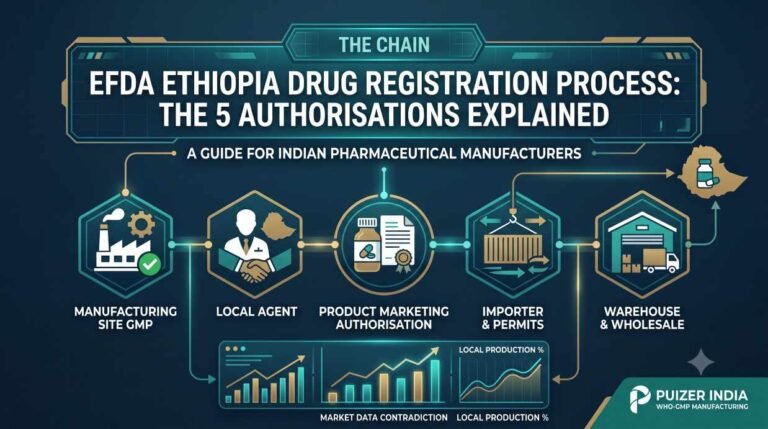
But registering the product is only one of five authorisations. Ethiopia licenses the whole supply chain, not just the molecule: the foreign manufacturing site, the Ethiopian local agent, the product itself, the importer, and the warehouse and wholesale operation each hold a separate EFDA authorisation. A product with a valid marketing authorisation still cannot legally land in Addis Ababa if the consignment has no import permit, or if the receiving warehouse has no competence certificate.
The marketing authorisation runs for five years, and renewal must be filed within 180 days before expiry.[4]
Ethiopia is the second-most populous country in Africa and, since 30 September 2025, one of only nine African states whose medicines regulator has been benchmarked by WHO at Maturity Level 3 — a stable, well-functioning regulatory system.[10] For an Indian manufacturer that already files in Kenya, Tanzania or Rwanda, Ethiopia is the largest East African market still outside the EAC harmonisation bloc — which means the dossier work does not transfer, and the entry has to be planned on its own terms.
This guide covers the five authorisations, the four registration routes and which one your product qualifies for, how i-Register and i-Import actually work, the import permit chain, and what the demand picture honestly looks like — including a contradiction in the published market data that most Ethiopia content ignores.
The five EFDA authorisations Ethiopia requires, not one
Most competitor content on Ethiopia collapses to a single instruction: “get your product registered.” That is the part every consultant sells, and it is roughly a quarter of the actual work. Ethiopia’s framework under Proclamation No. 1112/2019[2] and Council of Ministers Regulation No. 531/2023[15] attaches a separate authorisation to each link in the chain. Miss one and the product is registered but unsellable.
-
1
The manufacturing site
A valid GMP certificate or manufacturing licence from the exporting country’s authority is required at submission. An EFDA GMP inspection, or a formal EFDA GMP waiver letter, must be completed before the marketing authorisation is issued — not before you file.
GMP certificate + CPP -
2
The local agent
Every foreign manufacturer importing into Ethiopia must appoint a local agent physically located in Ethiopia. The appointed technical person must be a pharmacist, and must hold a valid EFDA competence certificate plus a trading licence.
Competence certificate + agency agreement -
3
The product
Marketing authorisation per product, per strength, per pharmaceutical form, filed on i-Register in CTD format. Valid five years, renewable.
Marketing authorisation -
4
The importer
A separate EFDA certificate of competence for pharmaceutical importation, held by the Ethiopian entity — plus a pre-import permit issued by EFDA for each consignment, applied for through i-Import.
Import competence + per-consignment permit -
5
Warehouse and wholesale
Storage and wholesale distribution are separately authorised, against EFDA’s good storage and distribution practice standards: controlled temperature and humidity with logged monitoring, cold chain with backup power where applicable, and a full-time licensed pharmacist as technical manager.
Wholesale / storage competence
The practical consequence is that your Ethiopian partner is not interchangeable. A trading company that can clear a consignment is not automatically permitted to hold your registration, and an agent that holds your registration is not automatically permitted to warehouse the stock. When you evaluate an Ethiopian partner, ask to see each certificate separately, with its expiry date, rather than accepting a single “we are EFDA licensed” claim.
The EFDA local agent requirement for pharmaceutical companies
The registration guideline is explicit: “All foreign medicine manufacturers who import or offer for import into the Ethiopian Market must identify local Agent or Local Representative,” who must be physically located in Ethiopia.[1] Three details in that clause decide how much control you keep over your own registration.
1. The technical person must be a pharmacist
The agent or manufacturer appoints a technical person who is capable of understanding EFDA’s guidelines and corresponding with assessors. That person “should be a pharmacist in the pharmaceutical field,” and cannot be involved in importing the registered product without a valid EFDA competence certificate and a trading licence from the Ethiopian Ministry of Trade or its designated equivalent.[1] The eRIS username and password are issued to that technical person alone — not to the company generally, and not to you.[1]
2. One agent for the registration, multiple distributors only if written in
EFDA permits more than one distributor, but only if the agency agreement says so. The registration application and every subsequent communication about it run through a single agent — the registrant.[1] If you plan to appoint regional distributors later, that has to be drafted into the agreement at the start; retrofitting it means a variation.
3. The agency agreement carries joint liability
The agreement must be signed and stamped by both parties and must state that if fraud or an unexpected, unacceptable adverse event occurs under normal use, all parties named in the agreement — local agent, manufacturer and licence holder — are responsible for recovering the product from the market. Both parties are responsible for pharmacovigilance and post-marketing reporting, and the agreement must set out a post-market risk management plan.[1]
Ethiopian Investment Board Directive No. 1001/2024 opened import trade to foreign investors for everything except fertiliser and petroleum — pharmaceuticals are not on the exclusion list. The conditions are demanding: the foreign investor must be a manufacturer or a manufacturer’s agent, or commit to importing at least USD 10 million of goods annually.[11] For a manufacturer with real Ethiopian volume this opens a route to owning your own import arm rather than renting one. It does not remove the EFDA requirements above: the entity still needs a competence certificate and a licensed Ethiopian pharmacist as technical manager. Confirm the current position with the Ethiopian Investment Commission before committing capital — investment directives in Ethiopia have moved quickly since 2024.
Which EFDA registration route does your product qualify for?
EFDA does not run one queue. Since Directive No. 963/2023 and the 2024 reliance guideline, there are four practical routes plus a non-routine track, and the difference between them is measured in months. Answer the three questions below.
Answer all three questions above
The selector will name the EFDA route your product is eligible for and the control point that governs it.
Governing instrument will appear here
Indicative routing based on published EFDA guidelines. Eligibility is confirmed by EFDA at screening, not by the applicant.
The routes side by side
| Route | Who it is for | What EFDA reviews | Published timeline | Instrument |
|---|---|---|---|---|
| Routine (full) assessment | No qualifying reference approval | Full CTD, Modules 1 to 5, including bioequivalence data for multisource products | Screening within 15 days; assessment period not published as a day count | Proc. 1112/2019 Art. 20(1) |
| Verification review (reliance) | WHO-prequalified products, and products assessed by AMA or IGAD | Administrative process and confirmation of sameness against the reference decision | Not stated in the reliance guideline | Reliance Guideline 2024 |
| Abridged review (reliance) | Products approved by an SRA or listed reference authority without mutual recognition | Only the aspects of the dossier relevant to the Ethiopian context; the rest is relied upon | Not stated in the reliance guideline | Reliance Guideline 2024 |
| WHO Collaborative Registration Procedure | WHO-prequalified products only | Verification against the full WHO PQ assessment and inspection reports, which WHO shares on your written consent | 90 days to marketing authorisation certificate | EFDA CRP Guideline, 6 Sep 2023 |
| Fast-track | HIV/AIDS, malaria, TB, vaccines, maternal and child health, oncology, orphan drugs and locally produced medicines | Same technical review as routine — fast-track exempts the queue, not the requirements | Exempt from first-in-first-out sequencing only | Registration Guideline v005 |
| Non-routine: conditional approval and emergency use | Declared public health emergency, unmet medical need, orphan indications, promising Phase III products with no alternative | Assessment task force within one week of positive screening; emergency steering committee decision within 3 days of the assessment outcome[8] | Conditional approval valid maximum 1 year; extension filed 1 month before expiry[8] | Directive 963/2023 Art. 23 and 24 |
| Renewal of marketing authorisation | Any registered product at the 5-year point | Renewal dossier including periodic safety reports and a summary of post-marketing changes | Approximately 60 working days; not more than 90 working days from submission | Renewal Guideline 2025; Directive 963/2023 Art. 20 |
Scroll sideways to see all five columns
EFDA’s published guidelines give a firm 90-day figure for the WHO CRP route and firm working-day windows for renewal, but they do not publish an end-to-end day count for a routine assessment; the registration guideline defers to Directive No. 963/2023.[1][3] Any article quoting you a confident “EFDA takes X months for a normal generic” is quoting an anecdote, not a published service standard. Plan against the control points you can verify: the 15-day screening notification, the six-month query response window, and the requirement that GMP clearance is completed before the certificate issues.
EFDA i-Register: how a medicine registration is actually filed
EFDA runs three e-services under one system, eRIS (Electronic Regulatory Information System), built with John Snow, Inc.[9] Knowing which one you are in saves a great deal of confusion, because agents use the names interchangeably:
- i-Register — product registration, marketing authorisation, renewals and exception requests.
- i-Import — import permit applications, with real-time status tracking.
- i-License — facility licensing: certificates of competence for importers, exporters, wholesalers and manufacturers.
Submission is web-based and online only.[1] The mechanics that catch first-time filers:
- The account belongs to the technical person. The local agent registers and assigns a focal person; credentials are issued to that individual. If they resign, EFDA must be notified — an unnotified change is how a live application goes silent.[1]
- Editable PDF, not scans. Scanned copies are unacceptable except for certificates. A4, Times New Roman, 12 point.[1]
- English throughout. Documents in English or with English translation. Labels, SmPC and patient leaflets in English and/or Amharic — and for products on the Essential Medicines List or in wide circulation, the leaflet must be in English and Amharic as a minimum.[1]
- eRIS generates the verification number that sets your queue position. Assessment is chronological on a first-in-first-out basis using that number, except for fast-track and non-routine applications.[1] Your payment receipt must quote the application number eRIS issued.
- Online data must match the attachments. The applicant is responsible for consistency between what is typed into the form and what is in the uploaded dossier.[1]
What goes in each CTD module
Module 1 — administrative and product information
The module that fails most often, because none of it is technical and all of it is dated:
- Online application form and dated covering letter
- Agency agreement, signed and stamped by both parties
- Valid GMP certificate or manufacturing licence from the exporting country’s authority
- Certificate of Pharmaceutical Product (CPP) — or, as an alternative, a valid cGMP certificate together with the marketing authorisation certificate from the NRA of the exporting country. WHO prequalification certificates and certificates from WHO-listed authorities are accepted case by case
- Product information: SmPC, labelling, patient information leaflet
- Proof of the application fee, quoting the eRIS application number
Module 2 — dossier overall summary
EFDA works from a Dossier Overall Summary for the product (DOS-PD). For a multisource generic this is the assessor’s map of the whole submission, and a weak summary slows a technically sound dossier down more than most applicants expect.
Keep the summary consistent with Module 3. Where the two disagree, the query comes back against both, and your six-month response clock is already running.
Module 3 — quality
Drug substance and finished product, in full CTD structure. For an Indian exporter the practical pressure points are:
- API supplier documentation must match what is declared — under EFDA’s reliance rules “sameness” explicitly includes the same suppliers of active pharmaceutical ingredients and the same quality of all excipients[5]
- Stability data must support the shelf life claimed on the label under the zone conditions relevant to Ethiopia
- Product samples are required as part of the application[1]
Modules 4 and 5 — nonclinical and clinical
Module 4 (nonclinical study reports) is generally not applicable to multisource products.[1]
Module 5 carries clinical study reports, and for a generic that means the bioequivalence study. This is where an Indian generic dossier either travels well or does not: a BE study run against a comparator EFDA will accept, in a facility whose data EFDA will accept, is the single most transferable asset across every African filing you make — including Uganda and Nigeria.
Labelling and artwork — Ethiopia-specific rules
Artwork is a recurring reason for avoidable rework. EFDA requires:[1]
- Brand name must not be identical or misleadingly similar to a registered product — as a general rule, the first three and last three letters must differ from existing Ethiopian registrations
- Batch number, manufacturing date and expiry date titles must be part of the printing; typewritten stickers are not accepted
- A unique barcode on all pharmaceutical trade items, per EFDA’s traceability directive
- Original or computer-ready colour-printed labels only; silk-screened labels on plastic bottles are accepted as coloured copies
- The manufacturer or licence holder logo, and the manufacturer licence number, on the immediate container where space permits
How to import medicine into Ethiopia: the permit chain
Registration gives you the right to place a product on the Ethiopian market. It does not move a single carton. Import runs on its own set of approvals, and this is the part of the chain that most often stalls a first shipment.
1. The importer must hold a certificate of competence
The Ethiopian entity receiving the goods needs an EFDA certificate of competence for pharmaceutical importation, applied for through i-License,[9] alongside a trading licence. A foreign national cannot import medicines directly into Ethiopia in their own name; the transaction runs through a licensed Ethiopian pharmaceutical importer under a written agency agreement.
2. Each consignment needs a pre-import permit
EFDA issues a pre-import permit in advance of each shipment, applied for on i-Import. This is a per-consignment control, not a one-off licence — which means your Ethiopian partner’s administrative capacity becomes a supply-chain variable, not a back-office detail. Build permit lead time into your order cycle rather than your dispatch schedule.
3. Storage and distribution are inspected against GSDP
Warehousing is assessed against EFDA’s good storage and distribution practice standards: dedicated compliant storage with controlled temperature and humidity and logged monitoring, cold-chain rooms with continuous monitoring and backup power for temperature-sensitive products, and a full-time licensed pharmacist as technical manager.
The exception: the special import permit for unregistered products
Ethiopia has a formal route for moving product that is not registered — and it is more usable than the equivalent in many neighbouring markets. Under EFDA’s special import permit guideline,[7] medical products may be imported “under special circumstance such as during emergency, unmet medical need, shortage of medical products in the local market, donation, for personal use, for health promotion and for clinical investigation or researches.”
- Who can apply: government and private health institutions, NGOs and UN agencies, government procurement agencies, research institutions, charity and religious organisations, manufacturers importing raw materials, and individuals with a prescription for personal use.[7]
- Decision timeline: reviewed within three working days.[7]
- Validity: one year, extendable by EFDA in certain circumstances.[7]
- Filed on eRIS, with proforma invoice, manufacturing or marketing authorisation certificate, GMP or QMS certificate, instructions for use, the institution’s licence, and a supporting letter from the Ministry of Health or a Regional Health Bureau.[7]
A three-working-day permit with one-year validity is a genuine bridge. It lets a manufacturer supply against a documented institutional shortage or a tender award while the full i-Register dossier is under assessment, instead of waiting for the certificate before earning anything. It is an exception route granted case by case on documented justification, not a substitute for registration — but treating it as a parallel workstream rather than a fallback is what separates an Ethiopian entry that generates revenue in year one from one that does not.
Pharmaceutical market in Ethiopia: what the demand data actually says
This is the section where most Ethiopia content quietly stops being useful, because the published figures disagree with each other and the disagreement is rarely acknowledged. Here is the honest position.
- USD 1.3-1.7bnEthiopia pharmaceutical market, 2022 estimate[12]
- ~USD 1.5bnEPSS public procurement value, 2022 — roughly 60% of total pharma procurement[12]
- 12Local pharmaceutical manufacturers, 5 with EFDA GMP approval at the time of the study[12]
- ML3WHO regulatory maturity level attained 30 Sept 2025 — 9th in Africa[10]
The contradiction, stated plainly
A 2025 sector study of Ethiopian pharmaceutical manufacturing put local production at just 3 to 5 percent of the market by value in 2022, implying import reliance of 95 to 97 percent, and noted that the local share had actually fallen from the 15 to 25 percent range recorded between 2015 and 2019.[12] A World Bank feature published in May 2026 states that local production now exceeds 40 percent of medicine supply, against a national target of meeting half of essential medicine demand locally.[13]
Those two figures cannot both describe the same quantity. The most likely reconciliation is that they measure different things — share of value in a market where high-cost imported products dominate spend, versus share of volume or supply where locally made basic orals dominate units — and that they are four years apart. We have not found a published reconciliation, so we are not going to pretend to one.
What follows for an exporter either way: local manufacturing is a stated national priority backed by real infrastructure — the Kilinto pharmaceutical industrial park covers roughly 270 to 279 hectares with close to 30 investors at various stages.[12][13] Ethiopia applies preference to locally produced medicines, and fast-track eligibility explicitly includes locally produced medicines alongside HIV, TB and malaria products.[1] The import window for commodity orals will narrow over a ten-year horizon. The durable positions are the products local capacity does not yet cover, and structures that put you inside the local supply chain rather than outside it — which is exactly the argument for looking at third-party and contract manufacturing models in parallel with a straight export play.
Where the demand actually sits
- Public procurement dominates. The Ethiopian Pharmaceutical Supply Service (EPSS) accounted for around 60 percent of pharmaceutical procurement, with donor funding at roughly 45 percent of the market.[12] If you are not tender-capable, you are competing for a minority of the value.
- The private market is volume-heavy. The private sector was around 45 percent of value but roughly 65 percent of volumes[12] — the profile of a market buying large quantities of low-priced essentials.
- The Essential Medicines List is the demand map. Ethiopia launched the 7th edition of its Essential Medicines List on 18 March 2025, based on the October 2024 revision.[14] Read it before you choose a portfolio: it guides selection and procurement nationally, and it also determines which of your products need a bilingual English and Amharic leaflet.[1]
- Currency risk is real. Ethiopia moved to a market-based exchange rate in 2024 and foreign exchange access has been a binding constraint on importers. Price your contracts accordingly and confirm the payment mechanism before you ship.
EFDA’s registration and renewal guidelines both direct applicants to the current Rate of Service Fees Regulation for fee amounts rather than stating them.[1][4] We were not able to verify current fee amounts from a primary source at the time of writing, so this guide quotes none. Ask your prospective local agent to show you the current fee schedule from EFDA directly — an agent who cannot produce it is not the agent you want.
Where EFDA filings lose time
- Choosing the agent last. The eRIS account, the competence certificate and the agency agreement all sit upstream of your first upload. Agent selection is the critical path, not an administrative step at the end.
- GMP clearance treated as a formality. Inspection or a formal EFDA waiver must be complete before the certificate issues.[1] A dossier that clears assessment and then waits on site clearance has wasted the queue position it earned.
- Burning the six-month query window. You get six months to answer EFDA’s queries, then a 15-day urgency notice, then rejection.[1] Six months feels generous until an API supplier change or a stability re-run lands inside it.
- Filing routine when reliance was available. If the product is WHO-prequalified, the CRP route carries a published 90-day commitment.[6] Filing that product into the routine queue is a self-inflicted delay.
- Sameness drift. Under reliance, the Ethiopian product must be the same as the reference-approved product down to API supplier and excipient quality.[5] A cost-driven excipient change between your EU filing and your Ethiopian one can push you out of the reliance route entirely.
- Missing the 180-day renewal window. Late renewal gets a 180-day grace period at new-application fee rates; miss that, and the authorisation is treated as revoked and you file a complete new dossier.[4] Five years passes faster than a regulatory calendar suggests.
- Artwork rework. Brand-name similarity, printed batch details and barcodes are checked. Resolve artwork before dossier compilation, not after a deficiency letter.
Frequently asked questions
An EFDA marketing authorisation is valid for five years. The renewal application must be submitted within 180 days before the due date. If that window is missed, a further 180-day grace period is available but the fee charged is equivalent to a new application. Applications not submitted within the due date are considered revoked, and the applicant must submit a complete new dossier. EFDA processes renewals in approximately 60 working days, and not more than 90 working days from submission.
Yes. All foreign medicine manufacturers importing or offering for import into the Ethiopian market must identify a local agent or local representative physically located in Ethiopia. The appointed technical person should be a pharmacist in the pharmaceutical field and must hold a valid EFDA competence certificate and a trading licence from the Ethiopian Ministry of Trade or an equivalent designated institution. Registration correspondence runs through a single appointed agent, although additional distributors are permitted if the agency agreement provides for them.
eRIS is EFDA’s Electronic Regulatory Information System, the umbrella platform for regulatory submissions. i-Register is the module within eRIS that handles pharmaceutical product registration, marketing authorisation, renewals and exception requests. Two sibling modules sit alongside it: i-Import for import permit applications with real-time tracking, and i-License for facility competence certificates covering importers, exporters, wholesalers and manufacturers. All medicine registration submissions to EFDA are web-based and online only through this system.
Yes, through a special import permit, but only under defined circumstances: emergency, unmet medical need, a documented shortage of the product in the local market, donation, personal use on prescription, health promotion, or clinical investigation and research. Applications are filed on eRIS with a proforma invoice, manufacturing or marketing authorisation certificate, GMP or QMS certificate, instructions for use, institutional licence and a supporting letter from the Ministry of Health or a Regional Health Bureau. EFDA reviews within three working days and the permit is valid for one year, extendable in certain circumstances.
Yes. EFDA’s 2024 reliance guideline recognises WHO prequalification, the EMA, the US FDA, TGA Australia, Health Canada, Swissmedic, the UK MHRA and a list of European national authorities, along with the African Medicines Agency, IGAD and regional harmonisation bodies. Two pathways exist: verification review, which focuses on administrative process and confirming sameness, and abridged review, which assesses only the aspects of the dossier relevant to the Ethiopian context. Separately, WHO-prequalified products can use the Collaborative Registration Procedure, under which EFDA commits to completing verification and granting the marketing authorisation certificate within 90 days once WHO shares its assessment and inspection reports with the applicant’s consent.
On 30 September 2025 Ethiopia became the ninth African country benchmarked by WHO at Maturity Level 3 for medicines regulation, joining Egypt, Ghana, Nigeria, South Africa, Tanzania, Zimbabwe, Senegal and Rwanda. WHO assessed the system against more than 250 indicators covering product authorisation, market surveillance and adverse event detection. In practice ML3 signals a stable, well-functioning regulator whose decisions other authorities can rely upon, and it opens a path towards WHO-listed Authority status after further performance evaluation. For an exporter it means EFDA scrutiny is real and its decisions carry weight regionally — a dossier built to pass EFDA travels well.
EFDA does not publish fee amounts inside its registration and renewal guidelines. Both documents direct applicants to the current Rate of Service Fees Regulation available on the Authority’s website, and the fee is paid per application with the receipt quoting the application number generated by eRIS. Because that schedule is amended from time to time, we do not quote a figure here. Request the current schedule from EFDA or from your appointed local agent, and treat regulatory fees as a small line item next to the cost of bioequivalence data, GMP clearance and artwork rework.
Ethiopian Investment Board Directive No. 1001/2024 opened import trade to foreign investors for all goods except fertiliser and petroleum, so pharmaceuticals are not excluded. The conditions are substantial: the foreign investor must be a manufacturer or a manufacturer’s agent, or commit to importing at least ten million US dollars of goods annually, and the Ethiopian Investment Commission inspects compliance and issues the permit. This is an investment permission, not a regulatory one. The entity would still need an EFDA certificate of competence for pharmaceutical importation and a full-time licensed Ethiopian pharmacist as technical manager. Confirm the current position with the Ethiopian Investment Commission before committing capital.
Filing in Ethiopia from an Indian manufacturing site
Puizer India manufactures tablets, capsules, syrups, dry syrups and nutraceuticals to WHO-GMP standard in India, with export documentation prepared for African regulatory entry from the outset. If you are assessing an Ethiopian entry, the useful first conversation is about which of your products can reach EFDA through a reliance route and which will need a full dossier — because that decision sets your timeline, not the paperwork.
References
- Ethiopian Food and Drug Authority. Guideline for Registration of Medicine. Version 005, 30 October 2023. Addis Ababa: EFDA. Available from: efda.gov.et. Accessed August 2026.
- Federal Democratic Republic of Ethiopia. Food and Medicine Administration Proclamation No. 1112/2019. Federal Negarit Gazeta. Article 20(1).
- Ethiopian Food and Drug Authority. Medicine Marketing Authorization Directive No. 963/2023. Available from: efda.gov.et. Accessed August 2026.
- Ethiopian Food and Drug Authority. Guideline for Renewal of Marketing Authorization. 2025. Available from: efda.gov.et. Accessed August 2026.
- Ethiopian Food and Drug Authority. Guidelines on Reliance for Medicine Marketing Authorization. 2024. Available from: efda.gov.et. Accessed August 2026.
- Ethiopian Food and Drug Authority. Guideline for WHO Pre-qualified Medicines through Collaborative Registration Procedure. 6 September 2023. Available from: eris.efda.gov.et. Accessed August 2026.
- Ethiopian Food and Drug Authority. Guideline on Medical Products Special Import Permit. 21 December 2023. Available from: eris.efda.gov.et. Accessed August 2026.
- Ethiopian Food and Drug Authority. Guideline for Non-Routine Registration. 2024. Available from: efda.gov.et. Accessed August 2026.
- Ethiopian Food and Drug Authority. e-Service: i-Register, i-Import and i-License. Available from: efda.gov.et. Accessed August 2026.
- World Health Organization. Ethiopia achieves major milestone in medicines regulation reaching WHO Maturity Level 3. 30 September 2025. Available from: who.int. Accessed August 2026.
- Ethiopian Investment Board. Directive to Regulate Foreign Investors Participation in Restricted Export, Import, Wholesale and Retail Trade Investments No. 1001/2024. March 2024. Available from: investethiopia.gov.et. Accessed August 2026.
- Manufacturing Africa. Potential in local pharmaceutical manufacturing in Ethiopia. October 2025. Available from: manufacturingafrica.org. Accessed August 2026.
- World Bank. Building Ethiopia’s Pharmaceutical Future: From Strong Regulation to Local Production. 26 May 2026. Available from: worldbank.org. Accessed August 2026.
- Ethiopian Food and Drug Authority. Ethiopian Essential Medicines List, Seventh Edition. October 2024, launched 18 March 2025. Available from: efda.gov.et. Accessed August 2026.
- Federal Democratic Republic of Ethiopia. Council of Ministers Regulation No. 531/2023 (Food and Medicine Administration).
Disclaimer. This article is technical and educational content for pharmaceutical professionals. It is not medical, legal or investment advice. Ethiopian regulatory instruments, EFDA guidelines, service fees and investment directives change frequently, and guideline versions are revised without notice. Verify every requirement against the current EFDA publication and your appointed local agent before acting. Where a figure could not be confirmed from a primary source, this article says so rather than estimating.
