
Prospectus · Fee and timeline comparator · Africa
Ghana FDA Registration Fees in 2026, and How 8 African Regulators Compare
Ghana FDA registration fees for imported medicines, taken from the official schedule and set side by side with NAFDAC, PPB Kenya, NDA Uganda, TMDA, Rwanda FDA, EFDA and ZAMRA: the published fee, the official timeline, the timeline actually measured, the source, and the date we last checked it.
Short answer
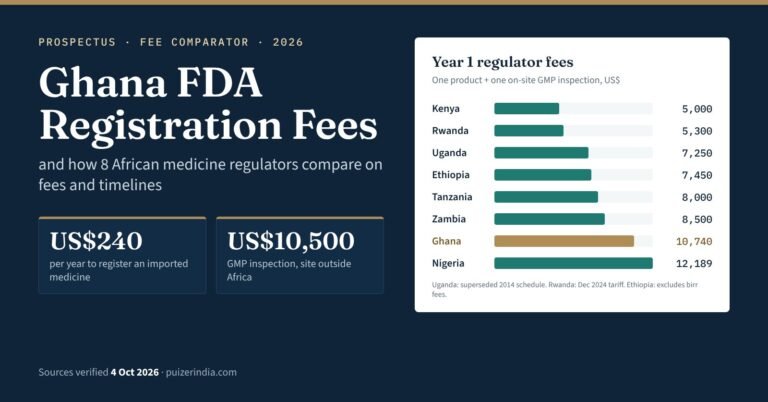
FDA Ghana charges the cedi equivalent of US$240 per annum to register an imported allopathic medicine, or US$360 for a new chemical product, under the Fees and Charges (Miscellaneous Provisions) Regulations, 2023 (L.I. 2481).[1] The fee that decides the budget is the GMP inspection: US$10,500 for a manufacturing site outside Africa, such as a plant in India. One product from a site FDA Ghana has not inspected therefore costs about US$10,740 in FDA fees in year one.
The routine review target is 120 working days.[2] Across the eight regulators compared below, registration fees set in US dollars run from US$240 to US$2,000 per product, and foreign inspection fees from about US$3,300 to US$11,000 per site.
01 · Ghana
Ghana FDA registration fees for imported medicines
FDA Ghana publishes its fees as a schedule under L.I. 2481. For imported products every amount is stated in US dollars and paid in the cedi equivalent, so the cedi cost moves with the exchange rate on the day you pay.[1] These are the lines an Indian exporter of finished medicines will actually meet:
| Fee item (imported products) | Basis | Amount |
|---|---|---|
| Registration or re-registration: allopathic medicinal product | Per annum | US$240 |
| Registration or re-registration: allopathic new chemical product | Per annum | US$360 |
| Registration or re-registration: biological product | As listed | US$360 |
| Registration or re-registration: herbal product | Per annum | US$240 |
| Registration or re-registration: orphan drug | As listed | US$60 |
| Foreign GMP or bioequivalence inspection: West Africa | Per inspection | US$6,000 |
| Foreign GMP or bioequivalence inspection: rest of Africa | Per inspection | US$8,000 |
| Foreign GMP or bioequivalence inspection: outside Africa (India) | Per inspection | US$10,500 |
| Variation, imported allopathic or biological: major | Per activity | US$500 |
| Variation, imported allopathic or biological: minor | Per activity | US$300 |
| Lot release, vaccines and plasma-derived products | Per lot | US$500 |
Scroll the table sideways to see every column.
What Ghana FDA registration fees mean for a launch budget
The inspection is charged per inspection; registration is charged per product. That makes Ghana FDA registration fees a basket calculation. On the published schedule, and assuming the registration fee applies to each product, one product from an Indian site FDA Ghana has not inspected costs about US$10,740 in year one. Five products from the same site cost about US$11,700, or US$2,340 each. Ten cost about US$12,900, or US$1,290 each.
Two points the schedule leaves open, which you should settle in writing through your local representative before you budget: whether the “per annum” registration fee is billed each year or for the whole registration period up front, and whether inspectors’ travel is billed on top of the US$10,500. The legal process, dossier and inspection route behind these fees is covered step by step in our FDA Ghana product registration guide.
FDA Ghana timelines: official and measured
- Routine review: 120 working days for medicines under FDA Ghana’s reliance guideline; reliance verification: 60 working days, excluding clock stops.[2]
- Fast-track: 90 calendar days for qualifying products under the fast-track guideline, including WHO-prequalified products and programme medicines.[3]
- Measured: for 704 generics approved in 2019 to 2021, the median time from submission to approval was 156 calendar days, counting both FDA Ghana and applicant time, according to a peer-reviewed study co-authored by FDA Ghana staff.[4] For 2023, FDA Ghana reported a mean of 56 calendar days for generics on the full-review pathway.[5]
02 · Comparator
Drug registration fees in Africa: 8 regulators side by side
Each row shows the fee for one imported generic medicine, the regulator’s fee for inspecting a manufacturing site in Asia, the official timeline and the latest measured timeline. “Year 1” adds one registration to one on-site inspection, which is the usual position of an Indian site the regulator has not inspected before. Sort the table to see who is cheapest and who is fastest.
| Country and regulator | Registration fee, imported generic | GMP inspection, site in Asia | Year 1: 1 product + inspection | Recurring fees | Official timeline | Measured timeline (latest published) | Fee source | Last verified |
|---|---|---|---|---|---|---|---|---|
| GhanaFDA Ghana | US$240per annum; US$360 new chemical product | US$10,500site outside Africa | US$10,740 | Registration fee listed per annum; variation US$500 major, US$300 minor | 120 working days routine; 60 wd reliance; 90 days fast-track[2][3] | Median 156 calendar days, generics 2019 to 2021[4] | L.I. 2481 fee schedule[1] | 4 Oct 2026 |
| NigeriaNAFDAC | US$1,200prescription medicine with no Nigerian manufacturing facility (POM 2); US$1,280 if made locally (POM 1) | US$10,989.01per foreign site; desk review of an already inspected site US$5,000 | US$12,189 | Renewal every 5 years at 80% of the new-registration cost | 120 working days[7] | Mean 247 calendar days, generics, 2023[5] | NAFDAC tariff, effective January 2020[6] | 4 Oct 2026 |
| KenyaPharmacy and Poisons Board | US$1,000fast-track evaluation US$2,000 | US$4,000GMP audit, foreign site | US$5,000 | Renewal US$1,000 every 5 years | No timeline in the 2022 Rules; PPB reported a 730-calendar-day overall target[10] | Mean 739 calendar days, generics, 2021[10] | L.N. 100/2022; L.N. 191/2010[8][9] | 4 Oct 2026 |
| UgandaNational Drug Authority | US$1,2502014 schedule, superseded 1 Oct 2025 | US$6,000outside Africa, 2014 schedule | US$7,250on the superseded schedule | 2014 schedule: retention US$500 a year | NDA reported a 547-calendar-day overall target[10] | Mean 284 calendar days, generics, 2023[10] | S.I. 31 of 2014, replaced by the Fees Regulations, 2025[11][12] | Current amounts not public |
| TanzaniaTMDA | US$2,000non-biological; US$3,000 biological | US$6,000per block, Asia | US$8,000 | Annual retention US$300; renewal at the new-application fee every 5 years | 180 days for imported products; 90 days priority[14] | Mean 85 calendar days, generics, 2023[10] | Fees and Charges Regulations, 2021[13] | 4 Oct 2026 |
| RwandaRwanda FDA | US$2,000“other sources” tier; US$750 SRA or WLA tier; US$300 EAC tier | US$3,300up to 5 lines; US$400 per extra line | US$5,300 | Renewal at 100% of the initial fee at 5 years; annual retention waived | Rwanda FDA reported a 365-calendar-day overall target[10] | Mean 735 calendar days, generics, 2023[10] | Tariff regulations, Rev_4, in force 31 Dec 2024[15] | Re-check pending |
| EthiopiaEFDA | ETB 2,100 + ETB 400dossier evaluation (generic with BE) plus pre-screening; agent registration US$50 | US$7,400“Far East” band; Middle East US$7,750; desk audit for SRA-certified sites US$3,500 | US$7,450 + ETB 2,500 | Re-registration ETB 1,000; schedule states every four years | Assessment period not published | No published measured data found | Council of Ministers Reg. No. 370/2015[16] | 4 Oct 2026 |
| ZambiaZAMRA | US$2,000generic; US$2,800 new chemical entity; US$1,700 abridged | US$6,500Far East or Asia | US$8,500 | Annual retention US$800; renewal US$1,200 | 351 calendar days full review, including applicant time; 90 days verification[18] | Median 1,055 calendar days, generics, 2020 to 2023[19] | ZAMRA fees for marketing authorisation[17] | 4 Oct 2026 |
Scroll sideways; the country column stays pinned.
Year-1 figures add one registration fee to one on-site inspection and exclude everything else. Ethiopia’s birr fees are left in birr; the Ethiopia Year-1 figure covers its US-dollar items only. “Measured time” sorts Ethiopia last because no figure is published.
Two rows need care. Uganda’s fees changed on 1 October 2025, when new NDA Fees Regulations took effect;[12] the new amounts were not publicly retrievable on 4 October 2026, so the row shows the last published (2014) schedule for orientation only.[11]
Rwanda’s figures come from the December 2024 tariff (Rev_4).[15] After Rwanda FDA moved its website, that file no longer opens, and the tariff currently offered on the new e-library is the older Rev 3 of April 2023, which lists US$750 for a foreign human medicine and US$3,000 for an Asian site.[20] Ask Rwanda FDA which revision your invoice will follow.
03 · Reading the table
Why the headline registration fee misleads
Of the regulators that set their registration fee in US dollars, Ghana charges the least per product; Ethiopia’s birr fees, fixed in 2016, are lower still at current exchange rates. Ghana also has one of the two highest inspection fees. Nigeria is the other: NAFDAC charges US$10,989.01 to inspect a foreign pharmaceutical site.[6] In both West African markets the inspection is roughly ten times the registration fee, so the cost of entry depends far more on whether your site needs inspecting than on how many products you file.
The East and Southern African regulators sit in a lower inspection band, from about US$3,300 (Rwanda, Rev_4) to US$6,500 (Zambia), but charge more per product and, in Tanzania and Zambia, an annual retention fee for every registered product. Over a five-year life, a large basket in Zambia (US$800 a year per product) or Tanzania (US$300) can cost more in retention than in first registration.
How to cut the inspection line
- Reliance on an earlier inspection. NAFDAC lists a US$5,000 risk-based desk review for manufacturers using a foreign site it has already inspected,[6] and EFDA a US$3,500 desk audit for sites holding GMP certificates from stringent authorities.[16]
- Verification and fast-track routes for WHO-prequalified or reference-authority-approved products shorten the review: 60 working days for reliance in Ghana,[2] 90 days for priority products in Tanzania[14] and 90 days for verification in Zambia.[18]
- One site, many products. Every inspection fee in this table is charged per site or per inspection, not per product. Filing a basket from one inspected site spreads that cost.
Per-shipment charges the registration fee does not cover
Several regulators also charge on every consignment, as a share of its free-on-board (FOB) value. These matter for landed cost more than for the registration budget.
| Regulator | Charge per consignment | Source |
|---|---|---|
| PPB Kenya | Import permit: 2% of FOB value | L.N. 191/2010, in PPB’s current fee schedule[9] |
| TMDA Tanzania | Import permit, medicinal products: 2% of FOB | Fees and Charges Regulations, 2021[13] |
| Rwanda FDA | Import licence: 0.2% of FOB (Rev_4); Rev 3 listed 2% | Tariff Rev_4 and Rev 3[15][20] |
| NAFDAC Nigeria | Import permit built into the registration fee (10% of it) | NAFDAC tariff[6] |
| NDA Uganda | Verification: 2% of FOB under the 2014 schedule; current rate not public | S.I. 31 of 2014[11] |
Scroll the table sideways to see every column.
FDA Ghana, ZAMRA and EFDA do not list a per-consignment percentage in the fee documents cited here; ask your importer what it pays at clearance. The documents each consignment needs are listed in our pharmaceutical export documentation checklist.
04 · Budget estimator
Estimate year-1 regulator fees for your product basket
Choose how many products you will file from one manufacturing site, whether the regulator will inspect it, and which markets to include. The estimator uses only the published fees in the comparator above.
Turn on JavaScript to use the estimator. One product plus one on-site inspection costs, in year one: Ghana US$10,740; Nigeria US$12,189; Kenya US$5,000; Uganda US$7,250 (superseded schedule); Tanzania US$8,000; Rwanda US$5,300; Ethiopia US$7,450 plus ETB 2,500; Zambia US$8,500.
Indicative regulator fees only, in US dollars. Excludes annual retention after year one, inspectors’ travel where billed, bioequivalence studies, samples, local representative charges, legalisation and per-shipment charges. Uganda uses the superseded 2014 schedule; Rwanda assumes the “other sources” tier for a product approved only in India. Not a quotation and not financial advice.
05 · Method
How these figures were collected, and their limits
- Fees come from each regulator’s own fee regulation or fee schedule, opened on the date shown. Where a regulator has replaced a schedule but not published the new amounts, the row says so instead of guessing.
- Official timelines are the regulator’s published targets. For Kenya, Uganda and Rwanda, where we found no target in the current rules or guidelines we could open, the figure is the overall target each authority reported to a peer-reviewed study.[10]
- Measured timelines are means or medians reported by the authorities to peer-reviewed studies using the OpERA method.[4][5][10][19] They cover different years, some include the applicant’s response time and some do not, so treat them as an indication of each queue, not a forecast for your dossier.
- Re-checks: fees and timelines change without notice. Each row carries its own check date; we update rows as regulators publish changes.
06 · FAQ
Frequently asked questions
The cedi equivalent of US$240 per annum for an imported allopathic medicinal product and US$360 for a new chemical product, under L.I. 2481. If FDA Ghana must inspect a manufacturing site outside Africa, the inspection adds US$10,500, so one product from an uninspected Indian site costs about US$10,740 in FDA fees in year one.
For imported products, FDA Ghana states each fee in US dollars and collects the cedi equivalent. The cedi amount therefore changes with the exchange rate on the day of payment. Fees for locally manufactured products are set directly in cedis.
FDA Ghana’s routine target is 120 working days, its reliance verification target 60 working days and its fast-track target 90 calendar days. For generics approved in 2019 to 2021, the measured median was 156 calendar days including the applicant’s response time.
Per product, FDA Ghana’s US$240 is the lowest US-dollar registration fee of the eight regulators compared here; EFDA’s birr-denominated fees, set in 2016, are lower at current exchange rates. Including one on-site inspection of an Asian site, PPB Kenya (about US$5,000) and Rwanda FDA (about US$5,300 on its December 2024 tariff) are the lowest in year one, while NAFDAC (about US$12,189) and FDA Ghana (about US$10,740) are the highest.
Sometimes. NAFDAC lists a US$5,000 desk review for foreign sites it has already inspected, and EFDA a US$3,500 desk audit for sites certified by stringent authorities. Reliance and verification routes for WHO-prequalified products can also replace an inspection. Confirm the GMP route in writing with each regulator before you budget.
No. Budget separately for bioequivalence and stability work, samples, legalised certificates such as the CoPP, the local representative’s charges, inspectors’ travel where billed, annual retention fees and per-consignment import charges of up to 2% of FOB value in some markets.
07 · Country guides
The process behind each fee
Planning a multi-country registration basket?
Puizer Cure (OPC) Pvt. Ltd. manufactures in Sonipat, Haryana, and shares the dossier and GMP documentation African importers need to decide which products to register first, and where.
Discuss your product basketReferences
Sources
- Food and Drugs Authority, Ghana. Fees and charges: Fees and Charges (Miscellaneous Provisions) Regulations, 2023 (L.I. 2481). Accra: FDA. Available from: https://fdaghana.gov.gh/fee-schedule/. Accessed 4 October 2026.
- Food and Drugs Authority, Ghana. Reliance guideline on regulatory decision-making. FDA/GEN/GDL-04/02, section 5.1. Accra: FDA; effective 1 March 2023. Available from: https://fdaghana.gov.gh/wp-content/uploads/2024/09/FDA-RELIANCE-GUIDELINE-ON-REGULATORY-DECISION-MAKING.pdf. Accessed 4 October 2026.
- Food and Drugs Authority, Ghana. Guidelines on the registration of medicinal products classified for fast-track processing. FDA/DNC/GDL-06/02. Accra: FDA; effective 8 January 2024. Available from: https://fdaghana.gov.gh/guidelines-on-the-registration-of-medicinal-products-classified-for-fast-track-processing/. Accessed October 2026.
- Owusu-Asante M, Darko DM, Asamoah-Okyere KD, Asante-Boateng S, Kermad A, Walker S, et al. Evaluation of the Food and Drugs Authority, Ghana regulatory review process: challenges and opportunities. Ther Innov Regul Sci. 2023;57(2):372-85. doi:10.1007/s43441-022-00478-x. Available from: https://pmc.ncbi.nlm.nih.gov/articles/PMC9646276/. Accessed 4 October 2026.
- Owusu-Asante M, Darko DM, Seaneke S, Nacoulma A, Traore OIO, Adeyeye MC, et al. Comparison of the review models and regulatory timelines of seven countries participating in the ECOWAS-MRH initiative: identifying opportunities for improvement. Front Med (Lausanne). 2025;12:1587761. doi:10.3389/fmed.2025.1587761. Available from: https://pmc.ncbi.nlm.nih.gov/articles/PMC12301391/. Accessed 4 October 2026.
- National Agency for Food and Drug Administration and Control (NAFDAC). NAFDAC tariff, effective January 2020. Abuja: NAFDAC. Available from: https://www.nafdac.gov.ng/wp-content/uploads/Publications/NAFDAC-2019-Tariff_Final_Combined.pdf. Accessed 4 October 2026.
- NAFDAC. Guidelines for the registration of imported drug products. Doc. Ref. R-and-R-GDL-005-00. Abuja: NAFDAC; effective 1 June 2018, reviewed 31 May 2023. Available from: https://www.nafdac.gov.ng/wp-content/uploads/Files/Resources/Guidelines/R_and_R_Guidelines/IIMPORTS/Guidelines-for-the-Registration-of-Imported-Drug-Products.pdf. Accessed 4 October 2026.
- Republic of Kenya. The Pharmacy and Poisons (Registration of Health Products and Technologies) Rules, 2022. Legal Notice No. 100 of 2022, Second Schedule and rule 10. Nairobi: Government Printer; 2022. Available from: https://new.kenyalaw.org/akn/ke/act/ln/2022/100/eng@2022-12-31. Accessed 4 October 2026.
- Pharmacy and Poisons Board, Kenya. Schedule of fees for regulatory activities (incorporating L.N. 100/2022 and the Pharmacy and Poisons (Amendments) Rules, 2010, L.N. 191). Nairobi: PPB; updated 24 March 2026. Available from: https://web.pharmacyboardkenya.org/download/schedule-of-fees-for-regulatory-activities-2/. Accessed 4 October 2026.
- Ngum N, Ndomondo-Sigonda M, Habonimana R, Siyoi F, Irasabwa C, Ojukwu J, et al. Evaluation of the review models and approval timelines of authorities participating in the East African Medicine Regulatory Harmonisation initiative: alignment and strategies for moving forward. Front Med (Lausanne). 2024;11:1438041. doi:10.3389/fmed.2024.1438041. Available from: https://pmc.ncbi.nlm.nih.gov/articles/PMC11442268/. Accessed 4 October 2026.
- Republic of Uganda. The National Drug Policy and Authority (Fees) Regulations, 2014. Statutory Instrument No. 31 of 2014. Kampala; 2014. Available from: https://ugandatrades.go.ug/media/Drug%20Fees%20Regulation_1.pdf. Accessed 4 October 2026.
- US National Institute of Allergy and Infectious Diseases, ClinRegs. Uganda profile updated with the latest regulatory fees (citing the National Drug Policy and Authority (Fees) Regulations, 2025, effective 1 October 2025). 25 November 2025. Available from: https://clinregs.niaid.nih.gov/updates/full/233-uganda-profile-updated-with-the-latest-regulatory-fees. Accessed 4 October 2026.
- United Republic of Tanzania. The Tanzania Medicines and Medical Devices (Fees and Charges) Regulations, 2021. Dodoma: TMDA. Available from: https://www.tmda.go.tz/uploads/publications/en1621327639-FEES%20AND%20CHARGES%20REGULATIONS%202021%20-%20ENGLIS%20VERSION%2025%20APRIL.pdf. Accessed 4 October 2026.
- Tanzania Medicines and Medical Devices Authority. Procedures for market authorization. Dodoma: TMDA. Available from: https://www.tmda.go.tz/pages/procedures-for-market-authorization. Accessed 4 October 2026.
- Rwanda Food and Drugs Authority. Regulations governing tariff/fees for services rendered by Rwanda Food and Drugs Authority. No. ODDG/RES/TRG/001, Rev_4. Kigali: Rwanda FDA; in force 31 December 2024. Previously available from: https://rwandafda.gov.rw/wp-content/uploads/2025/01/eRegulations-Governing-Fees_RFDA_31DECEMBER2024.pdf. Accessed August 2026; not retrievable on 4 October 2026.
- Federal Democratic Republic of Ethiopia. Rate of Service Fees for Food, Medicine, Health Professional and Health Institutions Registration and Licensing Council of Ministers Regulation No. 370/2015, Schedules 11, 12, 13 and 18. Federal Negarit Gazette No. 22, 11 January 2016. Available from: https://www.efda.gov.et/publication/rate-of-service-fees-regulation-no-370-2015/. Accessed 4 October 2026.
- Zambia Medicines Regulatory Authority. Fees for marketing authorisation. Lusaka: ZAMRA; uploaded July 2026. Available from: https://www.zamra.co.zm/wp-content/uploads/2026/07/FEES-FOR-MARKETING-AUTHORISATION-2.pdf. Accessed 4 October 2026.
- Sithole T, Mahlangu G, Capote V, Sitoie T, Shifotoka S, Gaeseb J, et al. Evaluation of the review models and approval timelines of countries participating in the Southern African Development Community: alignment and strategies for moving forward. Front Med (Lausanne). 2021;8:742200. doi:10.3389/fmed.2021.742200. Available from: https://pmc.ncbi.nlm.nih.gov/articles/PMC8429484/. Accessed 4 October 2026.
- Chisha CS, Siyanga M, Leigh S, Kermad A, Walker S. Evaluation of the regulatory review process of the Zambia Medicines Regulatory Authority: challenges and opportunities. Ther Innov Regul Sci. 2025;59(2):304-18. doi:10.1007/s43441-024-00730-6. Available from: https://pmc.ncbi.nlm.nih.gov/articles/PMC11880130/. Accessed 4 October 2026.
- Rwanda Food and Drugs Authority. Regulations governing tariff/fees and charges on services rendered by Rwanda Food and Drugs Authority. No. ODG/IMPO/TRG/001, Rev_3, adopted 14 April 2023. Kigali: Rwanda FDA. Available from: https://www.rwandafda.gov.rw/e-library/regulations. Accessed 4 October 2026.
This comparator is technical and educational information for pharmaceutical exporters, not legal, regulatory, financial or investment advice. Regulators revise fee schedules and timelines without notice; confirm every amount with the regulator and your local representative before you commit budget. All sources accessed on the dates shown.