
Export capability · India to East Africa
The short answer
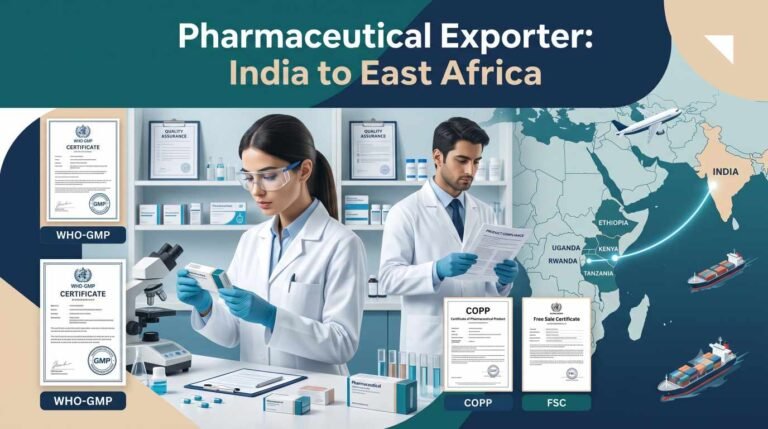
A pharmaceutical exporter’s marketing claims are worth less than three documents: a current WHO-GMP certificate, a Certificate of Pharmaceutical Product (COPP), and a Free Sale Certificate (FSC) for the exact product being quoted. Puizer Cure (Puizer Pharmaceuticals) holds WHO-GMP and ISO 9001:2015 certification, manufactures and exports more than 600 products across eight dosage forms, and has spent six years building East Africa-specific supply relationships, with in-house support for the registration paperwork each destination market asks for.
Compiled September 2026. Company figures (product count, years exporting, certifications held) are as provided by Puizer Cure (OPC) Pvt Ltd; external market figures are attributed to their original sources inline.
If you’re new to sourcing pharmaceuticals from India, start with our Pharmaceutical Export to Africa: Complete Guide for the full landscape, or the Export Documentation Checklist for the paper trail a shipment actually needs. This post is narrower: it’s a guide to sizing up any India-based exporter — Puizer included — before you commit an order, and a plain account of where our own certification and product range stand today.
Why the certificate check matters more than the sales pitch
The reason this matters is scale. Africa imports roughly 94% of its pharmaceutical and medicinal needs from outside the continent, at an annual cost of about $16 billion, according to a United Nations Economic Commission for Africa (UNECA) estimate[1]. India, together with China and the European Union, supplies more than three-quarters of that imported volume, per a Brookings Institution analysis of continental trade data[2]. At that volume, the difference between a compliant shipment and a rejected one usually comes down to paperwork a buyer never asked to see.
A glossy company profile or a stock photo of a “certified facility” proves nothing on its own. What your own drug regulatory authority will actually check — whether that’s the PPB in Kenya, the TMDA in Tanzania, the NDA in Uganda, Rwanda FDA, or EFDA in Ethiopia — is whether the manufacturer’s GMP status and the product’s certification are current, specific to that product and dosage strength, and issued by a real authority.
The three documents worth asking for
These three terms get used loosely in sourcing conversations, and buyers are sometimes handed the wrong one. Here’s what each actually covers.
What it proves
That the manufacturing site — not just the product — follows WHO’s Good Manufacturing Practice guidelines: qualified personnel, validated processes, documented quality systems, and traceability from raw material to finished pack. It’s a facility-level certification, issued after physical inspection, and it has an expiry date.
What it proves
A Certificate of Pharmaceutical Product confirms that a specific product, in a specific dosage form and strength, is manufactured under GMP conditions and is authorised for sale in the country of origin. It’s issued under the WHO Certification Scheme and is the document most East African drug regulators expect as part of a product’s marketing-authorisation dossier — it is not interchangeable with a plant-level GMP certificate.
What it proves
A Free Sale Certificate states that a product is legally and freely marketed with no restriction in its country of origin (or, for export-only lines, that it meets the origin country’s manufacturing and quality standards even where it isn’t sold domestically). Some destination authorities accept an FSC alongside or in place of a COPP depending on the product category and their own registration rules — which is exactly why it’s worth confirming with your target country’s regulator, or your import agent, which document their specific dossier requires.
Where this goes wrong
The most common gap isn’t a fake certificate — it’s a real one for the wrong thing: an expired WHO-GMP certificate, a COPP quoting a different pack size than what’s being invoiced, or a company-level compliance letter presented as if it were product-specific. Cross-check the product name and strength on the document against your purchase order line by line before you release payment.
Tip
Ask your supplier to send the certificate as a scan tied to the specific quotation, not a generic PDF from a shared company folder. A manufacturer that hesitates to do this for a real order is telling you something.
What Puizer exports
Puizer manufactures and exports more than 600 products across eight dosage forms from its WHO-GMP and ISO 9001:2015 certified facility in Sonipat, Haryana. In practice, that range groups into four categories:
Category 01Solid dosage
The largest share of the catalogue by product count.
- Tablets
- Capsules
Category 02Liquid dosage
Common in pediatric and general-ward institutional orders.
- Syrups
- Dry syrups
Category 03Topical & sterile
Higher documentation burden, handled in-house.
- Ointments
- Injectables
- Eye & ear drops
Category 04Nutraceuticals
Growing share of institutional and retail-chain orders.
- Nutraceutical formulations
Third-party and private-label manufacturing is available across the same range — see our Third Party Manufacturing for African Markets post if that’s the arrangement you’re evaluating rather than a direct product order.
Six years, East Africa first
Puizer’s export focus has been East Africa first — Kenya, Tanzania, Uganda, Rwanda, and Ethiopia — built over six years of shipments, documentation cycles, and repeat orders with distributors and institutional buyers in those markets, alongside existing reach into West Africa. That East Africa emphasis is deliberate: buyer requirements, registration timelines, and tender cycles differ meaningfully by country, and it’s faster to be genuinely good at five markets than superficially present in twenty.
Registration support: from COPP to marketing authorisation
Getting a product into a distributor’s warehouse and getting it registered for sale are two different projects. Puizer’s regulatory and documentation team assembles the CTD dossier, COPP, and GMP certification each destination authority’s registration process asks for, alongside the export-side paperwork (COA, packing list, certificate of origin, and the rest covered in the documentation checklist linked above).
Because requirements differ by country, we’ve written the registration process up separately, in full, for each East African market we serve:
- PPB Kenya Drug Registration Process
- Tanzania TMDA Drug Registration Process
- NDA Uganda Drug Registration Process
- Rwanda FDA Drug Registration Process
- EFDA Ethiopia Drug Registration Process
Frequently asked questions
It means the manufacturing facility has been inspected and found to follow WHO’s Good Manufacturing Practice guidelines — covering personnel qualification, process validation, documentation, and traceability. It’s a certification of the facility, has an expiry date, and should be checked against the specific site producing your order, not assumed from a company’s general reputation.
No. A WHO-GMP certificate covers the manufacturing site. A COPP covers a specific product, dosage form, and strength, and confirms it’s authorised for sale in the country of origin under GMP conditions. Most East African drug regulators ask for the COPP as part of the product registration dossier, separately from the site’s GMP status.
More than 600 products across eight dosage forms: tablets, capsules, syrups, dry syrups, ointments, injectables, eye and ear drops, and nutraceutical formulations, manufactured at Puizer’s WHO-GMP and ISO 9001:2015 certified facility in Sonipat, Haryana.
Yes. Puizer’s regulatory and documentation team prepares the CTD dossier, COPP, and GMP certification needed for registration with authorities including Kenya’s PPB, Tanzania’s TMDA, Uganda’s NDA, Rwanda FDA, and Ethiopia’s EFDA, alongside the standard export documentation for shipping.
East Africa first — Kenya, Tanzania, Uganda, Rwanda, and Ethiopia — built over six years of export relationships, alongside existing reach into West African markets.
Need certificates for a specific product?
Send us the product, strength, and destination market, and we’ll share the current WHO-GMP certificate, COPP, and pricing for that exact SKU.
Sources
- United Nations Economic Commission for Africa (UNECA), cited in “Africa Making Moves to Manufacture Its Own Medicines,” estimating Africa imports approximately 94% of its pharmaceutical and medicinal needs at an annual cost of $16 billion. Available from: uneca.org/node/671. Accessed September 2026.
- Brookings Institution, “Figure of the week: Africa’s trade in pharmaceuticals,” citing Africa sourcing more than 75% of pharmaceutical imports from the EU, India, and China combined (2017–2019 trade data). Available from: brookings.edu. Accessed September 2026.
Product range, certifications, and market focus described here reflect Puizer’s current status as of September 2026 and are subject to change; certificate and registration requirements vary by destination country and product category, so confirm specifics with the relevant regulatory authority or with Puizer directly before placing an order.