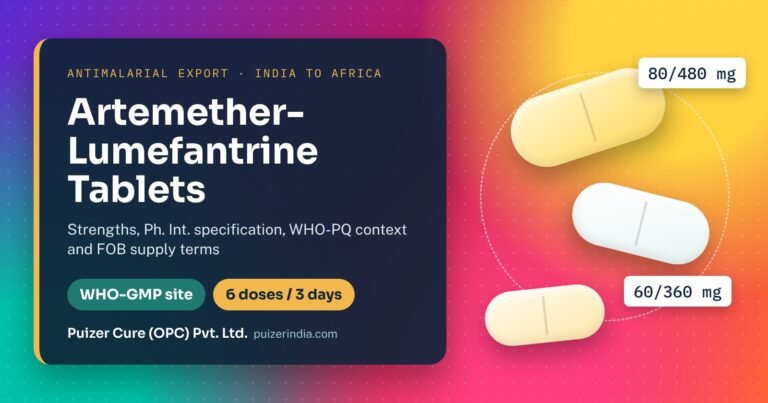

Artemether-lumefantrine tablets are the most widely prequalified artemisinin-based combination therapy (ACT) for uncomplicated Plasmodium falciparum malaria. Puizer Cure manufactures two strengths at its WHO-GMP tablet facility in Sonipat, Haryana: 80 mg + 480 mg (one tablet per dose for patients of 35 kg and above) and 60 mg + 360 mg (one tablet per dose for 25 to under 35 kg).[4][5] Both strengths are on the WHO prequalification list from other makers, so the strength itself is accepted.[1]
Our products are not WHO-prequalified. We supply them for national registration and private-market or government-budget tenders, not for Global Fund or other donor-financed tenders.
- 25artemether/lumefantrine products on the WHO-PQ list (29 Oct 2026)
- 6 dosesover 3 days, at 0 h, 8 h, then every 12 h
- 30 °Cdo not store above; protect from light
- FOBIndia port, advance T/T, quoted per order
Artemether-lumefantrine tablet strengths, and who each one is for
Every strength keeps the same 1:6 ratio of artemether to lumefantrine. The higher strengths exist to cut the pill burden: one 80/480 tablet replaces four 20/120 tablets per dose. For bioequivalence, WHO-PQ assessors accepted a fed crossover study comparing one 80/480 tablet with four Coartem 20/120 tablets.[8]
The WHO Model List of Essential Medicines names only the 20/120 tablet and the 20/120 dispersible tablet.[2] WHO prequalification goes further and lists 40/240, 60/360 and 80/480 tablets, plus a 2.5/30 dispersible tablet for babies under 5 kg.[1] Our essential generics range mapped to the WHO list explains how national lists treat other strengths.
| Strength (artemether + lumefantrine) | Form | Weight band, tablets per dose | WHO-PQ products | Puizer |
|---|---|---|---|---|
| 2.5 mg + 30 mg | Dispersible | Under 5 kg (new, Sep 2026 guideline update)[9] | 1 (Novartis, Apr 2026) | Not made |
| 20 mg + 120 mg | Dispersible | 5 kg and up, dosed as the 20/120 tablet | 6 | Not made |
| 20 mg + 120 mg | Tablet | 1 / 2 / 3 / 4 tablets for 5–15, 15–25, 25–35, 35+ kg[7] | 10 | Not made |
| 40 mg + 240 mg | Tablet | 15 to under 25 kg: 1 tablet[6] | 2 | Not made |
| 60 mg + 360 mg | Tablet | 25 to under 35 kg: 1 tablet[5] | 1 (Ajanta) | Made in Sonipat |
| 80 mg + 480 mg | Tablet | 35 kg and above: 1 tablet[4] | 5 (Ajanta, Ipca, Macleods, Novartis, Velvet Med) | Made in Sonipat |
Swipe the table sideways to see all columns → WHO-PQ counts read from the live list on 29 Oct 2026; the list changes, so check it on the day you tender.[1]
Which artemether-lumefantrine strength fits each weight band?
Pick a weight band to see the prequalified strength options and whether we supply one. Then enter how many treatment courses you plan to buy. The planner turns that into tablets and 6-tablet blisters, because every course is 6 doses.
Pick a weight band above
We make 60 mg + 360 mg tablets (25 to under 35 kg) and 80 mg + 480 mg tablets (35 kg and above), one tablet per dose.
Weight bands from the WHO-PQ SmPCs and the US Coartem label.
- –tablets of the selected strength
- –blisters of 6 (1 course each)
- –cartons of 30 blisters
A planning aid, not a quotation. The 1 × 6 blister and 30-blister carton follow the WHO-prequalified packs; your quotation confirms our pack, shelf life and MOQ.[5]
What The International Pharmacopoeia requires of artemether-lumefantrine tablets
Buyers and regulators usually ask which pharmacopoeia the finished-product specification follows. The monograph in The International Pharmacopoeia, 13th edition (2025), sets these limits.[3] Ask for each one on the certificate of analysis for every batch.
| Test | Requirement (Ph. Int., 13th ed.) | What to check on the CoA |
|---|---|---|
| Assay, artemether | 90.0–110.0% of label claim | Result for each component, by HPLC |
| Assay, lumefantrine | 90.0–110.0% of label claim | Reported separately from artemether |
| Identity | TLC, or HPLC retention time | Both components identified |
| Artemether-related substances (TLC) | Impurity A ≤ 1.5%; impurity B (artenimol) ≤ 1.0%; impurity C ≤ 0.5%; impurity D ≤ 0.3%; any other ≤ 0.2% | Each named impurity against its limit |
| General tablet tests | Comply with the general monograph for Tablets | Uniformity, disintegration, description |
| Storage | Well-closed container, protected from light | Pack matches the stability study |
Note on dissolution. The Ph. Int. monograph carries no dissolution test for these tablets. Prequalified products add one to their own specification; one WHO-PQ assessment records a two-point dissolution test for artemether.[8] Lumefantrine is poorly soluble in water, so ask your supplier for its dissolution method and results. Our guide on how to verify medicine quality before import covers independent testing and retention samples.
Where Indian artemether-lumefantrine 80/480 tablets can be sold in Africa
The buyer decides the route, and the route decides what quality status the product needs. Here is how our tablets fit each one.
Importers and distributors supplying pharmacies and private clinics
The product needs a marketing authorisation from the national regulator, for example NAFDAC, Ghana FDA, PPB or NDA. That needs a dossier, GMP evidence and samples. Our country guides give the steps and fees, starting with the NAFDAC drug registration guide.
- We provide the dossier sections, CoAs, stability data and WHO-GMP certificate needed for registration.
- Private label is available under your registered brand.
Central medical stores buying with national budgets
Each agency sets its own eligibility. Some accept a nationally registered product from a WHO-GMP site, while others ask for WHO-PQ. Read the tender document before you bid. Our guide to medical tenders in Africa for Indian suppliers sets out the rules at KEMSA, MSD, NMS, EPSS and ZAMMSA.
Global Fund and other donor-financed procurement
Global Fund grants pay only for antimalarials that are WHO-prequalified, approved by a stringent regulatory authority, or cleared by its Expert Review Panel.[12] Its malaria product list (version 132, 30 Sep 2026) carries 21 artemether-lumefantrine entries, including 80/480 tablets from four makers and a 60/360 tablet from one.[11] Our tablets have none of these approvals, so we do not bid for these tenders.
Stability, storage and packaging for hot, humid markets
Storage on the label
The WHO-recommended SmPCs for 60/360 and 80/480 tablets say: do not store above 30 °C, and keep in the original pack to protect from light.[4][5] The US Coartem label sets 25 °C, with excursions to 15–30 °C.[7]
Stability data
Prequalified 80/480 tablets were tested long-term at 30 °C / 75% RH and accelerated at 40 °C / 75% RH for six months.[8] Ask for Zone IVb data in the pack you will import. Our note on climate-zone stable packaging for export explains the zones.
Pack
Prequalified packs are clear PVC/PVdC–aluminium blisters of 6 tablets, one course per blister, packed singly or 30 to a carton.[5] One course per blister also makes stock counts simple at the dispensing point.
Prescribing points the artemether-lumefantrine label must carry
Regulators check the leaflet against the reference product information. These are the points that most often matter, from the WHO-PQ SmPC for the 80/480 tablet and the US Coartem label.[4][7]
Dosing schedule
- 6 doses over 3 days. The second dose follows 8 hours after the first, then twice daily.
- Take with food or a milky drink, which improves lumefantrine absorption.
- Repeat a dose if the patient vomits within 1 hour.
Contraindications and interactions
- Not for severe malaria.
- Avoid with congenital QT prolongation, low potassium or magnesium, or other QT-prolonging drugs.
- Strong CYP3A4 inducers such as rifampicin, carbamazepine and phenytoin are contraindicated. In the US label, rifampicin cut lumefantrine exposure by 68%.[7]
For trade and regulatory readers. This section summarises product information for registration and labelling. It is not treatment advice. Treatment decisions belong to a prescriber following national malaria guidelines.
Why artemether-lumefantrine demand in Africa stays high
Burden
WHO estimates 282 million malaria cases and 610,000 deaths in 2024. The African Region carries most of them.[10]
Resistance
WHO reports artemisinin partial resistance confirmed or suspected in at least 8 African countries.[10] Check the current national treatment policy before you plan volumes, because first-line choices can change.
Guidelines
The WHO guidelines for malaria were updated on 10 September 2026. The update covers a new artemether-lumefantrine formulation for children under 5 kg.[9]
Buying artemether-lumefantrine tablets from Puizer Cure
| Item | Our terms |
|---|---|
| Strengths | 80 mg + 480 mg and 60 mg + 360 mg tablets |
| Manufacturing site | Our WHO-GMP tablet facility in Sonipat, Haryana |
| Quality status | WHO-GMP site; product not WHO-prequalified |
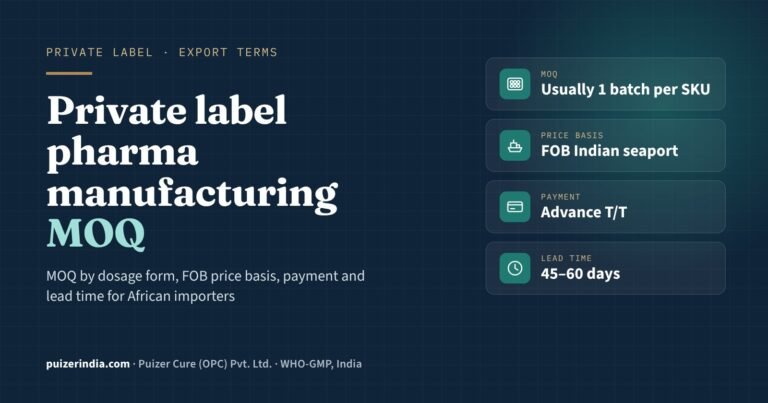
| Price basis | FOB Indian port, quoted per order |
| Payment | Advance T/T |
| Private-label lead time | 45–60 days after artwork approval |
| MOQ | Typical ranges, confirmed per quote |
Swipe sideways if the table is cut off → MOQ ranges and lead-time detail are on our MOQ and export terms page. Every shipment travels with the documents in our export documentation checklist.
Artemether-lumefantrine tablets: questions buyers ask
No. The WHO Model List names the 20/120 tablet and the 20/120 dispersible tablet. However, WHO prequalification lists five 80/480 products, and many national lists include the higher strengths. Check your own country’s list.
Six: one tablet per dose, six doses over three days, for patients of 35 kg and above. With 20/120 tablets the same course takes 24 tablets.
No. They are made at a WHO-GMP certified facility and supplied for national registration and private or government-budget supply. We do not bid in Global Fund or other donor tenders that require prequalification.
Not at present. We make the 60/360 and 80/480 tablets, which cover patients from 25 kg upward. Children under 25 kg need 20/120 tablets, dispersible 20/120 tablets or 40/240 tablets.
The WHO-GMP certificate, certificates of analysis, stability data, the product dossier sections your regulator asks for, and samples. Certificate numbers are shared on request.
Prices are quoted FOB Indian port, and payment is by advance T/T. Private-label orders ship 45 to 60 days after artwork approval.
Get an FOB quote for artemether-lumefantrine tablets
Tell us the strength, quantity in courses, destination country and whether the product is already registered there. Our export desk replies with price, pack, shelf life and MOQ.
Or email support@puizerindia.com · +91 93140 09978
Sources
- World Health Organization. Prequalified lists: medicines (finished pharmaceutical products), artemether/lumefantrine entries. Geneva: WHO Prequalification Unit; 2026. Available from: extranet.who.int/prequal. Accessed October 2026.
- World Health Organization. WHO Model List of Essential Medicines, 24th list. Geneva: WHO; 2025. Available from: who.int. Accessed October 2026.
- World Health Organization. Artemether and lumefantrine tablets. In: The International Pharmacopoeia, 13th ed. Geneva: WHO; 2025. Available from: digicollections.net/phint. Accessed October 2026.
- World Health Organization. WHOPAR MA130, Part 4: Summary of product characteristics, artemether/lumefantrine 80 mg/480 mg tablets (Ajanta Pharma). Geneva: WHO; revised 2023. Available from: extranet.who.int. Accessed October 2026.
- World Health Organization. WHOPAR MA129, Part 4: Summary of product characteristics, artemether/lumefantrine 60 mg/360 mg tablets (Ajanta Pharma). Geneva: WHO. Available from: extranet.who.int. Accessed October 2026.
- World Health Organization. WHOPAR MA143, Part 4: Summary of product characteristics, artemether/lumefantrine 40 mg/240 mg tablets (Macleods). Geneva: WHO. Available from: extranet.who.int. Accessed October 2026.
- Novartis Pharmaceuticals Corporation. Coartem (artemether/lumefantrine) tablets: prescribing information. Silver Spring (MD): US Food and Drug Administration; revised January 2018. Available from: accessdata.fda.gov. Accessed October 2026.
- World Health Organization. WHOPAR MA138, Part 6: Scientific discussion, artemether/lumefantrine 80 mg/480 mg tablets (Strides Pharma Global). Geneva: WHO. Available from: extranet.who.int. Accessed October 2026.
- World Health Organization Global Malaria Programme. Version updates to the WHO guidelines for malaria (10 September 2026 entry). Geneva: WHO; 2026. Available from: cdn.who.int. Accessed October 2026.
- World Health Organization. World malaria report 2025. Geneva: WHO; 4 December 2025. Available from: who.int. Accessed October 2026.
- The Global Fund. List of malaria medicines classified according to the Global Fund Quality Assurance Policy, version 132. Geneva: The Global Fund; 30 September 2026. Available from: theglobalfund.org. Accessed October 2026.
- The Global Fund. Quality assurance: medicines. Geneva: The Global Fund. Available from: theglobalfund.org. Accessed October 2026.
This page is technical and commercial information for pharmaceutical importers, distributors and regulatory professionals. It is not medical advice. Prequalification lists, pharmacopoeial texts and national registration rules change often: confirm the current position with the regulator or procurement agency before acting. Written by Darshan Singh, pharmaceutical QA, QC and regulatory affairs consultant, for Puizer Cure (OPC) Pvt. Ltd. Last reviewed 29 October 2026.