
Importer’s trust guide · Verification protocol
Don’t take a supplier’s paperwork on trust. Here is how to turn each claim into evidence before the container leaves India.
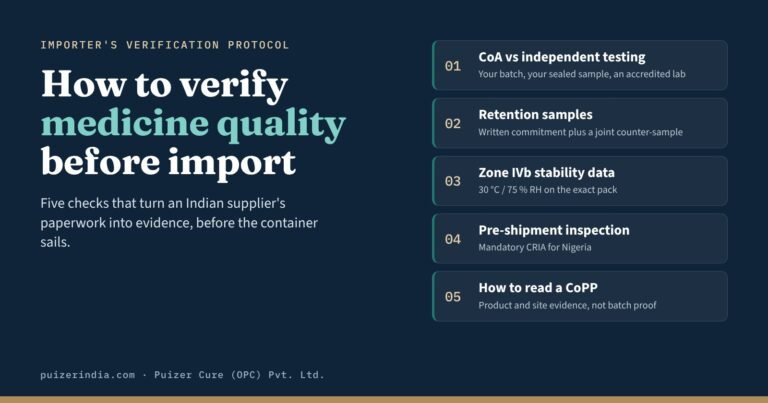
Five checks that separate a genuine WHO-GMP medicine from a risky shipment: the Certificate of Analysis against independent testing, retention samples, Zone IVb stability data, pre-shipment inspection, and reading a CoPP. They apply to any Indian supplier, including us.
The short answer
To verify medicine quality before import, treat every supplier document as a claim and check it against an independent source:
- CoPP: confirm the product and site with the Certificate of a Pharmaceutical Product, verified with the authority that issued it.
- CoA plus independent test: read the batch Certificate of Analysis against the registered specification, then have an accredited laboratory test a sample drawn from your batch.
- Stability: ask for long-term stability data at the condition your market requires — 30 °C/75 % RH (Zone IVb) for Nigeria, Ghana and Tanzania.
- Retention samples: get the supplier’s retention commitment in writing, and keep a sealed counter-sample yourself.
- Pre-shipment inspection: inspect and sample before loading. For Nigeria this is mandatory through a NAFDAC-accredited CRIA agent.
Why importers ask for proof first
The worry is reasonable. WHO estimates that at least 1 in 10 medicines in low- and middle-income countries is substandard or falsified. It separates substandard products, which fail their specifications, often through poor manufacturing or weak quality control, from falsified ones, which deliberately misrepresent their identity, composition or source [1].
India-made products have been part of that story. In October 2022, WHO alerted the world to four contaminated paediatric syrups identified in The Gambia. The stated manufacturer was a Haryana company, and laboratory analysis found diethylene glycol and ethylene glycol at unacceptable levels [2]. India responded by requiring cough syrups to be tested at listed government or NABL-accredited state laboratories, with a Certificate of Analysis, before export from 1 June 2023 [3].
None of this means Indian medicines are unsafe. India is a major supplier of quality generics to Africa. It does mean that a buyer who relies on paperwork alone is exposed. The protocol below shows what each document can prove, where it falls short, and the independent check that closes the gap.
How to verify medicine quality before import: CoA vs independent testing
A Certificate of Analysis (CoA) is the supplier’s own record of the release tests on one batch. It is necessary, but it is a self-declaration. The quality unit that signs it should be independent of production under WHO GMP [4]. Even so, it is still the seller’s laboratory reporting on the seller’s product. Independent testing means a laboratory with no stake in the sale analyses a sample drawn from the batch you are buying.
| Question | Supplier’s CoA | Independent test |
|---|---|---|
| Who generates it | Manufacturer’s QC laboratory | Third-party lab: ISO/IEC 17025-accredited, WHO-prequalified, or your regulator’s own lab |
| What it proves | The supplier tested this batch against its specification and says it passed | A sample of your batch meets the specification when someone else tests it |
| What it cannot prove | That the tested sample came from the goods shipped to you | Anything about batches you did not sample |
| Sample source | Chosen by the supplier | Drawn by you or your inspector, sealed, with chain of custody |
| When to use it | Every batch, every shipment | First orders, new products, high-risk dosage forms, then on a risk-based schedule |
Scroll sideways to see the full table →
What a credible CoA must show
WHO publishes a model Certificate of Analysis [5]. Use its fields as your checklist. A CoA missing any of these deserves a question before payment:
- Batch number, manufacturing date and expiry date, which must match the printed packs you receive.
- Name and address of the original manufacturer, plus any repacker or trader. A trader’s letterhead with no manufacturer named is a warning sign.
- Each test with its method reference, acceptance criteria and actual result. “Complies” with no number against an assay or dissolution test tells you very little.
- A conclusion on compliance, plus the name, signature and date of the person authorised to approve it.
Where to test independently
Choose a laboratory accredited to ISO/IEC 17025 for the methods you need, or one on WHO’s list of prequalified quality control laboratories. The 2020 edition of that list included national laboratories in Kenya, Uganda, Tanzania and Zimbabwe, as well as private and public laboratories in India and South Africa [6]. Check the current edition before you commission work. For oral liquids, ask the laboratory to include a diethylene glycol and ethylene glycol check on the batch, as these were the contaminants in the 2022 Gambia alert [2].
Chain of custody matters more than the lab’s name. A perfect result on a sample the supplier posted to the laboratory proves only that the supplier can send a good sample. Draw the sample at the warehouse or during loading, then seal and label it in front of a witness.
Retention samples: the evidence you need after delivery
Retention samples are units from each batch that the manufacturer keeps for later investigation. They are what lets a complaint be settled with data instead of argument. EU GMP Annex 19, the most detailed public statement of the norm, separates two kinds [7]:
Reference sample
Kept so the batch can be re-analysed if a question arises. Large enough to run the full analytical controls on at least two occasions.
Retention sample
A fully packaged unit kept for identification: the pack, label and leaflet as released. This is your comparator if a falsified pack turns up.
How long
Finished-product samples kept for at least one year after the expiry date. A revised Annex 19, applicable from September 2026, left this period and the sample size unchanged [8].
What to ask your supplier
- The retention period and quantity the site applies, in writing. National GMP codes state these differently, so get the supplier’s own commitment rather than assuming a figure.
- Whether they will re-test the reference sample and share the result if you raise a complaint, and how quickly.
- Agreement to a joint sealed counter-sample: a few packs from each batch, sealed at loading and signed by both sides. You keep them in your own warehouse. If the batch is later disputed, both parties test the same sealed units.
Zone IVb stability data: proof the medicine survives your climate
A batch can pass every release test in India and still degrade before its expiry date in a hot, humid warehouse. Only long-term stability data at your market’s storage condition answers that risk. WHO Prequalification sets the benchmark: shelf life for prequalified medicines must rest on complete long-term data at 30 °C ± 2 °C / 75 % RH ± 5 % RH (Zone IVb). WHO assumes these products may be used anywhere in Zones III and IV [9].
National requirements differ. WHO’s table of the conditions Member States have identified gives these long-term conditions for key markets [10]:
| Country | Long-term condition in WHO table | What to ask the supplier for |
|---|---|---|
| Nigeria | 30 °C / 75 % RH | Long-term data at 30/75 on the exact pack |
| Ghana | 30 °C / 75 % RH | Long-term data at 30/75 on the exact pack |
| Tanzania | 30 °C / 75 % RH | Long-term data at 30/75 on the exact pack |
| Kenya, Rwanda, Ethiopia | 30 °C / 65 % RH* | At least 30/65; 30/75 data covers it and is safer for regional redistribution |
| Uganda | 30 °C / 65 % RH | At least 30/65; prefer 30/75 |
| Zambia | 25 °C / 60 % RH or 30 °C / 65 % RH | Confirm with ZAMRA; prefer 30/75 |
| India (for comparison) | 30 °C / 70 % RH | Indian domestic data alone does not prove 30/75 performance |
Scroll sideways to see the full table →
* WHO marks these entries as sourced from the International Federation of Pharmaceutical Manufacturers and Associations rather than from the regulator. The table also mixes data from regional groups and older surveys, so always confirm the current requirement in the destination regulator’s guideline. For the country-by-country route, see our Tanzania TMDA registration guide and NAFDAC drug registration guide.
What a complete stability package contains
WHO’s stability guideline sets the minimum a regulator expects at submission [11]. Ask for the same:
- Accelerated data at 40 °C/75 % RH covering 6 months.
- Long-term data covering at least 6 months for products with existing APIs, or 12 months for new APIs, with the shelf life justified by the full study.
- Batches: at least two batches of at least pilot scale for products with existing APIs, or three primary batches per strength for new APIs.
- The same container-closure system you are buying. Data on Alu-Alu blisters says little about PVC blisters. Our guide to climate-zone stable packaging for export explains why the pack is part of the evidence.
Pre-shipment inspection: checking the goods before they sail
Pre-shipment inspection confirms that the goods in the container are the goods described on paper, then draws samples for testing before ownership and risk move to you.
Nigeria: CRIA is mandatory
NAFDAC requires a Clean Report of Inspection and Analysis (CRIA) for all NAFDAC-regulated products imported from India and China, except items on its exemption list [12]. Only NAFDAC-accredited agents can perform it. NAFDAC’s published list, current as of 15 April 2025, names five agents for India [13]. Under NAFDAC’s CRIA guidance, the agent samples every product, randomly selects 20 % of the batches being exported, and has a NAFDAC-approved laboratory test every parameter claimed on the product’s CoA [14].
A clean CRIA does not end the checks. At the port, NAFDAC inspectors draw samples during physical examination, and imported finished pharmaceuticals can be marketed only after satisfactory laboratory evaluation [15]. Our guide to NAFDAC CRIA agents in India covers the sequence and the documents the agent will ask for. The full India-to-Nigeria import process shows where CRIA sits among the other approvals.
Other markets: commission your own inspection
Where pre-shipment inspection is not compulsory, it is still the cheapest point to catch a problem. A useful inspection brief covers:
- Count and condition of shippers against the packing list.
- Labels and leaflets checked against the artwork registered in your country.
- Batch numbers and expiry dates matched to the CoA for every batch.
- Samples drawn and sealed for your independent laboratory, plus your counter-samples.
- Photographs of loading, the container number and the seal number.
Add inspection and testing fees to your cost model from the start. Our landed-cost calculator helps you see what they add per unit.
How to read a CoPP (Certificate of a Pharmaceutical Product)
The CoPP is issued by the exporting country’s regulator under the WHO Certification Scheme, not by the manufacturer. Through it, the regulator attests that the product is authorised for sale in its jurisdiction, or explains why it is not, and that the plant is inspected at suitable intervals for GMP compliance [16]. In India, WHO-GMP and CoPP certification follows a joint inspection by the CDSCO zonal office and the State Licensing Authority [17].
A CoPP is not batch evidence. It certifies the product and the site, not the consignment. Under the WHO Scheme a batch certificate is normally issued by the manufacturer [18], so batch proof still comes from the CoA and your own testing.
Use the reader below to check each part of the WHO model certificate [18]:
Item 2.A.1 · Marketing authorisation number and date
Check that the product name, strength and dosage form match your RFQ exactly. A CoPP for 500 mg tablets does not cover 650 mg tablets.
Item 2.A.3 · Status of the authorisation holder
Shows whether the holder makes the product or contracts it out. If the holder is not the manufacturer, find the actual manufacturing site in Section 3.
Item 2.A.5 · Product information
Confirms whether the product information is complete and consistent with the authorisation. Compare the composition with the label and leaflet you will register.
Item 1.4 · Is the product actually on the market?
The answer can be Yes, No or Unknown. A “No” is not disqualifying, since some products are made only for export. It is a reason to ask why, and to look harder at the stability and testing evidence.
What to ask
Where the product is sold today, for how long, and whether there have been any recalls or regulatory actions.
Item 3.2 · Periodic inspection
Shows whether the certifying authority arranges periodic inspection of the manufacturing site. Ask for the date of the last inspection.
Item 3.5 · GMP as recommended by WHO
Confirms that operations conform to WHO-recommended GMP. Before certifying, the authority must be satisfied that the same GMP applies to all batches, including export-only batches [19].
Site address
Match it to the address on the CoA and the WHO-GMP certificate. A different address means a different site, and possibly a different quality system.
Importing country and seal
Each certificate should identify the importing country, and each page should carry the issuing authority’s official seal [19]. A CoPP made out to another country is not yours to use.
Verification
When in doubt, the requesting authority should ask the certifying authority to verify the certificate. WHO discourages notarisation, legalisation and apostille because they cause delay, and allows secure electronic certificates [18].
Validity
The model certificate includes an optional validity field. If a period is stated, check it covers your registration and first shipments.
For the full document pack beyond the CoPP, including the Certificate of Origin and Free Sale Certificate, see our pharmaceutical export documentation checklist.
Build your verification plan
Answer three questions to get the checks that matter for your order. The plan follows the guidance above. It does not replace your regulator’s requirements.
Verification planner
Tap one option in each row.
1. Where will the medicine be sold?
2. What dosage form?
3. Supplier history?
Choose an option in each row to see your plan.
Red flags that should pause an order
- CoA results reported only as “Complies”, with no numbers for assay, dissolution or impurities.
- Batch number or expiry on the CoA doesn’t match the printed packs.
- A CoPP made out to another importing country, unsealed pages, or a site address that differs from the CoA.
- Stability data only at 25 °C/60 % RH, or accelerated data only, for a 30/75 market.
- Refusal to let your inspector sample at loading, or insistence on posting “representative” samples.
- No written retention-sample commitment, or no named person to handle complaints.
How to apply this protocol to Puizer Cure
We would rather be verified than believed. Puizer Cure (OPC) Pvt. Ltd. manufactures at its own facility in Sonipat, Haryana. Our QC evidence page sets out the site, product and batch documents we share: the WHO-GMP certificate, product CoPPs and batch CoAs, with certificate numbers on request. It also offers a video walkthrough or an on-site audit. Two points to note when you send an enquiry:
- Ask which products have 30 °C/75 % RH stability data before you quote for a Zone IVb market. Don’t assume every product does.
- Our injections are made by third-party manufacturers, not at our own site. Ask for the actual manufacturer’s CoPP and site details for any injectable.
- If you plan a third-party inspection or independent sampling, say so in your RFQ so it can be scheduled into dispatch.
Buyers asking what Indian GMP itself now requires of a manufacturer can read what importers should ask a revised Schedule M compliant manufacturer.
Frequently asked questions
No. A Certificate of Analysis is the manufacturer’s own report of the release tests on one batch. It is necessary, but it does not prove that the tested sample came from the goods shipped to you. Confirm it with an independent laboratory test on a sample drawn from your batch, at least for first orders, new products and high-risk dosage forms.
A CoPP (Certificate of a Pharmaceutical Product) is issued by the exporting country’s regulator under the WHO Certification Scheme. It covers the product’s authorisation status and the GMP inspection of the site. A CoA is issued by the manufacturer’s laboratory and covers the test results of one batch. The CoPP is product-level evidence; the CoA is batch-level evidence.
WHO’s table of Member State conditions lists 30 °C/75 % RH for Nigeria, Ghana, Tanzania, Zimbabwe and Cameroon, among others, and 30 °C/65 % RH for Kenya, Uganda, Rwanda and Ethiopia. Some entries come from industry sources rather than the regulator, so confirm the current requirement with the destination authority. Data at 30/75 also covers the 30/65 markets.
EU GMP Annex 19 sets at least one year after the expiry date for finished-product samples, with reference samples large enough for the full analytical controls to be run at least twice. National GMP codes word this differently, so ask your supplier to state its retention period and quantity in writing, and keep a sealed counter-sample yourself.
For Nigeria, yes. NAFDAC requires a Clean Report of Inspection and Analysis (CRIA) from an accredited agent for all regulated products imported from India and China, except items on its exemption list. For other markets it is usually the importer’s choice, but it remains the cheapest point to catch label, batch or quality problems before goods leave India.
Check that it names your importing country, carries the issuing authority’s seal on every page, and matches the product, strength and site address on the CoA. If in doubt, WHO guidance says the requesting authority should ask the certifying authority to verify the certificate. Your regulator can do this directly with the exporting country’s authority.
Send an RFQ with your verification plan attached
Tell us your market, products and the checks you want: independent sampling, inspection, stability data. We will confirm which documents we can share for each product before you commit.
References
- World Health Organization. Substandard and falsified medical products [fact sheet]. Geneva: WHO; 2024 Dec 3. Available from: who.int. Accessed Oct 2026.
- World Health Organization. Medical Product Alert N°6/2022: Substandard (contaminated) paediatric medicines. Geneva: WHO; 2022 Oct 5. Available from: who.int. Accessed Oct 2026.
- Business Standard. From June 1, cough syrups must be tested at govt labs before export [news report of DGFT notification; secondary source]. 2023 May 22. Available from: business-standard.com. Accessed Oct 2026.
- World Health Organization. WHO good manufacturing practices for pharmaceutical products: main principles. WHO Technical Report Series No. 986, Annex 2. Geneva: WHO; 2014. Glossary: quality unit. Available from: who.int. Accessed Oct 2026.
- World Health Organization. Model certificate of analysis. WHO Technical Report Series No. 1010, Annex 4, Appendix 1. Geneva: WHO; 2018. Available from: cdn.who.int. Accessed Oct 2026.
- World Health Organization Prequalification. WHO list of prequalified quality control laboratories. 51st ed. Geneva: WHO; 2020 Sep 7. Available from: extranet.who.int. Accessed Oct 2026. Check the current edition.
- European Commission. EudraLex Volume 4, EU GMP Annex 19: Reference and retention samples. Brussels; 2005 (in operation 1 Jun 2006). Sections 2.1, 3.1, 4.1. Available from: gmp-navigator.com (copy). Accessed Oct 2026.
- GMP Insiders. Revised EU GMP Annex 19: what changes for reference and retention samples? [secondary summary of Commission Decision C(2026) 4135]. 2026. Available from: gmpinsiders.com. Accessed Oct 2026.
- World Health Organization Prequalification Team: Medicines. Requirements for stability studies of finished pharmaceutical products. Geneva: WHO; 2010 Mar 29. Available from: extranet.who.int. Accessed Oct 2026.
- World Health Organization. Stability conditions for WHO Member States by region (formerly Table 2, Annex 2, TRS 953). Update March 2021. Available from: cdn.who.int. Accessed Oct 2026.
- World Health Organization. Stability testing of active pharmaceutical ingredients and finished pharmaceutical products. WHO Technical Report Series No. 1010, Annex 10. Geneva: WHO; 2018. Available from: extranet.who.int. Accessed Oct 2026.
- National Agency for Food and Drug Administration and Control (NAFDAC). Port inspection FAQs. Abuja: NAFDAC; n.d. Available from: nafdac.gov.ng. Accessed Oct 2026.
- NAFDAC. Pre-shipment inspection and testing agents. Content current as of 15 Apr 2025. Available from: nafdac.gov.ng. Accessed Oct 2026.
- NAFDAC. Guidance document for carrying out CRIA services by CRIA agents. Undated; copy published by a NAFDAC-accredited agent. Items 14 and 25. Available from: quntrol.com. Accessed Oct 2026.
- NAFDAC. Guidelines for clearing imported finished pharmaceutical (human and veterinary) products at ports of entry in Nigeria. Doc. Ref. PID-GDL-004-01; effective 24 Sep 2022. Sections 6.2, 8.1. Available from: nafdac.gov.ng. Accessed Oct 2026.
- World Health Organization. WHO Certification Scheme: provisions and objectives. Geneva: WHO; n.d. Section 1.3. Available from: who.int. Accessed Oct 2026.
- Medical Dialogues. CDSCO updates procedure for issuance of WHO GMP [secondary report of CDSCO procedure]. 2020 Mar 15. Available from: medicaldialogues.in. Accessed Oct 2026.
- World Health Organization. Guidelines on the implementation of the WHO Certification Scheme on the quality of pharmaceutical products moving in international commerce. WHO Technical Report Series No. 1033, Annex 9. Geneva: WHO; 2021. Sections 5.10, 5.15, 6.6, 6.7; Appendix 1. Available from: who.int. Accessed Oct 2026.
- World Health Organization. WHO Certification Scheme: issuing a certificate. Geneva: WHO; n.d. Available from: who.int. Accessed Oct 2026.
Scope and limits. This guide is technical and educational. It is not legal, regulatory or medical advice. Requirements change, so confirm current rules with your national regulator before you import. We could not open the gazette text of India’s revised Schedule M for its retention-sample period, so this page cites the EU benchmark and asks you to get the supplier’s period in writing. WHO’s country stability table mixes regulator, regional and industry sources. The prequalified laboratory list cited is the 2020 edition.