
The short answer
Two routes into Ethiopia, one registration behind both
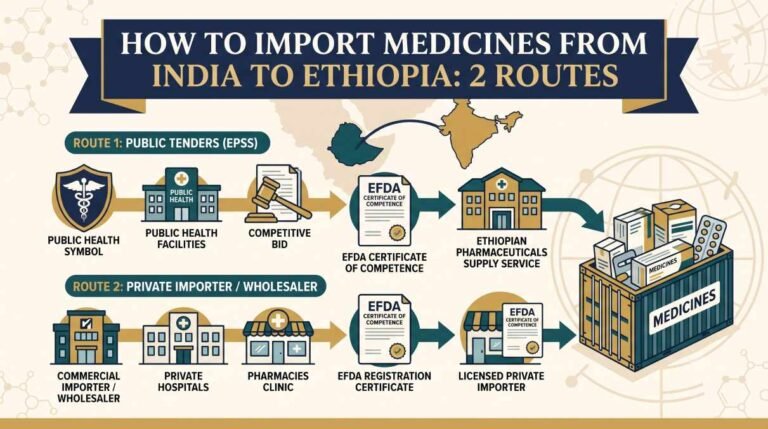
To import medicines from India to Ethiopia, you need an Ethiopian partner: an Indian manufacturer cannot import in its own name. Only an entity holding an EFDA certificate of competence may import,[3] and every imported medicine must be registered by EFDA unless a special permit applies.[3] Within those rules there are two commercial routes:
- EPSS public tenders — the Ethiopian Pharmaceuticals Supply Service buys for public health facilities through competitive bids. EPSS is the buyer and consignee.
- Private importer / wholesaler — a licensed Ethiopian importer buys from you, holds the import permits and sells on to private hospitals and pharmacies.
The registration is the same on both routes. What changes is who your local agent has to be, who applies for each import permit, and who sets the quality bar. That is what this guide maps, step by step.
What changed
EFDA reached WHO Maturity Level 3 in September 2025 — what that does and does not change
On 30 September 2025 WHO announced that the Ethiopian Food and Drug Authority had reached Maturity Level 3 (ML3) under the WHO Global Benchmarking Tool, which assesses a regulator against more than 250 indicators.[1] WHO’s own list of regulators operating at ML3 and ML4, dated August 2026, records EFDA’s scope as medicines and vaccines (non-producing).[2] By that list, EFDA is one of ten African authorities at ML3 for at least one product scope.[2]
What ML3 signals
- A regulatory system WHO describes as stable, well-functioning and integrated.[1]
- Registration, market surveillance and inspection that will be applied consistently. Plan for enforcement, not leniency.
- A stronger credential for EFDA in regional and continental reliance work.
What ML3 does not change
Side by side
EPSS tender vs private importer: how the two routes differ
| Station | EPSS public tender route | Private importer / wholesaler route |
|---|---|---|
| Who buys | EPSS, for public health facilities; it reports serving 4,000+ facilities.[9] | A licensed Ethiopian importer, who resells to private hospitals, clinics and pharmacies. |
| How you win volume | Competitive bids published on the EPSS portal and submitted through the federal e-GP system.[9] | Commercial negotiation with the importer; repeat orders. |
| EFDA registration | Required for imported product; exceptions only through EFDA’s special import permit.[3][7] | Required. Same dossier, same review.[4] |
| Local agent’s job | Registration, communication with EFDA, pharmacovigilance and recall. The agent does not need to import. | Often the same firm as the importer, so it also needs a certificate of competence and trading licence.[4] |
| Import permit applicant | EPSS as consignee. | Your importer, for every consignment.[5] |
| Quality bar | EFDA registration plus the bid documents. Donor-funded lots add the funder’s policy, e.g. WHO PQ, SRA or WLA authorisation.[11] | EFDA registration and your importer’s own due diligence. |
| Main risk | Lot-by-lot competition, a growing preference for local manufacturers, and donor eligibility rules.[12] | Your partner’s licences, storage standard and access to foreign exchange.[13] |
On a phone, scroll the table sideways.
Route finder
Which route fits your product today?
Answer the three questions
The verdict names the route to start with and the control point that decides it.
This is a planning aid based on EFDA and donor rules cited below, not a regulatory opinion on your product.
Step by step
How to import medicines from India to Ethiopia: the sequence on each route
Both sequences start with the same EFDA marketing authorisation. The owner of each step is marked so you can see where your Ethiopian partner, EPSS and EFDA each take over.
- Manufacturer + local agentAppoint a registration agentAll foreign manufacturers that import or offer medicines for import into Ethiopia must identify a local agent or representative. The person processing registration must be a pharmacist.[4] On this route the agent does not need an import licence, because EPSS is the consignee.
- Local agent → EFDAFile for marketing authorisation on i-RegisterCTD dossier, Modules 1–5, in English. EFDA aims to notify acceptance or deficiencies within 15 days of submission, and the applicant has six months to answer queries.[4][6]
- EFDASite GMP clearance before the certificateSubmission does not need a prior EFDA inspection, but the manufacturing site must be inspected, or covered by an EFDA GMP certificate or waiver, before marketing authorisation is issued.[4]
- ManufacturerRegister as an EPSS supplier and on e-GPEPSS publishes tenders on its portal, runs a supplier registration page, and takes bids through the federal e-GP system. The international notice open at the time of writing uses a two-envelope electronic process.[9]
- ManufacturerRead the bid data sheet before pricingCheck eligibility, the registration requirement, the funding source, Incoterms, payment terms and bid security for that lot. Where a lot is donor-funded, the funder’s quality policy applies on top of EFDA’s.[11]
- EPSS → EFDAAward, then import approval and port clearanceNo one may import medicine into Ethiopia without an EFDA import permit, and entry is only through approved ports of entry.[3] A port-clearance permit is needed to release the goods.[5] If an awarded product is not yet registered, the special import permit is the only lawful bridge.[7]
- Manufacturer + local agentAfter deliveryBoth parties carry responsibility for pharmacovigilance, safety and quality reporting, and product recall.[4]
- ManufacturerChoose an importer that holds a certificate of competenceAnyone who imports, exports or wholesales medicines must first hold an EFDA certificate of competence.[3] EFDA’s i-License system handles that application.[6] Ask for the certificate and trading licence before you share a price list.
- Manufacturer + importerSign an agency agreement EFDA will acceptIt must name the single agent for registration; if you will use several distributors, say so. It cannot be ended without justifiable reason before marketing authorisation, and it binds both parties on recall and pharmacovigilance.[4]
- Agent → EFDARegister the product on i-RegisterSame CTD dossier and GMP clearance as the tender route.[4] A registration agent that is not the importer cannot import the product unless it also holds a certificate of competence and trading licence.[4]
- Importer → EFDAGet the import permit for each orderEFDA must approve the purchase order before import, and i-Import runs that application from submission to approval.[5][6] Build this approval into your order cycle, not your dispatch date.
- Importer + bankPayment and foreign exchangeSince 29 July 2024 Ethiopian banks may buy and sell foreign currency at freely negotiated rates, and the old waiting-list allocation of foreign exchange was removed.[13] Agree the payment instrument with your importer’s bank before production.
- Importer → EFDAPort clearance and onward distributionA port-clearance permit releases the goods, and products may only be distributed to authorised institutions according to their level.[5]
The local agent
Same rule, different job on each route
EFDA’s registration guideline separates two roles that exporters often merge. The registration agent must be a pharmacist and handles the dossier and EFDA correspondence. The same guideline says that agent may not import the registered products without a valid certificate of competence and a trading licence.[4]
Tender route
- A pharmacist-led regulatory agent is enough. EPSS imports.
- The agent’s value is speed on EFDA queries, variations and pharmacovigilance.
- Keep distribution rights open in the agreement if you may add a private importer later.
Private route
- Simplest when the agent and importer are the same licensed company.
- If they differ, the agreement must say which one handles registration; EFDA deals with a single agent.[4]
- Check the importer’s premises and staff: the certificate of competence is issued against facility, professional and material requirements.[3]
Registration
Why an India-only approval takes the full review
EFDA runs reliance pathways that shorten review. A verification review applies to WHO-prequalified products; an abridged review relies on approvals from a list of 39 reference authorities, including the US FDA, EMA, MHRA, Health Canada, Swissmedic and TGA.[8] India’s CDSCO is not on that list, and reliance requires the product to be prequalified, or registered and marketed, in a reference authority’s country.[8]
A product approved only in India, made in a WHO-GMP facility, goes through EFDA’s full assessment. Budget for it, and prepare the dossier to CTD standard before filing. The full module-by-module breakdown is in our EFDA Ethiopia drug registration process guide, and the certificates EFDA expects are listed in the export documentation checklist.
The permit chain
Import permit, pre-import permit, port clearance: three different things
These terms are used loosely in the trade. EFDA’s import directive uses them precisely, and the difference decides which document your partner applies for.
| Permit | For | Key facts |
|---|---|---|
| Import permit | Products registered by EFDA | Required before any import; issued against an EFDA-approved purchase order.[3][5] |
| Pre-import permit (special import) | Products not registered, in defined circumstances | For emergencies, unmet need with documented shortage, no registered equivalent, research and similar cases. Reviewed within 3 working days; valid for one year. Government procurement agencies and private importers are among eligible applicants.[3][7] |
| Port-clearance permit | Every consignment at the port of entry | Needed to clear imported product from the port.[5] |
On a phone, scroll the table sideways.
It is granted case by case against documented justification. It can bridge an awarded tender or a shortage while registration is under assessment; it is not a substitute for registration.[7]
Where the volume sits
What the demand data says about each route
The public channel is the larger one, but it is gated. Donor-funded lots follow the funder’s quality policy: Global Fund money, for example, buys only products that are WHO-prequalified, authorised by a stringent authority or WHO-Listed Authority, or recommended by its Expert Review Panel — and they must also meet national regulations.[11] Ethiopia is also steering public demand toward local manufacturers; in 2023 EPSS was reported to be targeting around 97 items for local supply.[12] The same market study projects a slight contraction of about 1% a year for 2023–2028.[10]
For a WHO-GMP Indian generic without WHO PQ or a stringent-authority approval, the realistic start is the private route plus government-funded EPSS lots, with one registration serving both. Donor-funded lots open only once the product carries a qualifying approval. The 2024 foreign-exchange reform removed a long-standing bottleneck for private importers, but it did not remove currency risk.[13]
Avoidable delays
Where India–Ethiopia shipments usually stall
- Agent without import rights. The registration went through a regulatory agent, but that agent holds no certificate of competence, so nobody can import the product.[4]
- Assuming a reliance pathway. Pricing the launch on an abridged review when the only approval is Indian.[8]
- Wrong permit requested. Asking for a pre-import permit for a registered product, or expecting one to cover routine trade.[3]
- Missed query deadline. Letting EFDA queries sit; the applicant has six months to respond.[4]
- Donor lot, national-only approval. Bidding on a donor-funded lot with a product that does not meet the funder’s quality policy.[11]
- Packs not built for the lane. Ethiopia is landlocked, so sea freight has a long overland leg after the port. Match pack material and stability data to the route; see climate-zone stable packaging for export.
Questions
Import medicines from India to Ethiopia: common questions
No. Only an entity holding an EFDA certificate of competence may import medicines, and every foreign manufacturer that offers medicines for import must identify a local agent. Your product reaches Ethiopia either through EPSS as the buyer, or through a licensed private importer.
EFDA’s import directive requires every imported medicine to be registered, with exceptions only under a special import permit for defined circumstances such as documented shortages. Always check the bid documents of the specific tender, which set the eligibility rules for that lot.
Under EFDA Directive 872/2022 an import permit covers medicines registered by EFDA, while a pre-import permit authorises the import of an unregistered medicine once EFDA’s special-import requirements are met. The special permit is reviewed within three working days and is valid for one year. A separate port-clearance permit releases goods at the port.
Not by itself. ML3, announced by WHO on 30 September 2025, benchmarks EFDA’s regulatory system as stable and functioning. The dossier format and EFDA’s reliance list are unchanged, and India’s CDSCO is not a reference authority on that list, so an India-only product still takes the full review.
Yes. EFDA deals with a single agent for registration, who must be a pharmacist, and that agent may not import without a certificate of competence and trading licence. If you use several distributors the agency agreement must say so. Many exporters simplify this by appointing one licensed importer as both agent and importer.
Usually not. Donor-funded lots follow the funder’s quality policy. The Global Fund, for example, buys only finished products that are WHO-prequalified, authorised by a stringent regulatory authority or WHO-Listed Authority, or recommended by its Expert Review Panel, and they must also comply with Ethiopian regulations.
EFDA’s guideline sets milestones rather than one total: applicants are told of acceptance or deficiencies within 15 days of submission, have six months to answer queries, and the manufacturing site must be GMP-cleared before the marketing authorisation is issued. Overall assessment timelines follow Marketing Authorization Directive No. 963/2023.
Keep reading
Related on Puizer India
Planning your first India–Ethiopia consignment?
Puizer Cure (OPC) Pvt. Ltd. manufactures in a WHO-GMP facility in Sonipat, Haryana. Share your product list and tell us whether your Ethiopian partner is an importer, a regulatory agent or an EPSS bidder. We will tell you which products fit an EFDA dossier and which manufacturer documents we supply.
This guide is technical and educational. It is not legal, regulatory, medical or investment advice. EFDA directives and guidelines, EPSS bid rules and Ethiopian foreign-exchange rules change; confirm the current version with EFDA, the bid documents and your Ethiopian partner before acting. Sources were checked on 30 September 2026.
References
- World Health Organization. Ethiopia achieves major milestone in medicines regulation reaching WHO Maturity Level 3 [news release]. Geneva: WHO; 30 Sep 2025. Available from: who.int. Accessed Sep 2026.
- World Health Organization. List of national regulatory authorities (NRAs) operating at maturity level 3 (ML3) and maturity level 4 (ML4). Geneva: WHO; Aug 2026. Available from: cdn.who.int. Accessed Sep 2026.
- Ethiopian Food and Drug Authority. Medicine and Medical Device Import, Export and Wholesale Control Directive No. 872/2022. Addis Ababa: EFDA; 2022. Arts 2, 4, 15. Available from: efda.gov.et. Accessed Sep 2026.
- Ethiopian Food and Drug Authority. Guideline for Registration of Medicine. EFDA/GDL/017, Version 005. Addis Ababa: EFDA; 30 Oct 2023. Sections 1.4, 1.6 and General Guidance 3. Available from: efda.gov.et. Accessed Sep 2026.
- Ethiopian Food and Drug Authority. What are the requirements and procedures to import and distribute drugs? [FAQ]. Addis Ababa: EFDA. Available from: efda.gov.et. Accessed Sep 2026.
- Ethiopian Food and Drug Authority. e-Service: i-Register, i-Import and i-License. Addis Ababa: EFDA. Available from: efda.gov.et. Accessed Sep 2026.
- Ethiopian Food and Drug Authority. Guideline on Medical Products Special Import Permit. Addis Ababa: EFDA; May 2023. Sections 5–7. Available from: efda.gov.et. Accessed Sep 2026.
- Ethiopian Food and Drug Authority. Guidelines on Reliance for Medicine Marketing Authorization. EFDA/GDL/042, Version 003. Addis Ababa: EFDA; 2 Dec 2024. Sections 6 and 9. Available from: efda.gov.et. Accessed Sep 2026.
- Ethiopian Pharmaceuticals Supply Service. Tenders and supplier registration [portal]. Addis Ababa: EPSS. Available from: epss.gov.et. Accessed Sep 2026.
- Manufacturing Africa (UK aid). Potential in local pharmaceutical manufacturing in Ethiopia. Dec 2023. pp. 3, 17. Available from: manufacturingafrica.org. Accessed Sep 2026.
- The Global Fund. Quality assurance: medicines. Geneva: The Global Fund. Available from: theglobalfund.org. Accessed Sep 2026.
- The Reporter Ethiopia. New scheme drives state pharmaceuticals supplier to localize half of Ethiopia’s demand [trade press]. Addis Ababa; 11 Nov 2023. Available from: thereporterethiopia.com. Accessed Sep 2026.
- National Bank of Ethiopia. Press release: the National Bank of Ethiopia announces a new foreign exchange regime (Directive FXD/01/2024). Addis Ababa: NBE; 29 Jul 2024. Available from: nbe.gov.et. Accessed Sep 2026.