
Quality evidence · For African buyers and tender committees
The short answer
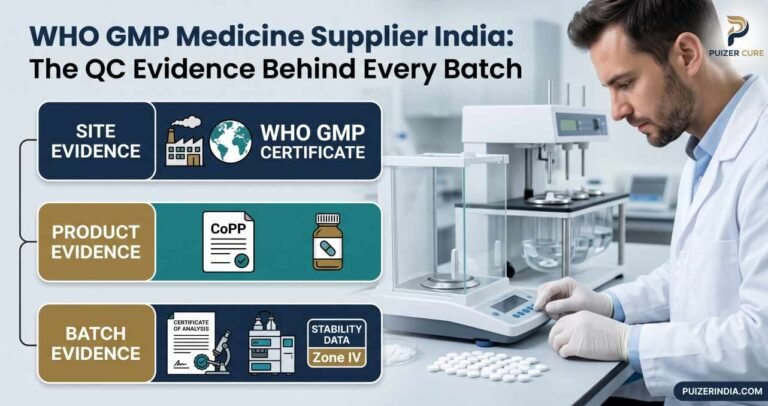
A WHO GMP medicine supplier in India should be able to prove quality at three levels, not one: the site (a current WHO-GMP certificate), the product (a Certificate of Pharmaceutical Product for the exact product and strength), and the batch (a Certificate of Analysis showing every release test and its result, plus stability data at your climatic zone).
Puizer Cure (OPC) Pvt. Ltd. manufactures in Sonipat, Haryana under WHO-GMP and ISO 9001:2015 certification, and tests every batch in its own quality control laboratory before release, with chemistry, microbiology and stability testing on site. This page shows what that evidence looks like, and how to check it.
Compiled September 2026. Company figures (certifications held, product count, years exporting) are as provided by Puizer Cure (OPC) Pvt. Ltd. Regulatory statements are cited to their primary sources below.
If you are comparing Indian exporters for the first time, our post on how to vet a WHO-GMP pharmaceutical exporter from India covers the three certificates to ask for. This page goes one level deeper: what happens inside the quality control laboratory, and which batch papers prove it happened.
01 · What a certificate proves
Site, product, batch: the three layers of quality evidence
Most sourcing mistakes happen because a buyer accepts evidence from the wrong layer, for example a real site certificate offered as if it proved the quality of one particular consignment. Each document below answers a different question.
Is the factory run to WHO GMP?
Answered by the WHO-GMP certificate and, for broader quality management, ISO 9001:2015. Both describe the facility and its systems, not any single product.
Is this exact product authorised and made at an inspected site?
Answered by the Certificate of Pharmaceutical Product (CoPP) and, where your regulator asks for it, a Free Sale Certificate (FSC).
Did the batch in this shipment pass every release test?
Answered by the Certificate of Analysis (CoA) for that batch number, backed by stability data that shows the product holds its specification through shelf life at your climate.
What each certificate covers, and what it does not
| Document | What it covers | Who issues it | What it does not prove |
|---|---|---|---|
| WHO-GMP certificate | The manufacturing site conforms to WHO good manufacturing practice, the standard set out in WHO’s GMP main principles[1]. | In India, the drug regulators, under the WHO Certification Scheme. Applications are reviewed and inspected jointly by CDSCO zonal or sub-zonal officers and the State Licensing Authority[2]. WHO itself does not issue these certificates, and they may not carry the WHO logo[3]. | That a product is registered in your country, or that WHO has prequalified it. WHO-GMP and WHO prequalification are different things. |
| ISO 9001:2015 | The company’s quality management system: document control, corrective and preventive action, internal audit, management review. | An independent certification body. | GMP compliance. ISO 9001 is a general quality-management standard used across all industries; it does not set pharmaceutical manufacturing requirements. |
| CoPP | A specific product: its marketing authorisation status in the exporting country, and that the site is subject to GMP inspection at suitable intervals[3]. | The exporting country’s competent authority, in the WHO-recommended format[3]. | The quality of an individual batch. A CoPP is product-level, not consignment-level. |
| Certificate of Analysis | One batch: every release-specification test, its acceptance criteria and the result[3]. | The manufacturer. WHO’s scheme calls this the batch certificate and notes it is normally issued by the manufacturer[3]. | Anything about a different batch number. Always match the CoA batch number to the pack in your warehouse. |
India notified a revised Schedule M (good manufacturing practice rules) on 28 December 2023. Large manufacturers had to comply from 28 June 2024; the deadline for small and medium manufacturers was extended to 31 December 2025, conditional on filing an upgrade plan[4]. When you audit any Indian supplier in 2026, ask how its site meets revised Schedule M, not only whether it holds a WHO-GMP certificate.
ISO 9001 is being revised and the 2026 edition will replace ISO 9001:2015, with a transition period for certified organisations[5]. Certification bodies expected publication in September 2026 and a transition of about three years, to be confirmed by the International Accreditation Forum[6]. An ISO 9001:2015 certificate therefore remains valid during the transition. Check its expiry date as you would any other certificate.
02 · Inside the QC laboratory
Quality control in pharmaceutical manufacturing: five checkpoints before a batch ships
Under WHO GMP, no batch may be released for sale until an authorised person certifies it, and the heads of production and quality must be independent of each other[1]. That independence is what gives a quality control laboratory in India, or anywhere else, the power to reject a batch. Here is what each checkpoint involves, and what document you can ask to see.
Raw material testing
Every consignment of active ingredient, excipient and packaging material is checked at receipt, at minimum for the integrity of package and seal and for agreement between the order, the delivery note and the supplier’s label[1]. Materials stay in quarantine until QC samples them and tests them against their specification.
- Identity testing of the active ingredient against the pharmacopoeial or in-house specification.
- Assay, related substances and physical tests as the specification requires.
- Supplier CoA reviewed against the result obtained in our own laboratory, not accepted on trust.
Ask to see: the raw-material specification and the approved-supplier record for the active ingredient in your product.
In-process checks
In-process controls are checks made during production to monitor the process and, if needed, adjust it so the product meets its specification. WHO GMP requires the master formula to state each in-process control and its limits[1].
- Tablets and capsules: weight variation, hardness, thickness, friability and disintegration at set intervals during compression or filling.
- Oral liquids and dry syrups: pH, fill volume or fill weight, and appearance.
- Ointments: fill weight and appearance of tubes.
Ask to see: a completed batch manufacturing record with the in-process results entered and signed.
Finished product analysis
Every batch is tested against the full finished-product specification before release. For a typical tablet this covers description, identification, assay, related substances where specified, uniformity of dosage units and dissolution.
- Assay and impurities are usually run by high-performance liquid chromatography (HPLC).
- Dissolution shows the medicine releases its active ingredient as it should. The test method is harmonised across the European, Japanese and United States pharmacopoeias through ICH Q4B[7].
- Residual solvents, where the specification requires them, are typically tested by gas chromatography (GC).
Ask to see: the CoA for your batch, and on request the chromatograms behind the assay result.
Microbiological testing
Tablets, syrups and ointments are not sterile, but they must stay within microbial limits. The tests are total aerobic microbial count (TAMC), total combined yeasts and moulds count (TYMC) and tests for specified organisms such as Escherichia coli. The acceptance criteria are harmonised through ICH Q4B, which recognises the European, Japanese and United States pharmacopoeia texts as interchangeable[8].
- Oral liquids and topical products carry the highest microbial risk, so they receive the closest attention.
- Purified water, used in almost every liquid product, is monitored as part of the same programme.
Ask to see: the microbial limit test result on the CoA and the most recent water-system trend summary.
Stability studies
Stability data is what supports the expiry date printed on the pack. WHO’s stability guideline sets accelerated testing at 40 °C ± 2 °C / 75 % RH ± 5 % RH, and long-term testing at 25 °C / 60 % RH, 30 °C / 65 % RH or 30 °C / 75 % RH. It notes that several hot and humid countries now require up to 30 °C / 75 % RH[9].
- For African markets, what matters is data at the long-term condition your regulator requires, not at the 25 °C condition used for temperate markets.
- An ongoing stability programme keeps testing marketed batches, and adverse trends are reviewed each year in the product quality review[1].
Ask to see: a stability summary stating the storage condition, time points and results. Our guide to climate-zone stable packaging for export explains how the pack is validated against these conditions.
Puizer manufactures tablets, capsules, oral liquids, dry syrups and ointments at its own Sonipat facility. Injections are supplied through third-party manufacturing. For those products, the GMP certificate, CoPP and batch documents relate to the site where the product is actually made, and we name that site before you order.
03 · Visual evidence
Facility, laboratory and batch paperwork
Photographs are a starting point, not proof. The documents behind them are what a regulator or an auditor will check. Qualified buyers can request a live video walkthrough or an on-site audit.



What a Certificate of Analysis should contain
The layout below is illustrative only. It shows the fields a complete CoA carries; it contains no real batch or client data. The model batch certificate in WHO’s scheme lists every release parameter with its acceptance criteria and the result obtained, and cross-refers to the CoPP number[3].
| Field | What to check |
|---|---|
| Product, strength, pack | Identical to your purchase order and to the CoPP |
| Batch no., mfg. and expiry date | Identical to the printed pack you received |
| Specification reference | Pharmacopoeia and edition, or in-house specification number |
| Each test, limit and result | Numeric results, not only the word “complies”, for assay, dissolution and impurities |
| Microbial limits | Reported for non-sterile products where the specification requires them |
| Release statement and signatory | Named, dated signature of the authorised QC or QA person |
Field layout only. Applicable quality and shipment documents are confirmed per order and destination market.
04 · Batch testing documentation
Which documents does your purchase need?
The right document pack depends on who is buying and why. Select your buyer type and the product category to see the documents to request and the point where most files fail.
The Global Fund’s quality assurance policy requires antiretroviral, anti-tuberculosis and antimalarial products to be WHO-prequalified, authorised by a stringent or WHO-listed regulatory authority, or recommended by its Expert Review Panel. All other products need only meet the standards of the regulator in the country of use[10]. A WHO-GMP certificate issued in India does not, on its own, meet the stricter standard. Tell us the funding source at enquiry so we can say plainly whether a product qualifies.
Choose a buyer type and a product category
- Your document pack appears here once both answers are selected.
Tip: answer for the buyer who will hold the product registration or sign the purchase order.
Country-specific requirements are set out in our registration guides for Kenya’s Pharmacy and Poisons Board, Tanzania’s TMDA and Uganda’s NDA. For the full shipment paper trail, including the Free Sale Certificate and certificate of origin, see the pharmaceutical export documentation checklist.
05 · Due diligence
How to verify any supplier’s quality claims, including ours
- Match the site address. The WHO-GMP certificate must name the site that makes your product. For Puizer’s own products that is Sonipat, Haryana.
- Check the dates. Every certificate carries an issue date and an expiry or validity statement. An expired certificate is not evidence.
- Match product to paper. The product name, strength and pack on the CoPP must match your purchase order line by line.
- Ask for a batch-specific CoA with numeric results, and check the batch number against the delivered packs.
- Ask for stability data at your climate, with the storage condition stated on the summary.
- Audit the site by video walkthrough or in person before a first large order or a tender award.
Certificate copies are shared with qualified buyers during due diligence under our document-control procedure, so each copy is tied to a named enquiry rather than circulated as a generic file.
06 · Common questions
Frequently asked questions
It means Indian regulators have inspected the manufacturing site and certified that it follows WHO good manufacturing practice. The certificate is issued by the national and state authorities under the WHO Certification Scheme, not by WHO itself. It covers the site, not the registration status of a product in your country.
No. WHO-GMP certification concerns the manufacturing site and is issued by the exporting country’s regulator. WHO prequalification is a separate WHO assessment of a specific product. Donor-funded procurement of antiretroviral, anti-tuberculosis and antimalarial products generally requires prequalification or an equivalent stringent authorisation.
ISO 9001:2015 certifies a general quality management system and applies to any industry. It does not set pharmaceutical manufacturing requirements such as validation, cleanroom controls or batch release. WHO-GMP does, so African regulators look for GMP evidence first and treat ISO 9001 as supporting evidence.
Each batch ships with a Certificate of Analysis showing every release test, its limit and its result. Product-level documents such as the CoPP and Free Sale Certificate, and stability data, are supplied for registration and on request. The exact pack depends on the destination regulator and the buyer.
Yes, stability summaries can be shared with qualified buyers for the products being quoted. Tell us the destination country so we can confirm which long-term storage condition the data covers, for example 30 degrees Celsius at 65 or 75 percent relative humidity.
Yes. Qualified buyers, tender committees and programme quality-assurance teams can request a live video walkthrough of the facility and laboratory, or arrange an on-site audit at Sonipat, Haryana. Request it through the export enquiry form or by email to the export team.
Related on Puizer
Keep reading
Next step
Request the WHO-GMP certificate and product catalogue
Send your target country, buyer type and the products you are evaluating. We will share the current WHO-GMP and ISO 9001:2015 certificates, the product catalogue, and the CoPP and stability status for the products you name.
References
- World Health Organization. Annex 2: WHO good manufacturing practices for pharmaceutical products: main principles. In: WHO Expert Committee on Specifications for Pharmaceutical Preparations, forty-eighth report. WHO Technical Report Series No. 986. Geneva: WHO; 2014. Available from: https://www.who.int/publications/m/item/trs986-annex2. Accessed September 2026.
- Medical Dialogues. CDSCO updates procedure for issuance of WHO GMP. 15 March 2020. Secondary report of a CDSCO procedure notice. Available from: https://business.medicaldialogues.in/pharma-news/cdsco-updates-procedure-for-issuance-of-who-gmp-63901. Accessed September 2026.
- World Health Organization. Annex 9: Guidelines on the implementation of the WHO certification scheme on the quality of pharmaceutical products moving in international commerce. WHO Technical Report Series No. 1033. Geneva: WHO; 2021. Available from: https://cdn.who.int/media/docs/default-source/medicines/norms-and-standards/guidelines/inspections/trs1033_annex9_guidelines-on-implementation-of-cpp.pdf. Accessed September 2026.
- Press Information Bureau, Ministry of Health and Family Welfare, Government of India. Conditional extension of timeline to small and medium pharmaceutical manufacturers for compliance with revised Schedule M notification. New Delhi: PIB; 12 February 2025. Available from: https://www.pib.gov.in/PressReleaseIframePage.aspx?PRID=2102291. Accessed September 2026.
- International Organization for Standardization. ISO 9001:2026 Quality management systems: Requirements (project status page). Geneva: ISO; 2026. Available from: https://www.iso.org/standard/88464.html. Accessed September 2026.
- LRQA. ISO 9001 revision update: publication date confirmed. LRQA; 2026. Available from: https://www.lrqa.com/en-ae/latest-news/iso-9001-revision-update-publication-date-confirmed/. Accessed September 2026.
- US Food and Drug Administration. Q4B Annex 7(R2): Dissolution Test General Chapter. Guidance for industry (ICH). Silver Spring: FDA; 2011. Available from: https://www.fda.gov/regulatory-information/search-fda-guidance-documents/q4b-annex-7-r2-dissolution-test-general-chapter. Accessed September 2026.
- US Food and Drug Administration. Q4B Annex 4C: Microbiological Examination of Non-Sterile Products: Acceptance Criteria for Pharmaceutical Preparations and Substances for Pharmaceutical Use General Chapter. Guidance for industry (ICH). Silver Spring: FDA; 2009. Available from: https://www.fda.gov/regulatory-information/search-fda-guidance-documents/q4b-annex-4c-microbiological-examination-non-sterile-products-acceptance-criteria-pharmaceutical. Accessed September 2026.
- World Health Organization. Annex 10: Stability testing of active pharmaceutical ingredients and finished pharmaceutical products. WHO Technical Report Series No. 1010. Geneva: WHO; 2018. Available from: https://www.who.int/docs/default-source/medicines/norms-and-standards/guidelines/regulatory-standards/trs1010-annex10-who-stability-testing-of-active-pharmaceutical-ingredients.pdf. Accessed September 2026.
- The Global Fund. Quality Assurance Policy for Pharmaceutical Products. Amended and restated 15 November 2023 (GF/B50/DP06). Geneva: The Global Fund; 2023. Available from: https://www.theglobalfund.org/media/0jmj2qqn/psm_qa-pharmaceutical-products_policy_en.pdf. Accessed September 2026.
This page is technical and educational information for pharmaceutical buyers. It is not legal, regulatory or medical advice. Certificate status, product range and market focus reflect Puizer Cure (OPC) Pvt. Ltd.’s position as of September 2026 and may change. Pharmacopoeial texts, WHO guidance and Indian statutory rules are revised frequently, and registration requirements differ by country and product. Confirm specifics with your national regulatory authority and with Puizer before placing an order.