
Essential generic medicines from India: the short answer
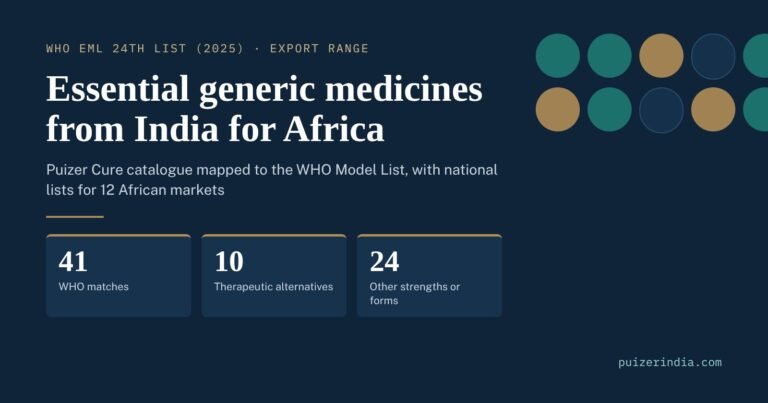
Puizer Cure’s essential generic medicines range is the part of its 590+ product export catalogue that maps to the WHO Model List of Essential Medicines, 24th list (2025).[1] We checked 75 catalogue products against that list: 41 match a WHO entry in molecule, dosage form and strength, 10 sit in a class WHO accepts as a therapeutic alternative, and 24 are WHO-listed molecules in a strength or form the WHO list does not carry. Tablets and capsules are made at our WHO-GMP facility in Sonipat, Haryana; oral liquids and topicals at a partner facility under a loan licence.
What makes a generic an “essential medicine”
An essential medicine is one that WHO’s Expert Committee places on the Model List of Essential Medicines (EML). The current edition is the 24th list, released in September 2025 together with the 10th list for children, after the 25th Expert Committee met in Geneva in May 2025.[2],[6] Three markers on the list change what a buyer can tender for:[1]
Core and complementary
The core list is the minimum set of medicines for a basic health system. The complementary list covers medicines that need specialist diagnosis, monitoring or care.
The [c] marker
A [c] next to a medicine or a strength restricts that entry to children. Ciprofloxacin 100 mg and paracetamol oral liquid 250 mg/5 mL are examples.
The square box
A square box marks therapeutic alternatives: other medicines in the same class (often the 4th level of the ATC classification) with similar effectiveness and safety. Atorvastatin, for example, is listed as an alternative to simvastatin.
Strength is part of the entry. WHO lists each medicine with specific dosage forms and strengths. It also warns that having both 120 mg/5 mL and 125 mg/5 mL paracetamol oral liquid on one market confuses prescribing and dispensing.[1] Quote the strength your national list carries, not the nearest one.
Your national essential medicines list decides the tender
The WHO list is a model. Each country adapts it into its own national essential medicines list (nEML), and public procurement follows that national list. In April 2025 WHO opened a repository of 150 national lists from all six WHO regions, 47 of them from the African Region.[3] These are the latest editions it holds for the markets our buyers write from:[4]
| Country | Latest list in the WHO repository | Registration guide on Puizer Cure |
|---|---|---|
| Kenya | Essential Medicines List 2023 | PPB Kenya drug registration |
| Uganda | Essential Medicines and Health Supplies List for Uganda (EMHSLU) 2023 | Uganda NDA registration |
| Tanzania | National Essential Medicines List (NEMLIT) 2026 | TMDA drug registration |
| Rwanda | National List of Essential Medicines for Adults 2022 | Rwanda FDA drug registration |
| Ethiopia | Essential Medicines List 2024 | EFDA drug registration |
| Zambia | Essential Medicines List 2025 | ZAMRA drug registration |
| Nigeria | Essential Medicines List 2024 | NAFDAC drug registration |
| Ghana | National Health Insurance Scheme (NHIS) Medicines List 2025 | FDA Ghana product registration |
| DR Congo | Liste Nationale des Médicaments Essentiels 2020 (French) | — |
| Burkina Faso | Liste Nationale des Médicaments Essentiels 2023 (French) | — |
| Cameroon | National list of medicines and pharmaceutical products 2022 (French) | — |
| Benin | Liste Nationale des Médicaments Essentiels 2018 (French) | — |
Swipe the table sideways to see all columns →
The repository can lag behind a ministry’s latest revision. Before you tender, confirm the edition in force with the ministry of health or the procurement agency.
Essential generics range by therapeutic group
Each row is a product from our export product catalogue, set against its entry on the WHO 24th list.[1] Your quotation confirms the label claim, pack and shelf life for each SKU.
- WHO match Same molecule, dosage form and strength as the WHO list.
- Therapeutic alternative In a class the WHO list marks with the square box.
- Other strength or form The molecule is on the WHO list; this strength or form is not. Many national lists still carry it.
Anti-infectives
| Puizer product | Status | WHO 24th list entry | Made at |
|---|---|---|---|
| Azithromycin tablets 250 mg | WHO match | Solid oral dosage form: 250 mg; 500 mg | Sonipat (WHO-GMP) |
| Azithromycin tablets 500 mg | WHO match | Solid oral dosage form: 250 mg; 500 mg | Sonipat (WHO-GMP) |
| Azithromycin oral suspension 200 mg/5 mL | WHO match | Powder for oral liquid: 200 mg/5 mL [c] | Partner site (loan licence) |
| Ciprofloxacin tablets 250 mg | WHO match | Solid oral dosage form: 100 mg [c]; 250 mg; 500 mg | Sonipat (WHO-GMP) |
| Ciprofloxacin tablets 500 mg | WHO match | Solid oral dosage form: 100 mg [c]; 250 mg; 500 mg | Sonipat (WHO-GMP) |
| Clarithromycin tablets 250 mg | WHO match | Solid oral dosage form: 250 mg [c]; 500 mg | Sonipat (WHO-GMP) |
| Clarithromycin tablets 500 mg | WHO match | Solid oral dosage form: 250 mg [c]; 500 mg | Sonipat (WHO-GMP) |
| Metronidazole tablets 400 mg | WHO match | Tablet: 200 mg; 250 mg; 400 mg; 500 mg | Sonipat (WHO-GMP) |
| Metronidazole benzoate oral suspension 200 mg/5 mL | WHO match | Oral liquid: 200 mg/5 mL (as benzoate) | Partner site (loan licence) |
| Nitrofurantoin sustained-release tablets 100 mg | WHO match | Solid oral dosage form: 50 mg [c]; 100 mg | Sonipat (WHO-GMP) |
| Levofloxacin tablets 250 mg and 500 mg | WHO match | Tablet: 250 mg; 500 mg; 750 mg (antituberculosis section only) | Sonipat (WHO-GMP) |
| Fluconazole capsules 150 mg; tablets 150, 200, 400 mg | Other strength or form | Capsule: 50 mg; oral liquid: 50 mg/5 mL | Sonipat (WHO-GMP) |
| Terbinafine tablets 250 mg and 500 mg | Other strength or form | Listed as 1% cream or ointment only | Sonipat (WHO-GMP) |
No products in this group for the selected status.
Antimalarials & antiparasitics
| Puizer product | Status | WHO 24th list entry | Made at |
|---|---|---|---|
| Artemether + lumefantrine tablets 80 mg + 480 mg | Other strength or form | Tablet: 20 mg + 120 mg; dispersible 20 mg + 120 mg [c] | Sonipat (WHO-GMP) |
| Artemether + lumefantrine tablets 60 mg + 360 mg | Other strength or form | Tablet: 20 mg + 120 mg; dispersible 20 mg + 120 mg [c] | Sonipat (WHO-GMP) |
| Chloroquine phosphate tablets, 150 mg base | WHO match | Tablet: 150 mg (base) | Sonipat (WHO-GMP) |
| Albendazole tablets 400 mg | WHO match | Tablet (chewable, scored): 400 mg | Sonipat (WHO-GMP) |
| Albendazole oral suspension 200 mg/5 mL | Other strength or form | Listed as chewable tablet only | Partner site (loan licence) |
| Ivermectin tablets 12 mg | Other strength or form | Tablet: 3 mg | Sonipat (WHO-GMP) |
| Permethrin cream 5% | WHO match | Cream: 5%; lotion: 1% | Partner site (loan licence) |
| Permethrin lotion 5% | Other strength or form | Cream: 5%; lotion: 1% | Partner site (loan licence) |
No products in this group for the selected status.
Cardiometabolic
| Puizer product | Status | WHO 24th list entry | Made at |
|---|---|---|---|
| Amlodipine tablets 5 mg | WHO match | Tablet: 5 mg (class alternatives: C08CA dihydropyridines) | Sonipat (WHO-GMP) |
| Losartan potassium tablets 25 mg | WHO match | Tablet: 25 mg; 50 mg; 100 mg | Sonipat (WHO-GMP) |
| Losartan potassium tablets 50 mg | WHO match | Tablet: 25 mg; 50 mg; 100 mg | Sonipat (WHO-GMP) |
| Clopidogrel tablets 75 mg | WHO match | Tablet: 75 mg; 300 mg | Sonipat (WHO-GMP) |
| Bisoprolol fumarate tablets 10 mg | Other strength or form | Tablet: 1.25 mg; 5 mg | Sonipat (WHO-GMP) |
| Atenolol tablets 50 mg | Therapeutic alternative | Alternative to bisoprolol; WHO note: not first-line in uncomplicated hypertension in patients over 60 | Sonipat (WHO-GMP) |
| Atorvastatin tablets 10, 20 and 40 mg | Therapeutic alternative | Alternative to simvastatin (tablet 5 mg to 40 mg) | Sonipat (WHO-GMP) |
| Metformin hydrochloride tablets 500 mg | WHO match | Tablet: 500 mg (hydrochloride) | Sonipat (WHO-GMP) |
| Metformin prolonged-release tablets 500 mg | Other strength or form | Listed as immediate-release tablet 500 mg | Sonipat (WHO-GMP) |
| Gliclazide extended-release tablets 30 mg and 60 mg | WHO match | Controlled-release tablets: 30 mg; 60 mg; 80 mg | Sonipat (WHO-GMP) |
| Gliclazide tablets 80 mg | Other strength or form | WHO entry is controlled-release | Sonipat (WHO-GMP) |
| Glibenclamide tablets 2.5 mg and 5 mg | Therapeutic alternative | Sulfonylurea alternative to gliclazide; WHO note: not suitable above 60 years | Sonipat (WHO-GMP) |
| Levothyroxine sodium tablets 50 micrograms | WHO match | Tablet: 25 micrograms [c]; 50 micrograms; 100 micrograms | Sonipat (WHO-GMP) |
No products in this group for the selected status.
Pain, GI & allergy
| Puizer product | Status | WHO 24th list entry | Made at |
|---|---|---|---|
| Paracetamol tablets 500 mg | WHO match | Tablet: 250 mg; 325 mg; 500 mg | Sonipat (WHO-GMP) |
| Paracetamol tablets 650 mg | Other strength or form | Tablet: 250 mg; 325 mg; 500 mg | Sonipat (WHO-GMP) |
| Paracetamol oral suspension and syrup 125 mg/5 mL | WHO match | Oral liquid: 120 or 125 mg/5 mL; 250 mg/5 mL [c] | Partner site (loan licence) |
| Paracetamol oral suspension and syrup 250 mg/5 mL | WHO match | Oral liquid: 120 or 125 mg/5 mL; 250 mg/5 mL [c] | Partner site (loan licence) |
| Ibuprofen oral suspension 100 mg/5 mL | WHO match | Oral liquid: 100 mg/5 mL [c]; 200 mg/5 mL | Partner site (loan licence) |
| Omeprazole capsules 20 mg | WHO match | Solid oral dosage form: 10 mg; 20 mg; 40 mg | Sonipat (WHO-GMP) |
| Ondansetron tablets 4 mg and orally disintegrating tablets 4 mg | WHO match | Solid oral dosage form: 4 mg; 8 mg | Sonipat (WHO-GMP) |
| Cetirizine hydrochloride tablets 10 mg | Therapeutic alternative | Alternative to loratadine (tablet 10 mg) | Sonipat (WHO-GMP) |
| Fexofenadine tablets 120 mg | Therapeutic alternative | Alternative to loratadine (tablet 10 mg) | Sonipat (WHO-GMP) |
| Prednisolone tablets 10 mg | Other strength or form | Tablet: 5 mg; 25 mg | Sonipat (WHO-GMP) |
| Zinc sulphate oral suspension 20 mg/5 mL | Other strength or form | Tablet (dispersible, scored): 20 mg | Partner site (loan licence) |
No products in this group for the selected status.
CNS
| Puizer product | Status | WHO 24th list entry | Made at |
|---|---|---|---|
| Amitriptyline tablets 25 mg | WHO match | Tablet: 25 mg; 75 mg | Sonipat (WHO-GMP) |
| Amitriptyline tablets 50 mg | Other strength or form | Tablet: 25 mg; 75 mg | Sonipat (WHO-GMP) |
| Fluoxetine capsules 20 mg | WHO match | Solid oral dosage form: 20 mg | Sonipat (WHO-GMP) |
| Levetiracetam tablets 500 mg | WHO match | Tablet: 250 mg; 500 mg; 750 mg; 1000 mg | Sonipat (WHO-GMP) |
No products in this group for the selected status.
Nutrition & haematinics
| Puizer product | Status | WHO 24th list entry | Made at |
|---|---|---|---|
| Folic acid tablets 5 mg | WHO match | Tablet: 400 micrograms; 1 mg; 5 mg | Sonipat (WHO-GMP) |
| Ferrous ascorbate 100 mg + folic acid 1.5 mg tablets | Other strength or form | Ferrous salt eq. 60 mg elemental iron + folic acid 400 micrograms | Sonipat (WHO-GMP) |
| Vitamin A paediatric oral solution 100,000 IU/mL | WHO match | Oral liquid: 100 000 IU/mL (as palmitate) | Partner site (loan licence) |
| Thiamine hydrochloride tablets 100 mg | Other strength or form | Tablet: 50 mg | Sonipat (WHO-GMP) |
| Tranexamic acid tablets 500 mg | Other strength or form | Listed as injection only | Sonipat (WHO-GMP) |
No products in this group for the selected status.
Skin & antiseptics
| Puizer product | Status | WHO 24th list entry | Made at |
|---|---|---|---|
| Miconazole nitrate cream 2% | WHO match | Cream or ointment: 2% (class alternatives: D01AC) | Partner site (loan licence) |
| Clotrimazole cream 1% | Therapeutic alternative | D01AC class alternative to miconazole | Partner site (loan licence) |
| Terbinafine cream 1% | WHO match | Cream or ointment: 1% | Partner site (loan licence) |
| Mupirocin ointment 2% | WHO match | Cream: 2%; ointment: 2% | Partner site (loan licence) |
| Betamethasone dipropionate cream 0.05% | Therapeutic alternative | D07AC class alternative to betamethasone valerate 0.1% | Partner site (loan licence) |
| Povidone-iodine ointment 5% and 10% | Other strength or form | Listed as solution 10% | Partner site (loan licence) |
No products in this group for the selected status.
Where our strength differs from the WHO list
Artemether + lumefantrine
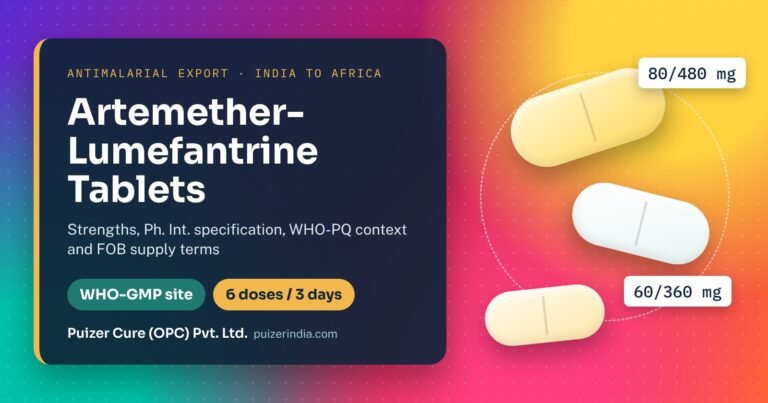
WHO lists 20 mg + 120 mg tablets, plus a dispersible 20 mg + 120 mg tablet for children.[1] We make 80 mg + 480 mg and 60 mg + 360 mg tablets: the same 1:6 ratio in fewer tablets per dose. Check that your national list and treatment guideline carry the higher strength before you register it.
Malaria medicines bought with Global Fund money must be WHO-prequalified, authorised by a stringent regulatory authority or WHO-listed authority, or cleared by its Expert Review Panel.[5] These tablets are offered for private-sector and nationally funded supply, not Global Fund-financed tenders.
Ivermectin, fluconazole, prednisolone
WHO lists ivermectin 3 mg tablets, fluconazole 50 mg capsules and 50 mg/5 mL oral liquid, and prednisolone 5 mg and 25 mg tablets.[1] Our ivermectin is 12 mg, fluconazole 150 mg to 400 mg, and prednisolone 10 mg. These register as separate products from the WHO strengths.
Levofloxacin
On the WHO list, levofloxacin 250 mg and 500 mg tablets appear only under antituberculosis medicines.[1] Public demand for it usually comes through national TB programmes rather than general antibiotic tenders.
A new strength is a new product
If your list needs a strength we do not make, it needs formulation work, stability data for your climatic zone and its own registration. Ask early, with the list, so the timeline is quoted honestly. See Zone IVb packaging and stability for export.
Essential medicines not in the current catalogue
These appear on most African essential medicines lists, but the current catalogue does not carry them. The tender-list matcher below flags them, so you can source them elsewhere or ask us.
- Amoxicillin, amoxicillin + clavulanic acid
- Sulfamethoxazole + trimethoprim (co-trimoxazole)
- Oral rehydration salts (ORS)
- Mebendazole, praziquantel
- Cefalexin, cefixime and other cephalosporins
- Doxycycline (single-ingredient)
- Injectables: not in this catalogue; quoted separately through third-party manufacture
Match your essential medicines tender list
The matcher checks only the essential generics range on this page, by molecule name. A product it misses may still be in the full catalogue. Nothing you paste is stored or sent anywhere unless you tap WhatsApp.
Where each product is made, and typical MOQ
| Dosage form | Where it is made | Indicative MOQ per SKU |
|---|---|---|
| Tablets | Puizer’s WHO-GMP facility, Sonipat | 100,000–300,000 tablets (1,000–3,000 boxes of 10×10) |
| Capsules | Puizer’s WHO-GMP facility, Sonipat | 100,000–200,000 capsules (1,000–2,000 boxes of 10×10) |
| Oral liquids | Partner facility under loan licence | 5,000–10,000 bottles |
| Creams and ointments | Partner facility under loan licence | 5,000–10,000 tubes |
Swipe the table sideways to see all columns →
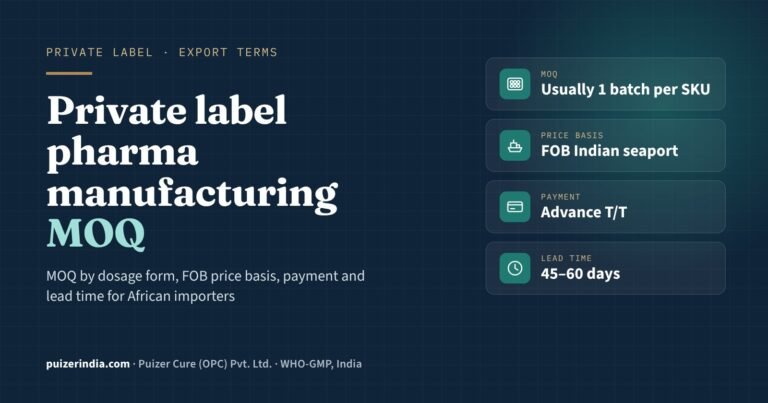
These are planning bands, not fixed minimums. Prices are quoted FOB an Indian port, payment is by advance T/T, and private-label lead time is 45–60 days after artwork approval. The full terms are in private label MOQ and commercial terms; for delivered cost, use the landed cost calculator.
Documents to ask for with each essential medicine
- Certificate of Analysis for every batch, and the batch records behind it. See our WHO-GMP batch QC evidence.
- WHO-GMP certificate and Certificate of Pharmaceutical Product (CoPP) for the site that makes the product, plus a Free Sale Certificate where your regulator asks for one. The export documentation checklist lists what goes with each shipment.
- Stability data for your climatic zone, and a plan for independent testing or pre-shipment inspection: how to verify medicine quality before import.
Liquids and topicals: their certificates are issued for the partner facility, not Sonipat. Confirm with the export desk which registration documents are available for a liquid or topical product before you plan its registration.
Essential generic medicines: questions buyers ask
No. Of the 75 catalogue products mapped on this page, 41 match a WHO 24th list entry exactly, 10 are WHO therapeutic alternatives and 24 are WHO molecules in another strength or form. Most of the rest of the 590+ catalogue are fixed-dose combinations and other molecules made for markets whose national lists include them.
The WHO Model List of Essential Medicines, 24th list (2025), read from the published list on 28 October 2026. Tenders follow your national list, so check the edition your ministry uses as well.
No. The Global Fund requires malaria medicines bought with its funds to be WHO-prequalified, authorised by a stringent or WHO-listed regulatory authority, or cleared by its Expert Review Panel. Our 80 mg + 480 mg and 60 mg + 360 mg tablets are offered for private-sector and nationally funded supply after registration in your country.
WHO marks some medicines with a square box. Other medicines in the same class, often at the 4th ATC level, with similar effectiveness and safety may be selected for a national list instead. Atorvastatin for simvastatin and cetirizine for loratadine are examples in this range.
Sometimes. A strength we do not make is a new product: it needs formulation, stability data for your climatic zone and its own registration. Send the list and we will say which items are feasible and on what timeline.
At a partner facility under a loan licence. Tablets and capsules are made at Puizer’s WHO-GMP facility in Sonipat, Haryana. Certificates for liquids and topicals are issued for the partner site.
Prices are quoted FOB an Indian port and payment is by advance T/T. MOQ is quoted per SKU; tablets typically start at 100,000 to 300,000 units.
Send your essential medicines list for a quotation
Send the list with strengths, pack sizes, quantities and destination country. We reply with what we make, the WHO and national-list status of each item, MOQ and FOB price.
Email: support@puizerindia.com · Puizer Cure (OPC) Pvt. Ltd., Sonipat, Haryana, India
Related on Puizer Cure
References
- World Health Organization. The selection and use of essential medicines, 2025: WHO Model List of Essential Medicines, 24th list. Geneva: WHO; 2025. Available from: https://www.who.int/groups/expert-committee-on-selection-and-use-of-essential-medicines/essential-medicines-lists. Accessed October 2026.
- World Health Organization. WHO updates list of essential medicines to include key cancer, diabetes treatments [news release]. Geneva: WHO; 5 September 2025. Available from: https://www.who.int/japan/news/detail-global/05-09-2025-who-updates-list-of-essential-medicines-to-include-key-cancer–diabetes-treatments. Accessed October 2026.
- World Health Organization. WHO unveils global repository for National Essential Medicines Lists (nEMLs) [news]. Geneva: WHO; 8 April 2025. Available from: https://www.who.int/news/item/08-04-2025-who-unveils-global-repository-for-national-essential-medicines-lists-(nemls). Accessed October 2026.
- World Health Organization. Repository of National Essential Medicines Lists (nEMLs). Geneva: WHO. Available from: https://www.who.int/teams/health-product-policy-and-standards/assistive-and-medical-technology/essential-medicines/national-emls. Accessed 28 October 2026.
- The Global Fund. Medicines: quality assurance requirements (Quality Assurance Policy for Pharmaceutical Products, November 2023). Geneva: The Global Fund. Available from: https://www.theglobalfund.org/en/sourcing-management/quality-assurance/medicines/. Accessed October 2026.
- World Health Organization. The selection and use of essential medicines: report of the WHO Expert Committee on Selection and Use of Essential Medicines, 2025 (WHO Technical Report Series, No. 1064). Geneva: WHO; 2026. ISBN 978-92-4-011974-1. Available from: https://www.who.int/publications/i/item/9789240119741. Accessed October 2026.
This page is technical and commercial information for licensed importers, distributors and procurement agencies. It is not medical advice. The WHO Model List and national essential medicines lists are revised periodically; check the current edition before tendering. Product availability, strengths and documents are confirmed in each quotation.