
Prospectus · Country guide · West Africa
FDA Ghana Product Registration: The Indian Exporter’s Guide
How to register a medicine with Ghana’s Food and Drugs Authority from an Indian site — the CTD dossier, the GMP evidence FDA Ghana actually wants, the local representative, the fees in US dollars, realistic timelines, and the products that are closed to import before you start.
How to register a product with FDA Ghana, in six steps
- Check the product can be imported at all — 49 generics are reserved for local manufacture, and FDA Ghana has not registered some opioids.
- Appoint one local representative: a Ghana-incorporated company authorised by FDA Ghana to import, holding a wholesale dealer’s licence.
- Build the dossier in CTD format, with Zone IVb stability data (30 °C/75 % RH) and bioequivalence for generics.
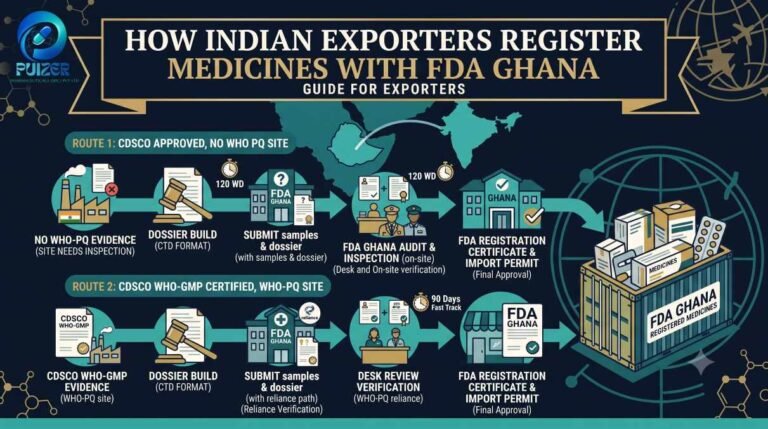
- Prove GMP: a desk review if the site is WHO-prequalified, otherwise plan for an FDA Ghana on-site inspection of the Indian plant.
- Submit with samples and fees: routine review runs to 120 working days; fast-track 90 calendar days for qualifying products.
- After registration, your importer takes an import permit (valid one calendar year) and clears through Tema port or Kotoka airport.
Who FDA Ghana is, and what ML3 means for an exporter
The Food and Drugs Authority (FDA Ghana) is benchmarked by WHO at Maturity Level 3 — a stable, well-functioning, integrated regulatory system. WHO’s current list (as of August 2026) records Ghana at ML3 for medicines since 2020 and for vaccines (as a non-producing country) since 2025 [1]. When the medicines benchmark was announced in May 2020, Ghana and Tanzania were the only two ML3 authorities in WHO’s 47-country African Region [2].
For an Indian exporter, ML3 has a practical meaning: the review is real. Expect a full CTD assessment, a structured query cycle and a GMP decision on your site — not a paperwork stamp. It also means FDA Ghana is a credible reference authority for other markets, a point our Rwanda FDA registration guide covers in its ML3 comparison.
The legal frame: Public Health Act, 2012 (Act 851)
- Section 117 — registration is applied for “in the prescribed manner” with the prescribed fees.
- Section 118 — FDA Ghana registers a drug when satisfied it meets the prescribed standards.
- Section 119 — registration can be suspended or cancelled if submitted information changes or proves inaccurate.
- Section 120 — no drug may be imported without a certificate from the competent authority of the exporting country [3]. For India, that is the WHO-format Certificate of Pharmaceutical Product (CoPP), which the registration guideline also lists as a dossier document [4].
Which FDA Ghana route applies to your product?
FDA Ghana runs three review speeds. Fast-track (90 calendar days) covers WHO-prequalified products, programme drugs — antiretrovirals, antimalarials, TB medicines, reproductive-health products and medicines for neglected tropical diseases — and products registered by stringent authorities that were ICH members before 2015 [5]. A reliance verification pathway, built on the reference authority’s full assessment report, targets 60 working days; the routine pathway targets 120 working days, both excluding clock stops [6]. Answer three questions to see where a product lands.
- The verdict names the review pathway, the GMP route, the target timeline and the cost driver to budget for.
This selector is a planning aid built from FDA Ghana’s published guidelines, not a regulatory determination. Confirm the pathway in writing with FDA Ghana through your local representative before you commit budget.
What FDA Ghana asks for: the CTD, module by module
FDA Ghana’s registration guideline (FDA/DNC/GDL-01/03, version 02, effective 8 January 2024) makes the ICH Common Technical Document mandatory and tells applicants not to alter its overall organisation. The submission is two electronic copies in PDF, with Module 2.3 also supplied as an MS Word file [4].
Module 1: the Ghana-specific administrative file
- Application form and proof of fee payment.
- A valid manufacturing licence for each site involved in production [4].
- A valid Certificate of Pharmaceutical Product; where the API carries one, the latest valid European Certificate of Suitability (CEP).
- The local representative’s authorisation and its FDA import authority and wholesale dealer’s licence.
- Labels and patient information leaflet in English — legible, indelible and comprehensible — following FDA Ghana’s templates.
- Samples per FDA Ghana’s sample schedule, with at least 60 % of shelf life remaining (80 % where shelf life is under 24 months).
The export paperwork behind these items — CoPP, WHO-GMP certificate, CoA — is mapped in our pharmaceutical export documentation checklist.
Modules 2–3: quality, and the stability trap for Indian dossiers
FDA Ghana’s stability guideline (FDA/DNC/GDL-03/02) asks for at least 12 months of long-term data and 6 months accelerated (40 °C/75 % RH) at submission, on a minimum of three primary batches of the finished product, two of them at least pilot scale [7].
The long-term condition is set by where the product will be stored. WHO’s table of stability conditions lists Ghana at 30 °C/75 % RH (Zone IVb) — while it lists India at 30 °C/70 % RH [8]. A dossier built only on Indian domestic stability data will not match what Ghana expects. Run 30/75 studies, and pick packaging that holds up at that humidity: see climate-zone stable packaging for export.
Modules 4–5: bioequivalence for generics
For a generic, the clinical module carries the bioequivalence evidence. FDA Ghana’s guideline treats two products as bioequivalent when they are pharmaceutical equivalents or alternatives whose rate and extent of availability, after administration in the same molar dose, are similar [4]. FDA Ghana publishes a separate guideline on conducting BE studies; check the reference product and study design against it before you commission a study.
A BE study is the single largest cost in most generic files. Confirm FDA Ghana will accept your study’s reference product before submission — a reference-product mismatch is far cheaper to fix on paper than after a deficiency letter.
GMP evidence for an Indian site
The registration guideline is direct: only products made entirely at sites FDA Ghana considers cGMP-compliant are eligible [4]. FDA Ghana’s inspection-waiver notice (FDA/DID/NOT-01) waives the on-site audit for manufacturers in ICH member countries and for WHO-prequalified manufacturing facilities, which must then use the Collaborative Registration Procedure [9]. A site whose GMP standing rests on a CDSCO WHO-GMP certificate sits outside both categories, so plan for an FDA Ghana inspection unless FDA Ghana confirms otherwise in writing.
For a desk review, the waiver notice lists what to send:
- Manufacturing authorisation, with certified English translations where needed.
- Site Master File not older than one year from its approval date.
- Full product list, and the latest inspection reports and GMP certificates.
- Any warning letters or regulatory actions, with CAPA evidence against inspection observations.
- Recent Annual Product Quality Reviews, batch manufacturing and packaging records, and three years of recall history.
Even where an inspection follows, assembling this pack first is the best inspection preparation there is. What WHO-GMP certification does and does not prove to an African buyer is set out in what WHO-GMP certification means for African importers.
The local representative, and who holds the registration
The applicant is the product owner
FDA Ghana defines the applicant as the product owner or licence holder. A representative cannot present itself as the applicant unless it owns the product [4]. For an Indian manufacturer, that keeps the registration in your name — protect it in the distribution agreement.
One local representative, three tests
Every non-resident applicant appoints one local representative that is (1) incorporated in Ghana, (2) authorised by FDA Ghana to import medicinal products and (3) holds a wholesale dealer’s licence [4].
Importing is a separate licence chain. FDA Ghana’s importation guideline (FDA/DNC/GDL-10/02) permits import of registered medicines only, by licensed entities such as wholesalers registered with both the Pharmacy Council and FDA Ghana. Each consignment needs an import permit, obtained on FDA Ghana’s electronic platform and valid for one calendar year, and medicines enter through Tema port or Kotoka International Airport [10]. Choose a representative that can also act as your importer of record: splitting the two roles adds a hand-off at every consignment.
FDA Ghana fees, in US dollars
Fees are set by the Fees and Charges (Miscellaneous Provisions) Regulations, 2023 (L.I. 2481) and are payable in the cedi equivalent of the US-dollar amount for imported products [11].
Scroll the table sideways →
| Fee item (imported products) | Basis | Amount |
|---|---|---|
| Registration — allopathic medicinal product | Per annum | US$ 240 |
| Registration — allopathic new chemical product | Per annum | US$ 360 |
| Registration — orphan drug | Per annum | US$ 60 |
| Foreign GMP inspection — site outside Africa (India) | Per inspection | US$ 10,500 |
| Foreign GMP inspection — rest of Africa | Per inspection | US$ 8,000 |
| Foreign GMP inspection — West Africa | Per inspection | US$ 6,000 |
| Variation — major | Per application | US$ 500 |
| Variation — minor | Per application | US$ 300 |
What the numbers mean for a launch plan
The inspection fee is charged per inspection while registration is charged per product, so the economics favour a basket. Illustratively, on the published schedule and assuming the registration fee applies to each product: one product from a non-prequalified Indian site costs about US$ 10,740 in FDA fees in year one (US$ 10,500 + US$ 240); five products from the same site cost about US$ 11,700 — roughly US$ 2,340 each. These are FDA Ghana fees only. They exclude the BE study, samples, the local representative’s charges and import verification charges on FOB value, and the schedule does not say whether inspectors’ travel is billed separately — ask FDA Ghana in writing.
From dossier to first shipment: the FDA Ghana route
- Screen the productCheck it is not on the local-manufacture list or a controlled-substance exclusion (section 07).
- Appoint the local representativeGhana-incorporated, FDA-authorised importer, wholesale dealer’s licence.
- Build the Ghana CTD30/75 stability, BE, English labels, CoPP and samples.longest lead time: stability
- Submit and payTwo electronic copies in PDF; Module 2.3 in Word as well.
- GMP decisionDesk review for WHO-PQ sites; on-site inspection otherwise.US$ 10,500 if inspected
- Evaluation and queriesAssessment, then the Drug Registration Committee.120 wd routine90 days fast-track60 wd reliance
- Register, permit, shipImport permit valid one calendar year; entry via Tema or Kotoka.
Targets are not guarantees. An FDA Ghana–co-authored study of 2019–2021 found the authority met its own targets, with generics approved faster than new active substances — but approval times for new active substances rose from 84 to 355 calendar days over the period, which the authors linked to the pandemic [12]. A 2025 review also reported that applicants cannot track a submission electronically and must follow up in person [13], which is one more reason a capable local representative matters.
If an application is rejected, the reliance guideline provides for an appeal to the Minister of Health within 30 working days [6]. The 2024 registration guideline we reviewed does not state the registration validity period; read it from your registration certificate and diarise the renewal.
Products that are closed, or nearly closed, to import
Local-manufacture list (E.I. 181). Executive Instrument 181 of 10 May 2017 restricted 49 medicines to local manufacture; innovator brands of the listed medicines were exempted [14]. FDA Ghana’s 2024 importation guideline still references the list, which includes common molecules such as amoxicillin, paracetamol and diazepam [10]. Check the current list before you spend a dollar on a dossier.
A proposed expansion. In February 2024, Ghana’s pharmacy and importer bodies publicly asked the Ministry of Health to suspend a 2023 Executive Instrument that would restrict a further 142 medicines [15]. We could not confirm its current status — verify it through your local representative before choosing products.
Opioids and controlled products. In February 2025 FDA Ghana stated it has not registered tapentadol or carisoprodol as single-ingredient products. It also reported that tramadol was reclassified as prescription-only under Executive Instrument 168 (2018) and that codeine-containing cough syrups have been banned under Executive Instrument 167 since 2018 [16]. Ghana is not a market for these products, whatever an importer suggests.
Ghana in the West African picture
Ghana is the second West African guide in this series after Nigeria. The two authorities share a benchmark — both are at WHO ML3 [1] — and FDA Ghana’s reliance guideline names the ECOWAS medicines-regulatory harmonisation initiative among the regional bodies whose work it may rely on [6]. They do not share a dossier: Nigeria routes import through NAFDAC registration and pre-shipment inspection, while Ghana’s decisive step for an Indian site is usually FDA Ghana’s own GMP inspection.
If Nigeria is also on your list
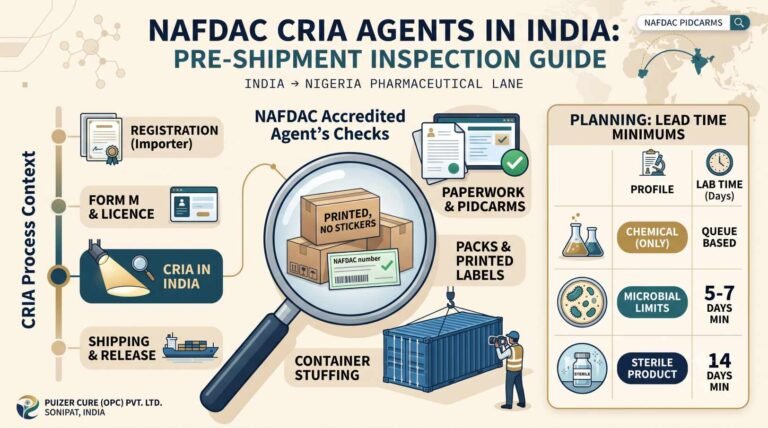
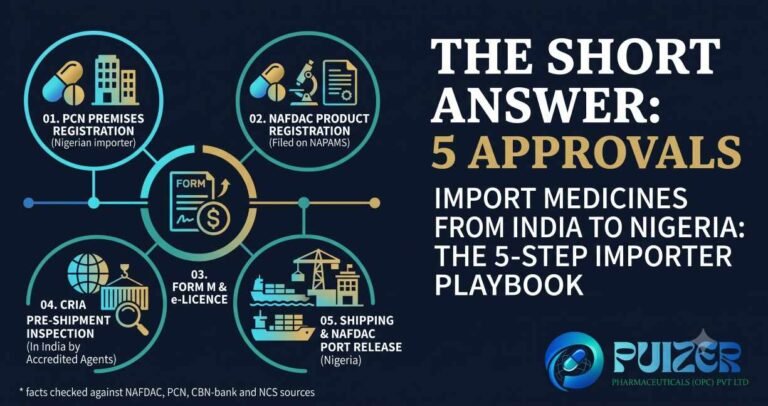
Read the NAFDAC drug registration process guide and how NAFDAC CRIA pre-shipment inspection agents in India fit in.
If you are choosing a first market
Compare Ghana with the East and Southern African routes in the pharmaceutical export to Africa guide.
Frequently asked questions
Yes — it requires them. FDA Ghana’s registration guideline mandates the CTD modular format and asks applicants not to modify its overall organisation. The dossier goes in as two electronic copies in PDF, with Module 2.3 also supplied as an MS Word document [4].
The Indian product owner is the applicant, but a non-resident applicant must appoint one local representative: a Ghana-incorporated company authorised by FDA Ghana to import medicinal products and holding a wholesale dealer’s licence. A representative cannot hold itself out as the applicant unless it owns the product [4].
The routine pathway targets 120 working days and reliance verification 60 working days, both excluding clock stops [6]. Fast-track products — WHO-prequalified, programme drugs and products registered by pre-2015 ICH-member authorities — target 90 calendar days [5]. Add the time your company takes to answer queries and, for most Indian sites, to schedule the GMP inspection.
Under L.I. 2481 (2023), registration of an imported allopathic medicinal product is the cedi equivalent of US$ 240 per annum, and US$ 360 per annum for a new chemical product. The larger cost for an Indian site is usually the US$ 10,500 foreign GMP inspection, which is charged per inspection rather than per product [11].
Related guides on Puizer India
- NAFDAC drug registration processThe other West African ML3 route, for buyers serving Nigeria and Ghana together.
- Pharmaceutical export documentation checklistCoPP, WHO-GMP, CoA and origin documents behind Module 1.
- WHO-GMP medicine supplier: QC and batch evidenceThe batch-level evidence an inspector and an importer will ask to see.
- Third-party manufacturing for AfricaFranchise, private label or own registration: choosing the business model first.
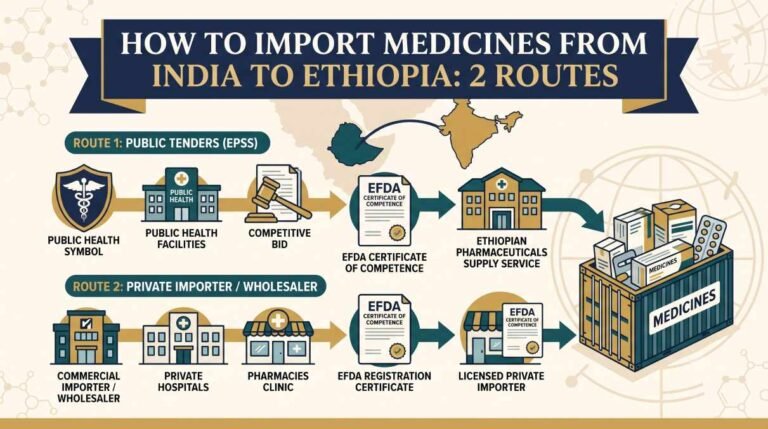
- EFDA Ethiopia drug registrationAnother ML3 authority, for comparing dossier and GMP demands.
Planning a Ghana registration?Puizer Cure (OPC) Pvt. Ltd. manufactures in Sonipat, Haryana, and can share the dossier and GMP documentation a Ghanaian importer needs to assess a product basket.
Discuss a Ghana product basketReferences
- World Health Organization. List of national regulatory authorities (NRAs) operating at maturity level 3 (ML3) and maturity level 4 (ML4). Geneva: WHO; as of August 2026. Available from: https://cdn.who.int/media/docs/default-source/medicines/regulatory-systems/wla/list-of-nras-operating-at-ml3-and-ml4.pdf Accessed October 2026.
- WHO Regional Office for Africa. Ghana Foods and Drugs Authority (FDA) attains maturity level 3 regulatory status [news release]. Brazzaville: WHO AFRO; 18 May 2020. Available from: https://www.afro.who.int/news/ghana-foods-and-drugs-authority-fda-attains-maturity-level-3-regulatory-status Accessed October 2026.
- Republic of Ghana. Public Health Act, 2012 (Act 851), Part Seven, sections 117–120. Accra: Ministry of Health; 2012. Available from: https://www.moh.gov.gh/wp-content/uploads/2016/02/Public-Health-Act-851.pdf Accessed October 2026.
- Food and Drugs Authority, Ghana. Guideline on registration of allopathic drugs. FDA/DNC/GDL-01/03, version 02. Accra: FDA; effective 8 January 2024. Available from: https://fdaghana.gov.gh/wp-content/uploads/2024/09/GUIDELINES-ON-REGISTRATION-OF-ALLOPATHIC-DRUGS.pdf Accessed October 2026.
- Food and Drugs Authority, Ghana. Guidelines on the registration of medicinal products classified for fast-track processing. FDA/DNC/GDL-06/02. Accra: FDA; effective 8 January 2024. Available from: https://fdaghana.gov.gh/guidelines-on-the-registration-of-medicinal-products-classified-for-fast-track-processing/ Accessed October 2026.
- Food and Drugs Authority, Ghana. Reliance guideline on regulatory decision-making. FDA/GEN/GDL-04/02. Accra: FDA; effective 1 March 2023. Available from: https://fdaghana.gov.gh/wp-content/uploads/2024/09/FDA-RELIANCE-GUIDELINE-ON-REGULATORY-DECISION-MAKING.pdf Accessed October 2026.
- Food and Drugs Authority, Ghana. Guidelines on stability testing of active pharmaceutical ingredients and finished pharmaceutical products. FDA/DNC/GDL-03/02. Accra: FDA; effective 8 January 2024. Available from: https://fdaghana.gov.gh/guidelines-on-stability-testing-of-active-pharmaceutical-ingredients-and-finished-pharmaceutical-products-2/ Accessed October 2026.
- World Health Organization. Stability conditions for WHO Member States by region (appendix to WHO Technical Report Series No. 953, Annex 2). Geneva: WHO; update March 2021. Available from: https://cdn.who.int/media/docs/default-source/medicines/norms-and-standards/guidelines/regulatory-standards/trs953-annex2-appendix1-stability-conditions-table-2018.pdf Accessed October 2026.
- Food and Drugs Authority, Ghana. Waiver requirements for cGMP inspections. FDA/DID/NOT-01. Accra: FDA; effective 1 January 2019. Available from: https://fdaghana.gov.gh/waiver-requirements-for-cgmp-inspections/ Accessed October 2026.
- Food and Drugs Authority, Ghana. Guidelines on importation of drugs. FDA/DNC/GDL-10/02. Accra: FDA; effective 8 January 2024. Available from: https://fdaghana.gov.gh/guidelines-on-importation-of-drugs/ Accessed October 2026.
- Food and Drugs Authority, Ghana. Fees and charges: Fees and Charges (Miscellaneous Provisions) Regulations, 2023 (L.I. 2481). Accra: FDA. Available from: https://fdaghana.gov.gh/fee-schedule/ Accessed October 2026.
- Owusu-Asante M, Darko DM, Asamoah-Okyere KD, Asante-Boateng S, Kermad A, Walker S, Salek S. Evaluation of the Food and Drugs Authority, Ghana regulatory review process: challenges and opportunities. Ther Innov Regul Sci. 2023;57(2):372–85. Epub 2022 Nov 9. doi:10.1007/s43441-022-00478-x. Available from: https://doi.org/10.1007/s43441-022-00478-x Accessed October 2026.
- Bharti G, Bhandari D. An overview of the allopathic drug registration process and requirements in Ghana. Int J Drug Regul Aff. 2025;13(2) [secondary source]. Available from: https://www.ijdra.com/index.php/journal/article/view/767 Accessed October 2026.
- Graphic Online. No more import of 49 medicines; local manufacturers to fill gap [news report on Executive Instrument 181 of 10 May 2017; secondary source]. Accra; 23 May 2017. Available from: https://www.graphic.com.gh/news/general-news/no-more-import-of-49-medicines-local-manufacturers-to-fill-gap.html Accessed October 2026.
- GhanaWeb. Suspend E.I. 2023 restricting import of 142 medicines – PIWA, GNCoP to MoH [news report; secondary source]. Accra; 10 February 2024. Available from: https://www.ghanaweb.com/GhanaHomePage/business/Suspend-E-I-2023-restricting-import-of-142-medicines-PIWA-GNCoP-to-MoH-1916125 Accessed October 2026.
- Food and Drugs Authority, Ghana. FDA responds to BBC Africa Eye investigation: Who is flooding West Africa with opioids [press statement]. Accra: FDA; 26 February 2025. Available from: https://fdaghana.gov.gh/wp-content/uploads/2025/02/FDA-Responds-to-BBC-Africa-Eye-Investigation-Who-is-Flooding-West-Africa-with-Opioids.pdf Accessed October 2026.
This guide is technical and educational information for pharmaceutical exporters, not legal, regulatory or investment advice. FDA Ghana guidelines, fee schedules and Executive Instruments change; confirm current requirements with FDA Ghana and your local representative before filing. All sources accessed October 2026.