
Commercial terms · Puizer Cure (OPC) Pvt. Ltd.
Private label pharmaceutical manufacturing MOQ: the short answer
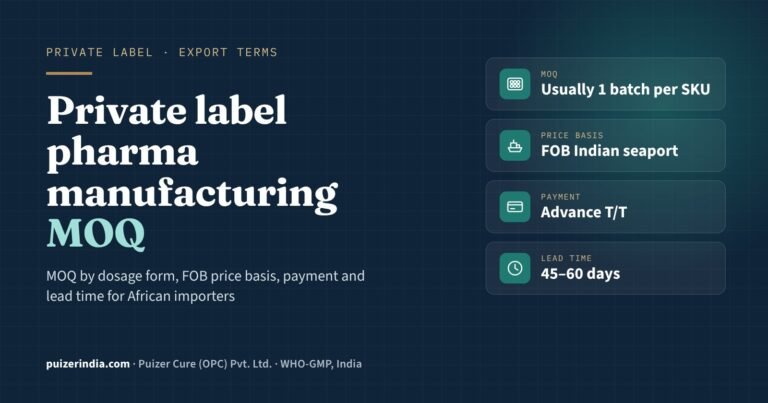
The private label pharmaceutical manufacturing MOQ at Puizer Cure is set per SKU, and it is usually one manufacturing batch, because your brand’s printed foil and cartons cannot be used for anyone else. Typical planning bands are 100,000 to 300,000 tablets per SKU (1,000 to 3,000 boxes of 10×10) and 5,000 to 10,000 bottles or tubes for liquids and topicals. The exact MOQ is confirmed on each quotation.
Prices are quoted FOB a named Indian seaport, payment is by advance T/T, and production lead time is 45 to 60 days after you approve the artwork.
Answers to the questions in every enquiry
Commercial terms at a glance
Buyers writing to us ask the same six things: MOQ, FOB or CIF price, lead time, shelf life, documents and payment. Here they are in one place.
| Term | Puizer Cure’s position | What it means for you |
|---|---|---|
| MOQ | Usually one manufacturing batch per SKU; bands by dosage form below | Each strength and pack under your brand is its own SKU |
| Price basis | FOB, named Indian seaport | You or your forwarder book the sea freight and insurance |
| Payment | Advance telegraphic transfer (T/T) | Deposit and balance split is set on the proforma invoice |
| Lead time | 45–60 days after artwork approval | Registration in your country is separate and comes first |
| Shelf life | As supported by each product’s stability data | Check your market’s remaining-shelf-life rule before ordering |
| Documents | CoA per batch, invoice, packing list, certificate of origin; CoPP and WHO-GMP copies on request | See the full set in our export documentation checklist |
| Scope | Finished dosage forms only | No APIs, peptides or bulk drug substances |
Swipe the table sideways to see all columns →
Why the number is what it is
How MOQ is set for private label medicines
A private label MOQ is not a sales rule. It is the smallest quantity that uses up what has to be made or printed only for you. Three things set it.
1. The batch
Granulation, compression, filling and quality testing run per batch. A part batch still needs the full set of tests and records, so its cost per pack rises sharply.
2. Printed packaging
Your brand name sits on the printed foil, the carton and the leaflet. Printers sell these in minimum runs, and printed stock with your brand cannot go to another customer.
3. One-time artwork costs
A new brand needs artwork, and printed foil needs printing cylinders. These are paid once, on the first order, and do not repeat on reorders with unchanged artwork.
One SKU = one strength + one pack + one brand. Amlodipine 5 mg and 10 mg are two batches, so combining them does not reach one MOQ. Two pack sizes of the same strength can sometimes be packed from one batch; ask for this at quotation.
Planning ranges, confirmed per quotation
Indicative private label MOQ by dosage form
Use these bands to plan budget and warehouse space. They are typical batch sizes, not fixed minimums: your quotation states the actual MOQ for each SKU.
| Dosage form | Indicative MOQ per SKU | In common packs | Where it is made |
|---|---|---|---|
| Tablets | 100,000–300,000 tablets | 1,000–3,000 boxes of 10×10 | Puizer’s WHO-GMP facility, Sonipat |
| Capsules | 100,000–200,000 capsules | 1,000–2,000 boxes of 10×10 | Puizer’s WHO-GMP facility, Sonipat |
| Oral liquids (syrups, suspensions) | 5,000–10,000 bottles | Depends on fill volume | Loan-licence partner facility |
| Dry syrups | 5,000–10,000 bottles | Depends on fill volume | Loan-licence partner facility |
| Creams, ointments, gels | 5,000–10,000 tubes | Depends on tube size | Loan-licence partner facility |
Swipe the table sideways to see all columns →
Controlled and abuse-prone products (for example tramadol, tapentadol and pregabalin) are supplied on enquiry only, against the import permits your country requires. They are not quoted from these bands.
Interactive
MOQ and lead-time planner
Enter what you want to order. The planner converts packs into tablets or bottles per SKU, compares that with a typical batch, gives the ready-to-ship window and writes your enquiry for you.
Your result appears here
Change any field to update the result.
The planner uses the indicative bands on this page. It is a planning aid, not a quotation: the MOQ, price and dates on your proforma invoice are the ones that apply.
Lead time
Private label lead time: what happens in the 45–60 days
The clock starts when you approve the final artwork, because printed foil and cartons can only be ordered after that. A first order runs like this.
- Quotation and proforma invoiceMOQ, FOB price per pack, shelf life and the document list for each SKU.
- Order and advance paymentYour purchase order and the T/T deposit set the production slot.
- Artwork approvalday 0Your brand, pack text and your regulator’s labelling rules on foil, carton and leaflet.
- Packaging and materialsPrinted foil, cartons and leaflets are printed; API and excipients are tested on receipt.
- Manufacture and packingThe batch is made and packed under the batch manufacturing record.
- QC testing and releaseFinished-product testing against the agreed pharmacopoeial specification; the Certificate of Analysis is issued.
- Ready for loadingday 45–60Balance payment, export documents, and goods delivered on board at the named Indian port.
Registration is not inside the 45–60 days. In most African markets a medicine must be registered, or covered by a special import permit, before commercial quantities clear customs. If your product is not yet registered, the first step is usually dossier documents and registration samples. Our country guides for Nigeria (NAFDAC), Ethiopia (EFDA), Uganda (NDA) and Ghana (FDA) give each regulator’s timeline.
Price basis
Why prices are quoted FOB an Indian port
Under FOB, Puizer Cure clears the goods for export and delivers them on board the vessel you nominate at the named Indian port. Risk passes to you once the goods are on board, and you pay the main freight and insurance.[1]
FOB lets you use your own forwarder and compare freight yourself, which matters for buyers in markets such as DR Congo or Burkina Faso, where the last leg is often overland from another country’s port. To add freight, insurance, duty and clearing to the FOB price, use our landed cost calculator (FOB vs CIF).
Two points to agree in writing. First, name the port on the contract, for example “FOB [port], Incoterms 2020”, not just “FOB”. Second, under FOB you must tell us the vessel and loading date in time; if the vessel is late or not nominated, the extra cost and risk fall on the buyer.[1] For container cargo handed to a carrier at a terminal, the ICC considers FCA a better fit than FOB; ask us if your forwarder prefers FCA.[1]
Payment
Payment terms: advance T/T
Puizer Cure works on advance telegraphic transfer (T/T): a deposit with the order and the balance before the goods are handed over at the port. The split is set on the proforma invoice.
The reason is practical. Private label stock carries your brand and your registration details, so it cannot be sold to anyone else if an order is cancelled. The deposit pays for the packaging and materials bought only for you.
- Pay against the proforma invoice only, and check that the bank details match the ones on our official documents.
- Bank charges at your end and any intermediary bank charges are usually for the buyer’s account; confirm this on the proforma.
- Before paying the balance, you receive the batch Certificate of Analysis for review.
Shelf life
Shelf life at dispatch, and the rule at your port
The shelf life on your quotation is the one each product’s stability data supports. For African markets that data has to be generated at a hot-climate long-term condition, 30 °C at 65 % or 75 % relative humidity, not only the 25 °C / 60 % RH used for temperate markets.[2] Our guide to climate-zone stable packaging explains why the pack matters as much as the formula.
Many regulators also set a minimum remaining shelf life on arrival. Two published examples:
- Tanzania: at least 60 % of shelf life remaining for products with a shelf life above 24 months, and at least 80 % for 24 months or less.[3]
- Rwanda: at least two-thirds of shelf life remaining on arrival at the port of entry.[4]
Other markets have their own rules. Tell us your country on the enquiry, and we plan the production date so the goods meet its rule after sea transit.
Documents
Documents with every order
With each shipment
Commercial invoice, packing list, Certificate of Analysis for every batch, and certificate of origin. Batch numbers must match across all of them.
For registration and tenders
WHO-GMP certificate and Certificate of Pharmaceutical Product (CoPP). A CoPP is issued by the regulator, not by the manufacturer.[5] In India it follows a joint inspection by CDSCO and the State Licensing Authority.[6]
Market-specific
Some markets add pre-shipment steps. For Nigeria, see NAFDAC CRIA pre-shipment inspection.
For what the CoA and retention samples should show, read WHO-GMP batch QC evidence and how to verify medicine quality before import.
Scope
What Puizer Cure does and does not supply
We manufacture finished dosage forms: tablets and capsules at our WHO-GMP facility in Sonipat, and liquids and topicals at our loan-licence partner facility. We do not supply APIs, peptides or bulk drug substances.
Brand names shown in our product catalogue are proposed names. Under private label, the product carries your brand. For how the private label service works step by step, see private label pharmaceutical manufacturing for East Africa.
FAQ
Private label MOQ and commercial terms: questions buyers ask
At Puizer Cure it is usually one manufacturing batch per SKU. Typical planning bands are 100,000 to 300,000 tablets, 100,000 to 200,000 capsules, or 5,000 to 10,000 bottles or tubes. The exact MOQ is stated on each quotation.
Ask on your enquiry. A part batch costs nearly as much to make and test as a full one, and your printed packaging has its own minimum run, so the price per pack is higher. For registration samples, quantities are much smaller and are quoted separately.
No. Each strength is a separate batch, so each one has its own MOQ. Two pack sizes of the same strength can sometimes be packed from one batch; ask for this at quotation.
FOB a named Indian seaport. You or your forwarder arrange the sea freight and insurance, and risk passes to you once the goods are on board. Our landed cost calculator adds freight, duty and clearing to the FOB price.
Advance telegraphic transfer (T/T): a deposit with the order and the balance before the goods are handed over at the port. The split is set on the proforma invoice.
45 to 60 days from your artwork approval to goods ready at the Indian port. Sea transit and product registration in your country are not included.
It depends on the product’s approved shelf life and your market’s rule. Tanzania, for example, requires at least 60 % remaining for products with a shelf life above 24 months, and Rwanda requires two-thirds. Name your country on the enquiry so production is timed to meet it.
No. Puizer Cure supplies finished dosage forms only: tablets, capsules, oral liquids and topicals. We do not supply APIs, peptides or bulk drug substances.
Get a quotation with MOQ, FOB price and shelf life
Send the product, strength, pack, quantity per SKU, destination country and registration status. Puizer Cure (OPC) Pvt. Ltd. replies with the MOQ, FOB price per pack, shelf life and document list for each SKU.
Related on Puizer Cure
References
- Bustamante Morales MA. FCA and FOB Incoterms® 2020 explained: key differences. Paris: ICC Academy, International Chamber of Commerce; 19 Nov 2024. Available from: https://academy.iccwbo.org/incoterms-2020-fca-or-fob. Accessed October 2026.
- World Health Organization. Stability testing of active pharmaceutical ingredients and finished pharmaceutical products. Annex 10, WHO Technical Report Series, No. 1010. Geneva: WHO; 2018. Available from: https://extranet.who.int/prequal/sites/default/files/document_files/TRS1010_Annex10.pdf. Accessed October 2026.
- Tanzania Medicines and Medical Devices Authority. Guidelines for Importation and Exportation of Pharmaceutical Products and Raw Materials. 4th ed. Dodoma: TMDA; January 2021. Available from: https://www.tmda.go.tz/pages/import-and-export-control. Accessed September 2026.
- Rwanda Food and Drugs Authority. Guidelines for Importation and Exportation of Pharmaceutical Products and Medical Devices. Doc. No. FDSIM/FDIEC/GDL/001, Revision 1. Kigali: Rwanda FDA; 2022. Available from: https://rwandafda.gov.rw/import-and-export-requirements/. Accessed September 2026.
- World Health Organization. WHO Certification Scheme on the quality of pharmaceutical products moving in international commerce: issuing a certificate. Geneva: WHO. Available from: https://www.who.int/teams/regulation-prequalification/regulation-and-safety/regulatory-convergence-networks/certification-scheme/issuing-a-certificate. Accessed October 2026.
- Central Drugs Standard Control Organisation. RTI suo moto disclosure, CDSCO Sub-Zone Indore, 2026. New Delhi: CDSCO; 2026. Available from: https://cdsco.gov.in/opencms/export/sites/CDSCO_WEB/Pdf-documents/SUO-MOTO-DISCLOSURE-2026-Indore.pdf. Accessed October 2026.
This page is commercial and technical information for importers and distributors, not legal, regulatory or financial advice. MOQ bands and lead times are indicative and confirmed per quotation. Import rules, remaining-shelf-life limits and Incoterms practice change; check the current rules with your regulator and forwarder before ordering. Written by Darshan Singh, pharmaceutical QA and regulatory affairs consultant. Last reviewed 26 October 2026.