
India → Nigeria · Pre-shipment inspection
The short answer
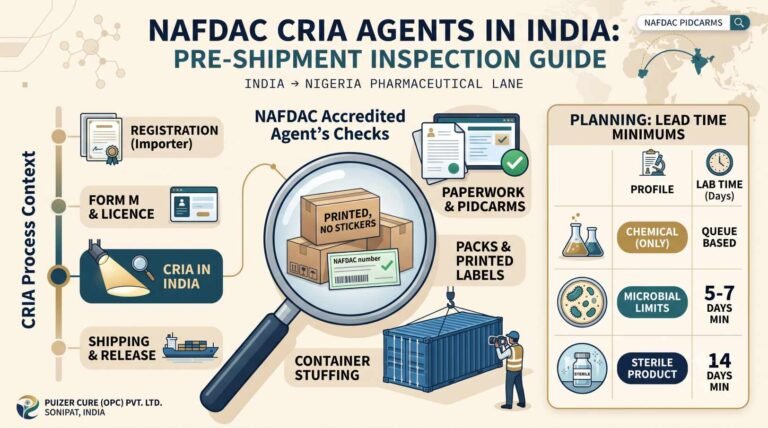
NAFDAC CRIA agents in India issue the CRIA (Clean Report of Inspection and Analysis), the pre-shipment report NAFDAC requires for every regulated product imported from India or China, except items on its exemption list.[1] Only a NAFDAC-accredited agent can issue it; reports from any other agent are not honoured at clearance.[2] For a finished medicine, the agent:
- checks the importer’s NAFDAC registration, e-licence and Form M before accepting the job;
- inspects the goods at container stuffing and photographs the container and labels;
- samples every product and a random 20% of batches;
- has them tested at a NAFDAC-approved laboratory for every parameter on your CoA;
- uploads the report and evidence to NAFDAC’s PIDCARMS portal.[3]
The laboratory step sets your lead time. If your CoA claims microbial limits, colony counts need 5–7 days of incubation;[4] a sterility test needs at least 14 days.[5] No agent can go faster than the method allows.
The list of NAFDAC CRIA agents in India changes. NAFDAC’s February 2020 notice listed four agents for India and suspended a fifth, stating its reports would not be accepted at clearance.[2] The page current as of 15 April 2025 lists five for India and four for China.[6] Always book from NAFDAC’s own list on the day you book.
Context
Where CRIA sits in an India → Nigeria shipment
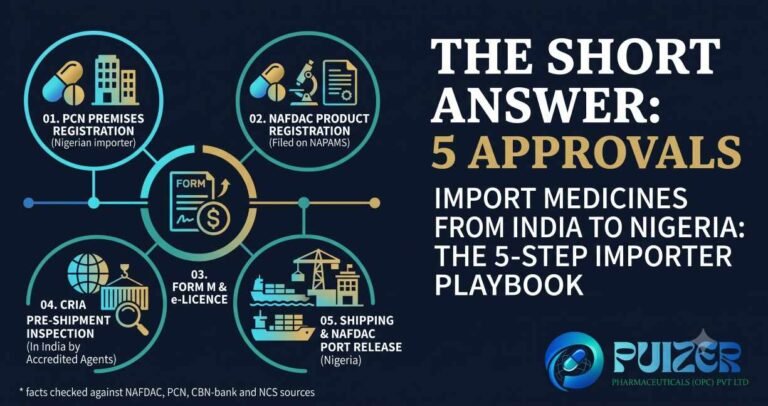
CRIA is the fourth of five approvals on the lane. It cannot start until the Nigerian importer holds the product registration and a Form M, because the agent must see both before taking the job.[3] The full sequence, with who owns each step, is in our five-step guide to importing medicines from India to Nigeria. This page goes deep on step four: what NAFDAC CRIA agents in India check at the Indian plant.
- PCN premises (importer)
- NAFDAC product registration
- E-licence and Form M
- CRIA in India
- Shipping and port release
NAFDAC’s focus on this lane is volume-driven. In April 2025 its Director-General said China and India supply about 60% of Nigeria’s pharmaceutical imports, and urged stakeholders to engage CRIA agents before shipping any consignment.[7]
Inspection scope
What NAFDAC CRIA agents in India check
All five areas below come from NAFDAC’s guidance document to its CRIA agents.[3] Pick one to see the specific checks.
Paperwork, before the job is accepted
- The importer’s e-licence must be confirmed on PIDCARMS before any CRIA service is provided.
- A valid NAFDAC registration certificate or import permit. A Treasury Receipt (proof that a fee was paid) is not accepted in its place.
- A copy of Form M. Only shipments by governments and UN agencies are exempt.
- The Certificate of Pharmaceutical Product (CoPP) and the manufacturing licence of the manufacturer.
- The consignee must be the brand owner (marketing authorisation holder) or the company named on the NAFDAC registration certificate.
Why it matters to the plant: if any of these is missing, the agent cannot book your inspection, however ready the goods are.
Packs and labels, against the registration certificate
- Packaging must match the details on the NAFDAC registration certificate.
- Primary and secondary packs must bear the manufacturer’s name and address and the Nigerian marketing authorisation holder’s name, exactly as on the certificate.
- Stickering the NAFDAC number, manufacturer details or holder details is strictly not allowed. They must be printed.
- Different pack designs for the same brand name and strength are not allowed.
- Pack size must match the certificate, or a Pack Size Extension Letter is needed.
- For bulk material, labels on drums and bags must be PVC or another water-resistant material.
Why it matters to the plant: artwork is fixed at printing. A label query at inspection usually means reprinting, not a quick fix.
Container stuffing inspection
- The agent must carry out a container stuffing inspection of every consignment exported to Nigeria.
- The inspection report must give the names and photographs of the inspectors who attended.
- Photographs are required of the sampled products, the container’s exterior and interior, and the product label.
Why it matters to the plant: the inspector must be physically present when the container is loaded, so the stuffing slot has to be booked with the agent, not only with the forwarder.
Sampling and laboratory analysis
- Every product in the consignment is sampled, with 20% of the batches selected at random.
- Samples are tested at NAFDAC-approved laboratories, for all parameters claimed on the product’s CoA, unless the approved lab lacks the facility.
- Each agent works with up to three approved labs; using another approved lab needs NAFDAC’s approval.
- Bulk APIs must come with a Drug Master File (DMF); where there are several APIs, a maximum of two are sampled. A one-off grace applies if the DMF is not immediately available.
Why it matters to the plant: whatever your CoA claims, the lab will test. Each claim on the CoA, especially a microbiological one, adds its own test time.
Report and PIDCARMS upload
- Every CRIA report must be uploaded to PIDCARMS immediately. Issuing a report without uploading it is not acceptable.
- All documents on PIDCARMS must be in English.
- The upload set is: bill of lading, Form M, inspection report, invoice, laboratory analysis report (certificates of analysis), packing list, container exterior photo, container interior photo and product label photo.
Our reading, not a stated rule: because the bill of lading is part of the upload set, the report is completed around or after loading. The guidance does not say whether the vessel may sail before the lab result is known, so ask your agent and importer to agree this in writing.
Readiness file
Documents the Indian site must have ready
Have everything below in one file before you book one of the NAFDAC CRIA agents in India. Items marked Required or If applicable are taken from NAFDAC’s CRIA guidance.[3] Items marked Our practice are what our QC team keeps ready to answer lab queries quickly; they are not NAFDAC requirements.
| Document | Comes from | Status | What the agent does with it |
|---|---|---|---|
| NAFDAC registration certificate or import permit | Nigerian importer (holder) | Required | Checks pack details and consignee against it. A Treasury Receipt is not accepted. |
| NAFDAC e-licence | Nigerian importer | Required | Must confirm it on PIDCARMS before providing the service. |
| Form M (copy) | Importer and its bank | Required | Part of the document review and the PIDCARMS upload. Government and UN shipments are exempt. |
| Certificate of Pharmaceutical Product (CoPP) | Indian manufacturer | Required | Confirms the product’s regulatory status in the country of manufacture. |
| Manufacturing licence | Indian manufacturer | Required | Confirms the manufacturer is licensed for the product. |
| Batch certificate of analysis for every batch | Indian manufacturer | Required | Sets the test list: the lab tests every parameter the CoA claims. |
| Finished packs with printed Nigerian label details | Indian manufacturer | Required | Checked against the registration certificate; stickers not allowed. |
| Commercial invoice and packing list | Exporter | Required | Uploaded to PIDCARMS with the report. |
| Bill of lading | Exporter or forwarder | Required | Uploaded to PIDCARMS with the report. |
| Pack Size Extension Letter | Nigerian importer | If applicable | Needed when the shipped pack size differs from the certificate. |
| Drug Master File | API manufacturer | If applicable | For bulk APIs. See the note on APIs below. |
| Test methods and specifications for in-house (non-pharmacopoeial) CoA tests | Indian manufacturer | Our practice | Lets the testing lab run your method without a query round-trip. |
| Batch manufacturing and release records, control samples | Indian manufacturer | Our practice | Ready evidence if a result is disputed and a retest is ordered. |
On a phone, swipe the table sideways to see every column. For the general export set (CoA, CoPP, WHO-GMP, certificate of origin), see our pharmaceutical export documentation checklist.
Planning
How CRIA affects lead time
CRIA adds three things to an export timeline: booking the agent for the stuffing slot, laboratory testing of the samples, and issuing and uploading the report. The first and last depend on which of the NAFDAC CRIA agents in India you use. The laboratory step has a hard floor set by the test methods on your CoA, because the lab must test every parameter the CoA claims.[3]
- Chemical tests only (identification, assay, dissolution, related substances): no incubation period applies; time depends on the lab’s queue.
- Microbial limits claimed: the harmonised plate-count method incubates total aerobic counts at 30–35 °C for 3–5 days and yeast and mould counts at 20–25 °C for 5–7 days.[4]
- Sterile products: the harmonised sterility test incubates inoculated media for not less than 14 days.[5]
We did not find any NAFDAC document that publishes a standard CRIA turnaround, so use your agent’s written quote in the planner below, not a generic figure.
1. What does the batch CoA claim?
Choose a test profile
The minimum laboratory time for that profile will appear here.
2. Enter your dates and your agent’s quote
Fill in all four fields to see when the CRIA report is expected.
A planning aid only. It uses your inputs and the pharmacopoeial incubation periods cited above; it is not a NAFDAC timeline or a regulatory determination. Nothing you enter is stored or sent.
CRIA is not the last test
A clean CRIA does not end testing. Under NAFDAC’s port clearance guideline for finished pharmaceuticals, inspectors draw samples during physical examination in Nigeria and send them to a NAFDAC laboratory, and the products can be marketed only after satisfactory laboratory evaluation.[8] Your importer’s lead time therefore includes a second analysis after arrival, which is outside the exporter’s control.
When it goes wrong
What happens if a CRIA sample fails
- 01The approved laboratory notifies the agent of an unsatisfactory result.
- 02The agent must report the failure to NAFDAC within 24 hours of that notification.[3]
- 03If NAFDAC approves testing at a designated laboratory, the agent sends all batches of the product to another CRIA laboratory within 3 working days, after the manufacturer or exporter pays for the new service.[3]
Note the scope of step 3: a failure on one sampled batch pulls every batch of that product into the retest. Retained samples and complete batch records are what make that stage quick to answer.
Risk
Where CRIA jobs usually stall
- Booking before the importer’s paperwork exists. No Form M copy or unconfirmed e-licence means the agent cannot start.[3]
- Stickered labels. NAFDAC number and holder details must be printed, not stickered.[3]
- Consignee mismatch. Shipping to a buyer who is neither the brand owner nor the company on the certificate.[3]
- A CoA that claims more than you planned for. Every claimed parameter is tested; a microbial claim alone sets a multi-day floor.[4]
- A quoted turnaround shorter than the method. If a quote for a sterile product is under 14 days, ask how the sterility test will be completed.[5]
- Using an agent that is not, or is no longer, accredited. NAFDAC does not honour those reports.[2]
Two NAFDAC documents circulating in the public domain disagree. The CRIA agent guidance requires bulk APIs to come with a DMF and be sampled and tested.[3] NAFDAC’s CRIA exemption list includes “Bulk Active Pharmaceutical Ingredients and Excipients”.[9] Neither copy is dated. If you ship APIs rather than finished products, get the current position in writing from NAFDAC or your agent before booking the shipment.
FAQ
NAFDAC CRIA agents in India: common questions
CRIA stands for Clean Report of Inspection and Analysis. It is issued by a NAFDAC-accredited agent after inspecting, sampling and testing a consignment in the exporting country, and NAFDAC requires it for regulated products imported from India and China unless the item is on its exemption list.
Check NAFDAC’s Pre-Shipment Inspection and Testing Agents page on the day you book. The list of NAFDAC CRIA agents in India changes: in February 2020 NAFDAC listed four agents for India and suspended another, and the page current as of 15 April 2025 lists five. Reports from agents not on the list are not honoured at clearance.
NAFDAC’s announcement tells importers to obtain CRIA services before shipment, and the importer needs the original CRIA to clear the goods. In practice the Indian manufacturer hosts the inspection. NAFDAC’s guidance places the cost of a retest after a failure on the manufacturer or exporter; who pays for the first inspection is a commercial term to agree in the contract.
NAFDAC does not publish a standard turnaround, so use your agent’s written quote. The laboratory stage has a floor set by your CoA: microbial counts need 5 to 7 days of incubation, and a sterility test needs at least 14 days. Booking the stuffing inspection and issuing the report add time on top.
No. NAFDAC’s port clearance guideline for finished pharmaceuticals has inspectors draw samples during physical examination and send them to a NAFDAC laboratory, and the products can be marketed only after satisfactory laboratory evaluation.
Only as a temporary measure. During the April 2020 lockdown NAFDAC let agents issue a Document Clearance Report, with laboratory testing done by NAFDAC after arrival.[10] The current guidance requires a container stuffing inspection of every consignment.
No. NAFDAC’s guidance to CRIA agents says stickering of the NAFDAC registration number, the manufacturer’s name and address, or the Nigerian marketing authorisation holder’s details is strictly not allowed. These must be printed on primary and secondary packs as shown on the registration certificate.
The agent must report the failure to NAFDAC within 24 hours of the lab’s notification. If NAFDAC approves a retest at a designated laboratory, all batches of the product go to another CRIA laboratory within three working days, paid for by the manufacturer or exporter.
Related on Puizer
Keep reading
- How to import medicines from India to NigeriaThe five approvals around CRIA, and who owns each one.
- NAFDAC drug registration processThe registration certificate every CRIA job is checked against.
- Starting a pharmaceutical import business in NigeriaWhat the Nigerian importer needs before any shipment.
- The QC evidence behind every batchHow the batch CoA the CRIA lab tests against is generated.
- Climate-zone stable packaging for exportPack choices that also have to pass the label check.
Puizer Cure (OPC) Pvt. Ltd. · Sonipat, India
Shipping to Nigeria from India?
Our export team prepares the manufacturer’s side of CRIA: printed Nigerian artwork that matches the registration, CoAs your importer can plan around, and a readiness file for the stuffing inspection.
References
- NAFDAC Ports Inspection Directorate. Port Inspection FAQs. Abuja: NAFDAC; n.d. Available from: https://nafdac.gov.ng/about-nafdac/nafdac-organisation/directorates/ports-inspection/port-inspection-faqs/. Accessed September 2026.
- NAFDAC. Public Announcement: Notification of Newly Accredited Clean Report of Inspection and Analysis (CRIA) Agents for China and India. Abuja: NAFDAC; 4 February 2020. Available from: https://nafdac.gov.ng/public-announcement-notification-of-newly-accredited-clean-report-of-inspection-and-analysis-cria-agents-for-china-and-india/. Accessed September 2026.
- NAFDAC. Guidance Document for Carrying Out CRIA Services by CRIA Agents. Abuja: NAFDAC; n.d. [undated; copy published by a NAFDAC-accredited CRIA agent]. Available from: https://www.quntrol.com/web_img/nigeria/cria_requirements_and_guidelines.pdf. Accessed September 2026.
- British Pharmacopoeia Commission. Appendix XVI B. Microbiological Examination of Non-sterile Products (Ph. Eur. method 2.6.12, harmonised). British Pharmacopoeia 2013. London: TSO; 2012. Reprint available from: https://www.drugfuture.com/Pharmacopoeia/BP2013/data/855.html. Accessed September 2026.
- British Pharmacopoeia Commission. Appendix XVI A. Sterility (Ph. Eur. method 2.6.1, harmonised). British Pharmacopoeia 2012. London: TSO; 2011. Reprint available from: https://www.drugfuture.com/Pharmacopoeia/BP2012/data/871.html. Accessed September 2026.
- NAFDAC. Pre-Shipment Inspection and Testing Agents [accredited CRIA agents, India and China; content current as of 15 April 2025]. Abuja: NAFDAC; 2025. Available from: https://nafdac.gov.ng/regulatory-resources/pre-shipment-inspection-and-testing-agents/. Accessed September 2026.
- Channels Television. NAFDAC Tightens Pharmaceutical Imports from China, India [news report; secondary source]. Lagos: Channels TV; 4 April 2025. Available from: https://www.channelstv.com/2025/04/04/nafdac-tightens-pharmaceutical-imports-from-china-india/. Accessed September 2026.
- NAFDAC. Guidelines for Clearing Imported Finished Pharmaceutical (Human and Veterinary) Products at Ports of Entry in Nigeria. Doc. Ref. PID-GDL-004-01, effective 24 September 2022, review date 23 September 2027. Abuja: NAFDAC; 2022. Available from: https://nafdac.gov.ng/wp-content/uploads/Files/Resources/Guidelines/PORTINSPECTION_GUIDELINES/2022_To_2027/Guidelines-For-Clearing-Imported-Finished-Pharmaceutical-Human-And-Veterinary-Products-at-Ports-of-Entry-in-Nigeria.pdf. Accessed September 2026.
- NAFDAC. NAFDAC Regulated Products Exempted from Clean Report of Inspection and Analysis (CRIA). Abuja: NAFDAC; n.d. [undated; copy published by a NAFDAC-accredited CRIA agent]. Available from: https://www.quntrol.com/web_img/nigeria/cria_exemption_list.pdf. Accessed September 2026.
- NAFDAC. Public Announcement: Instructions on CRIA During This Lockdown. Abuja: NAFDAC; 9 April 2020. Available from: https://nafdac.gov.ng/public-announcement-instructions-on-cria-during-this-lockdown-04201/. Accessed September 2026.