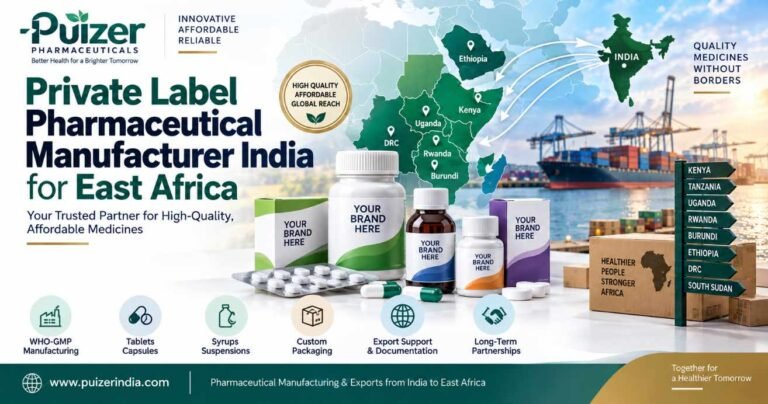

Private label manufacturing · India to East Africa
The short answer
Puizer Cure is a private label pharmaceutical manufacturer in India for East Africa — it formulates, packs, and prints your brand name on tablets, capsules, syrups, or nutraceuticals, then exports the finished, branded product to your market. WHO-GMP and ISO 9001:2015 certified and based in Sonipat, near Delhi, Puizer runs this model for importers, distributors, pharmacy chains, and institutional buyers across Kenya, Tanzania, Uganda, Rwanda, and Ethiopia — handling formulation, MOQ planning, COPP/GMP/Free Sale documentation, and export logistics under one roof, so you own the brand without owning a factory.
Compiled September 2026 from public trade and market-research data (see Sources); MOQs, lead times, and manufacturing terms confirmed directly with Puizer’s export desk.
Private label is one of three ways East African buyers typically bring Indian-made pharmaceuticals to market, alongside straight third-party manufacturing and PCD franchise distribution. This post focuses on the private label route specifically — what it costs you in paperwork, what it saves you in capital, and how the process runs end to end for buyers in Nairobi, Dar es Salaam, Kampala, Kigali, and Addis Ababa. For the wider export landscape, see the pharmaceutical export to Africa guide.
Private label, third-party manufacturing, or PCD franchise?
These three terms get used loosely, and often interchangeably, in pharma sourcing conversations — but they describe different commercial arrangements with different implications for brand ownership, dossier responsibility, and capital outlay. The tabs below lay out the practical differences before we go further.
You own the brand; Puizer owns the factory
You supply, or approve, the brand name, packaging design, and pack size. Puizer manufactures against an agreed specification and prints your brand on the primary and secondary packaging. Finished goods ship under your label, not Puizer’s.
Registration dossier: Usually filed in your name or your local agent’s name, with Puizer supplying COPP, GMP, and CTD/COA support.
Typical buyer: Importer or distributor building a house brand, a retail pharmacy chain, or an institutional supplier.
Trade-off: More documentation and MOQ commitment than a franchise arrangement, far less capital than owning a plant.
The broader umbrella term — private label sits inside it
“Third-party manufacturing” is the wider contract-manufacturing relationship: Puizer manufactures to a buyer’s specification, whether or not that buyer wants their own brand on the pack. Private label is the branded subset of it. A buyer could also third-party-manufacture an unbranded pack, or simply reorder a product Puizer already makes for other clients.
Registration dossier: Same as private label when the product is branded.
Typical buyer: Any volume buyer, branded or not.
Trade-off: The most flexible of the three, but the term alone doesn’t guarantee brand exclusivity — confirm that explicitly in the agreement if it matters to you.
A distribution-rights model, not a manufacturing one
PCD (Propaganda Cum Distribution) franchise is primarily an Indian domestic model: Puizer grants a franchisee monopoly distribution rights for a defined territory and product basket, under Puizer’s own brand or a co-branded pack. It’s rarely used for cross-border East African supply, where import registration and landed-cost economics favor private label or direct third-party orders instead.
Registration dossier: Manufacturer-led.
Typical buyer: India-based distributor with a defined domestic or regional territory.
Trade-off: Lower entry cost and built-in marketing support, but you don’t build an independent brand asset.
Why a private label pharmaceutical manufacturer in India fits East Africa
Africa still manufactures very little of what it consumes. Continent-wide, only about 3% of global pharmaceutical manufacturing capacity sits on the continent, and an estimated 70–80% of medicines used in Sub-Saharan Africa are imported.[1] The African Union puts the imported share of medicines consumed across Africa at nearly 60%, with India and China as the two largest sources,[2] and India alone is widely estimated to meet more than half of Africa’s generic medicine demand.[3]
East Africa specifically is still flagged by market researchers as a comparatively untapped pharmaceutical market with room to grow.[4] Kenya and Tanzania each carried an estimated $359–403 million pharmaceutical import bill in 2024, and neither meets more than a small share of that demand from domestic production.[5] For a distributor in that position, private label solves two problems at once: it lets you build a brand and price position of your own inside a structurally import-dependent market, without taking on the capital cost, regulatory risk, and multi-year build-out timeline of a compliant plant of your own.
Where the real savings sit
The capital case for private label isn’t simply “manufacturing is cheaper in India.” It’s that MOQ-based private label lets a distributor test a therapeutic category or pack size with a few thousand units of committed spend, rather than the capital a WHO-GMP facility requires before it ships a single strip.
What can be private labeled
Puizer’s private label programme covers the dosage forms most in demand across East African retail and institutional channels:
Category 01Tablets & capsules
The highest-volume category for East African distributors.
- Antimalarials, antibiotics, analgesics, antacids
- Chronic-therapy: antidiabetics, antihypertensives, cardiac support
Category 02Liquids
Syrups and dry syrups, including pediatric lines.
- Pediatric antibiotics and antipyretics
- Cough, cold, and ORS/rehydration formulations
Category 03Topicals & drops
Ointments, creams, and eye/ear drops.
- Antifungal and antiseptic topicals
- Ophthalmic and otic drop formulations
Category 04Nutraceuticals
Growing fastest among institutional and retail buyers.
- Multivitamin and mineral formulations
- Immunity and general wellness supplements
How the private label process runs, step by step
1. Brand brief and product selection
You share the product list (or therapeutic gap you want to fill), target pack size, and any existing brand name or packaging concept. Puizer confirms formulation feasibility and gives an indicative MOQ and cost for each SKU.
2. Formulation, samples, and specification sign-off
Puizer prepares samples against the agreed specification (or an existing approved formulation) for your approval before any commercial batch is committed.
3. Documentation package
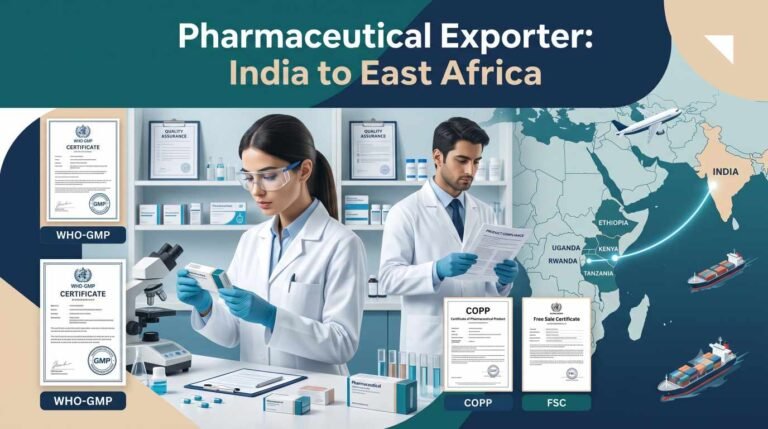
Puizer issues the Certificate of Pharmaceutical Product (COPP), GMP certificate, Free Sale Certificate, and Certificate of Analysis (COA) needed to support drug registration with your national regulator — PPB in Kenya, TMDA in Tanzania, NDA in Uganda, Rwanda FDA, or EFDA in Ethiopia. Our export documentation checklist walks through the full paper trail if you want the detail.
4. Artwork and label approval
Your brand name, logo, and pack copy are laid out to meet both your brand guidelines and the destination market’s labelling rules (language, dosage/warning text, registration number placement once issued).
5. Production and quality control
Manufacturing runs under WHO-GMP conditions with batch-level QC testing; COA is issued per batch and matched to shipment documentation.
6. Export documentation and shipment
Commercial invoice, packing list, certificate of origin, and any destination-specific import permit paperwork are prepared alongside the shipment, coordinated with your customs clearing agent on arrival.
Where this goes wrong
The most common private label delay isn’t manufacturing — it’s a mismatch between the brand name approved for packaging and the name actually filed in the registration dossier with the national regulator. Lock the brand name before artwork goes to print, and confirm it’s the exact name your local agent is filing with the regulator, not a shortened or stylised version used only on-pack.
MOQs and typical timelines
Minimum order quantities and lead times vary by dosage form, pack size, and whether the formulation already exists in Puizer’s range or needs new development. As a general guide:
| Dosage form | Typical MOQ range | Indicative lead time |
|---|---|---|
| Tablets / capsules (existing formulation) | Low tens of thousands of units per SKU | 4–6 weeks |
| Tablets / capsules (new formulation) | Higher, to justify development cost | 8–12 weeks, plus stability data |
| Syrups / dry syrups | Low tens of thousands of bottles per SKU | 5–7 weeks |
| Nutraceuticals | Generally the lowest MOQ of the range | 4–6 weeks |
Swipe to see all columns →
Treat these as a starting planning range, not a quote — confirm current MOQ and lead time for your specific SKU list directly with Puizer’s export desk, since both move with raw-material sourcing and current production scheduling.
MOQ depends on the dosage form and whether the formulation already exists in the manufacturer’s range. Existing tablet or capsule formulations typically carry lower MOQs than a newly developed formulation, which needs to justify its development and stability-testing cost. Get a per-SKU MOQ quote before committing to a product list.
Ownership is usually the importer’s or their appointed local agent’s, since most East African regulators require an in-country registration holder. The manufacturer supplies the supporting documents — COPP, GMP certificate, COA, and CTD-format technical data — but the buyer or their agent is typically the one who files and holds the registration.
Yes. Puizer is WHO-GMP and ISO 9001:2015 certified and issues COPP, GMP, Free Sale Certificates, and CTD-format dossiers as part of its export documentation support, which East African regulators such as PPB Kenya, TMDA Tanzania, NDA Uganda, Rwanda FDA, and EFDA Ethiopia typically require for import registration.
Manufacturing and documentation for an existing formulation typically runs 4–6 weeks. The larger variable is the destination country’s own drug registration timeline, which runs separately and in parallel where possible — this can add several months depending on the regulator and product category, so it’s usually the critical path rather than manufacturing itself.
Tablets, capsules, syrups and dry syrups, ointments and topicals, eye/ear drops, and nutraceuticals are all available under private label, alongside injectables handled on a case-by-case basis given the additional regulatory and cold-chain considerations involved.
Ready to scope a private label brand?
Share your target dosage forms and destination market, and Puizer’s export desk will come back with indicative MOQs, lead times, and documentation requirements.
Sources
- Mobility Foresights, “Africa Pharmaceutical Market Size and Forecasts 2030” — continent-wide manufacturing share and Sub-Saharan import dependency estimates. Available from: mobilityforesights.com. Accessed September 2026.
- MarketDataForecast, “Africa Pharmaceutical Market Size & Share, 2033” — African Union estimate on imported share of medicines consumed in Africa. Available from: marketdataforecast.com. Accessed September 2026.
- Eximpedia, “Mapping India’s Top 10 Pharmaceutical Export Destinations in 2025-26” — estimate of India’s share of Africa’s generic medicine demand. Available from: eximpedia.app. Accessed September 2026.
- Archive Market Research, “Africa Pharmaceutical Market Analysis 2026 and Forecasts 2033” — characterisation of East Africa as a relatively untapped growth market. Available from: archivemarketresearch.com. Accessed September 2026.
- Uchumi360, “The Economics of Pharmaceuticals in East Africa” — 2024 Kenya and Tanzania pharmaceutical import bill estimates. Available from: uchumi360.com. Accessed September 2026.
MOQs, lead times, and specifications described here are indicative and vary by product and destination market — confirm current terms directly with Puizer before planning a launch. Drug registration requirements are set by each national regulator and change periodically; verify current requirements with the relevant authority or your local regulatory agent.