
India → Nigeria · Importer playbook
The short answer: five approvals, in this order
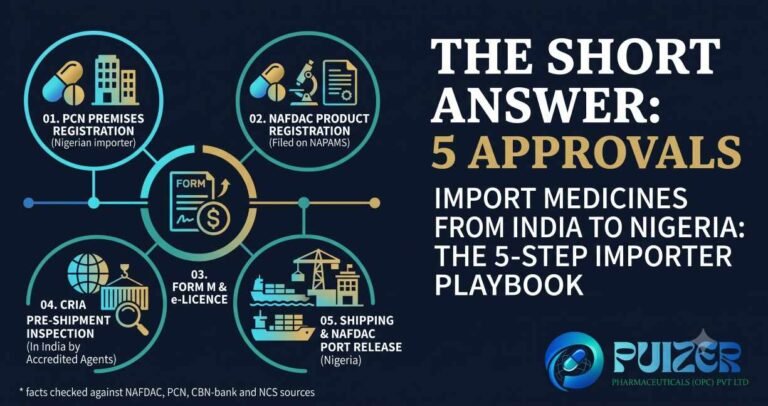
To import medicines from India to Nigeria legally, the steps below have to happen in sequence. Each one names who does the work.
- PCN premises (importer). The Nigerian importer registers its premises with the Pharmacy Council of Nigeria, run under a superintendent pharmacist.[1]
- NAFDAC registration on NAPAMS (importer files, manufacturer supplies). Each product is registered by the Nigerian applicant using the dossier, CoPP and GMP evidence from the Indian manufacturer.[2]
- Form M (importer). The importer obtains NAFDAC’s e-licence to open Form M, and its bank registers Form M against the manufacturer’s proforma invoice.[3][4]
- CRIA pre-shipment inspection (manufacturer hosts, importer is accountable). A NAFDAC-accredited agent in India inspects, samples and tests the consignment before it ships.[5]
- Shipping, PAAR and port release (both). The goods ship with the original CRIA, Nigeria Customs issues the PAAR, and NAFDAC releases the consignment at the port.[6]
The lane at a glance
Who owns each station on the India → Nigeria lane
Most delays on this route come from one side waiting on a document only the other side can produce. It helps to agree on ownership before the first proforma invoice is sent.
- 01PCN premises registrationImporter
- 02NAFDAC product registration (NAPAMS)Importer filesManufacturer supplies
- 03NAFDAC e-licence + Form MImporter + bankProforma
- 04CRIA inspection in IndiaManufacturer hostsImporter accountable
- 05Shipping, PAAR, NAFDAC port releaseShip + originalsClear
Why Form M comes before CRIA
Many guides put the pre-shipment inspection first, but NAFDAC’s guidance to its CRIA agents lists a copy of Form M among the documents the agent must see (only governments and UN agencies are exempt).[7] Banks also require Form M to be registered when the order is placed, which is before anything is manufactured for dispatch.[4] If an Indian exporter books CRIA before the Nigerian buyer has a Form M number, the job cannot be completed.
The consignee must match the registration
CRIA agents may only certify exports to the brand owner (marketing authorisation holder) or to the company named on the NAFDAC registration certificate.[7] If a different Nigerian company wants to import a product registered to someone else, the registration holder must first authorise it through NAFDAC’s Letter of No Objection route.[8]
Step by step
How to import medicines from India to Nigeria: the five steps
Pick a step to see what happens, what the Nigerian importer does and what the Indian manufacturer does.
Step 1: Register the importer’s premises with PCN
Lead: importerPharmacy Council of Nigeria
Nigerian law requires every place used for storing, distributing or selling drugs to be inspected and registered by the Pharmacy Council of Nigeria (PCN), and every pharmaceutical premises must be under the direct supervision of a superintendent pharmacist.[1] The regulator was renamed in 2022: the Pharmacy Council of Nigeria (Establishment) Act 2022 repealed the old Pharmacists Council of Nigeria Act, but the acronym stayed PCN.[1]
Importer does
- Incorporates a Nigerian company first. The full company-setup sequence is in our guide to starting a pharmaceutical import business in Nigeria.
- Appoints a fully registered superintendent pharmacist who holds a current annual licence, and has at least one pharmacist on the board.[9]
- Applies for premises registration on PCN’s Form B and hosts the PCN inspection.[9]
- Renews every year, because premises certificates fall due for renewal from 1 January.[9]
Indian manufacturer does
- Files nothing at this step.
- Asks for copies of the buyer’s current PCN premises certificate and superintendent pharmacist licence before quoting. NAFDAC asks for both at port clearance, so a buyer without them cannot receive the goods.[6]
Watch-out: A general trading company without a PCN-registered premises cannot be the importer of record for medicines, however strong its bank line or distribution network.
Step 2: Register each product with NAFDAC on NAPAMS
Applicant: importerEvidence: manufacturerNAFDAC
Every product (each brand, strength and dosage form) needs its own NAFDAC registration number before commercial import. Applications for imported drugs are filed on NAFDAC’s NAPAMS portal (registration.nafdac.gov.ng) by a company incorporated in Nigeria. NAFDAC’s current guideline for imported human and veterinary drugs, DR&R-GDL-005-03 (effective 20 March 2025), gives 240 working days to complete registration, and certificates are valid for five years.[2] A full walkthrough of the registration stages is in our NAFDAC drug registration guide.
Importer does
- Acts as the applicant, submitting evidence of CAC incorporation and the superintendent pharmacist’s annual licence.[2]
- Pays fees, answers NAFDAC queries on time and receives the permit to import registration samples.[2]
- Holds the registration certificate. The supply agreement should say what happens to it if the partnership ends.
Indian manufacturer does
- Supplies the technical dossier and the Certificate of Pharmaceutical Product (CoPP) and GMP evidence, authenticated by the Nigerian mission.[2]
- Provides a Power of Attorney notarised in India where the applicant does not own the brand name.[2]
- Ships registration samples with their certificates of analysis and prepares the site for a NAFDAC GMP inspection if one is scheduled. Our export documentation checklist covers the paperwork.
About the fast track: NAFDAC’s reliance guideline (DR&R-GDL-035-01, effective 25 September 2025) aims for a decision within 60 working days, but only for products already approved by a reference authority such as a stringent regulator or WHO prequalification.[10] Most Indian generics made for African markets will not qualify, so plan on the standard 240-day route.
Step 3: Open Form M with a NAFDAC e-licence
Lead: importer + bankProforma: manufacturerNAFDAC · CBN trade portal
Form M is Nigeria’s mandatory import declaration for goods paid for in foreign currency. It is registered through an authorised dealer bank on the trade portal when the order is placed, and is valid for 180 days for general merchandise, with extension possible.[4] For NAFDAC-regulated products, the e-Form M is checked against NAFDAC’s electronic permit. Since 9 September 2019, only digital NAFDAC permits, verified by an Approval Reference Code, have been accepted.[11]
Importer does
- Applies on the Nigeria Trade Portal (trade.gov.ng) for NAFDAC’s e-licence “Authorization to Open Form M”, attaching an application letter from the marketing authorisation holder and the NAFDAC registration certificate.[3]
- Gives the bank a valid proforma invoice and insurance certificate so it can register the Form M.[4]
- Sends the approved Form M copy and the e-licence to the manufacturer. The CRIA agent needs both.[7]
Indian manufacturer does
- Issues a proforma invoice that matches exactly what will be loaded: registered product names, strengths, pack sizes, quantities and values.
- Does not book CRIA or dispatch until the Form M copy arrives.
Platform in transition: The Nigeria Customs Service began piloting Form M processing on its B’Odogwu system in May 2025.[12] Ask the bank which platform your Form M will go through. The requirement is the same either way.
Step 4: CRIA pre-shipment inspection in India
Hosted by: manufacturerAccountable: importerNAFDAC-accredited agent
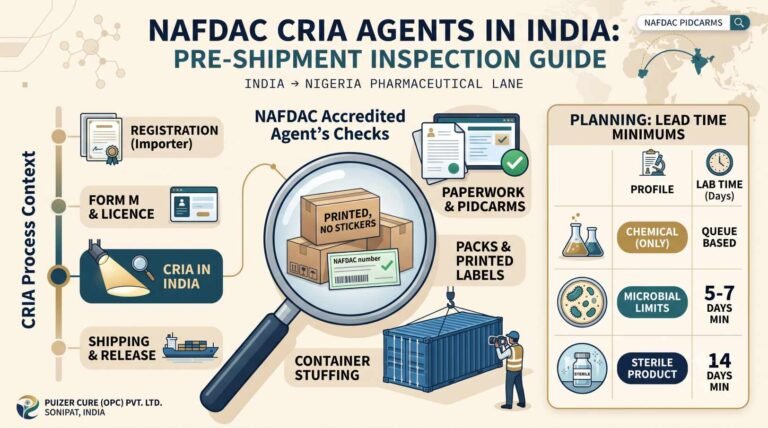
All NAFDAC-regulated products imported from India need a Clean Report of Inspection and Analysis (CRIA). The only exceptions are items on NAFDAC’s CRIA exemption list.[13] NAFDAC requires importers to obtain CRIA from an accredited agent before shipment, and consignments without it are not accepted at clearance.[14] NAFDAC currently lists five accredited agents in India: QCS Labs LLP, Silis Labs Pvt Ltd, Assurance Analytical Pvt Ltd, Quntrol Laboratories Pvt Ltd and Cotecna Inspection India Pvt Ltd.[5]
Importer does
Indian manufacturer does
- Books the agent and hands over the NAFDAC registration certificate or import permit, the e-licence, CoPP, Form M copy, bill of lading, invoice, packing list, laboratory report and manufacturing licence.[7]
- Presents the goods for sampling. The agent samples every product and randomly selects 20% of batches, testing all claimed parameters.[7]
- Prints the NAFDAC number, the manufacturer’s name and address, and the Nigerian authorisation holder’s name and address on the pack. Stickering these details is not allowed.[7]
- Hosts the container-stuffing inspection. The agent records inspector names and takes photographs.[7]
What happens next: The agent uploads the report to NAFDAC’s PIDCARMS system. A failed laboratory result must be reported to NAFDAC within 24 hours.[7] Packaging that has already been printed cannot be fixed with stickers at this stage, so settle Nigerian labelling at artwork stage. Our note on climate-zone packaging for export covers the pack side.
Step 5: Ship, obtain the PAAR and clear NAFDAC at the port
Ship + originals: manufacturerClear: importer’s agentNCS · NAFDAC PID
Once the CRIA is issued, the consignment ships. Before it arrives, the Nigeria Customs Service issues a Pre-Arrival Assessment Report (PAAR). PAAR now sits within B’Odogwu, the customs system that is replacing NICIS II. Your clearing agent will know which system your port of entry uses.[15] NAFDAC clearance of imported regulated products is done online on PIDCARMS,[13] following NAFDAC’s clearing guideline for finished pharmaceutical products (PID-GDL-004-00).[6]
Importer (via licensed clearing agent) does
- Pays the NAFDAC fee via Remita and files an indemnity letter undertaking to notify NAFDAC 48 hours before arrival and not to sell before examination.[6]
- Presents the SGD, commercial invoice, PAAR, Form M, bill of lading, packing list, Form C-30, evidence of registration, the manufacturer’s original certificate of analysis, the original CRIA, the pharmacy registration and the pharmacist’s licence.[6]
- Goes through First Endorsement, joint inspection and sampling, then Second Endorsement, which is the release.[6]
Indian manufacturer does
- Couriers the originals quickly: CRIA, batch certificates of analysis, commercial invoice, packing list and bill of lading.
- Keeps retention samples and batch records ready, because NAFDAC laboratory findings come back through the importer.
Release is not the finish line: Finished pharmaceuticals can be marketed only after a satisfactory NAFDAC laboratory evaluation, and an unsatisfactory result puts the consignment on hold.[6]
Division of work
Importer vs Indian manufacturer: who does what
| Step | Nigerian importer | Indian manufacturer / exporter | Authority · platform | Output |
|---|---|---|---|---|
| 1 · PCN premises | Superintendent pharmacist, Form B, inspection, annual renewal | Verifies buyer’s PCN certificate before quoting | Pharmacy Council of Nigeria | Premises certificate |
| 2 · NAFDAC registration | Applicant on NAPAMS, fees, queries, sample permit | Dossier, CoPP, GMP evidence, POA, samples, site inspection | NAFDAC · NAPAMS | NAFDAC number (5 years) |
| 3 · Form M | NAFDAC e-licence to open Form M; bank registers Form M | Exact proforma invoice; waits for Form M copy | NAFDAC · bank · trade portal | Form M number (180 days) |
| 4 · CRIA | Accountable; shares Form M and e-licence; agrees who pays | Books agent, presents goods, printed labels, stuffing inspection | Accredited agent · PIDCARMS | Clean Report of Inspection and Analysis |
| 5 · Port release | PAAR, NAFDAC clearance, indemnity, inspection, lab evaluation | Ships; couriers originals; supports lab queries | NCS (B’Odogwu) · NAFDAC PID | Second Endorsement (release) |
On a phone, swipe the table sideways to see every column.
Interactive · readiness check
Can this consignment ship yet?
Answer three questions to see the next step and who owns it. Nothing is stored or sent; it runs in your browser.
Your result
Choose one answer in each row
The verdict and the party responsible will appear here.
A planning aid based on the published NAFDAC, PCN and bank requirements cited on this page. It is not a regulatory determination.
Paperwork timing
What the Indian manufacturer sends, and when
For NAFDAC registration
- Dossier and CoPP
- GMP evidence, authenticated
- Power of Attorney (if needed)
- Registration samples + CoA
For Form M
- Proforma invoice matching the registered products and the planned load
For CRIA
- Registration certificate / permit and e-licence (from importer)
- Form M copy (from importer)
- CoPP, manufacturing licence, lab report
- Invoice, packing list, bill of lading
- Finished packs with printed Nigerian label details
At dispatch
- Original CRIA
- Original batch CoA
- Commercial invoice, packing list, bill of lading
Sources: NAFDAC DR&R-GDL-005-03, NAFDAC CRIA agent guidance and PID-GDL-004-00, as cited above.[2][7][6] For how batch evidence is generated at the plant, see the QC evidence behind every batch.
Risk
Where India → Nigeria shipments usually stall
- Booking CRIA before Form M exists. The agent needs the Form M copy, so the inspection cannot be closed.[7]
- Stickered labels. Adding the NAFDAC number or the Nigerian holder’s details by sticker is not allowed. Those details must be printed on the pack.[7]
- Consignee mismatch. Shipping to a buyer who is not the registration holder or brand owner, without NAFDAC authorisation, blocks CRIA.[7][8]
- Proforma drift. Pack sizes or product names on the invoice that differ from the registration and the Form M create a query at every later step.
- Originals travelling late. Clearance needs the original CRIA and the original manufacturer’s CoA.[6]
FAQ
Importing medicines from India to Nigeria: common questions
Both, in different ways. NAFDAC requires importers of regulated products from India to obtain CRIA from an accredited agent before shipment, so the importer is accountable if it is missing. The inspection itself happens in India, so the manufacturer or exporter books the agent, supplies the documents and presents the goods for sampling. Who pays the agent is a commercial term to agree in the contract.
Before. NAFDAC’s guidance to CRIA agents lists a copy of Form M among the required documents, and banks register Form M when the order is placed. The correct order is NAFDAC registration, then the NAFDAC e-licence and Form M, then CRIA in India, then shipment.
No. The applicant on NAPAMS must be a company incorporated in Nigeria with a licensed superintendent pharmacist. The Indian manufacturer supplies the dossier, the CoPP, GMP evidence and, where the applicant does not own the brand, a Power of Attorney notarised in India.
NAFDAC’s pre-shipment inspection page lists QCS Labs LLP, Silis Labs Pvt Ltd, Assurance Analytical Pvt Ltd, Quntrol Laboratories Pvt Ltd and Cotecna Inspection India Pvt Ltd. NAFDAC has suspended agents in the past, so check the live list on nafdac.gov.ng before booking.
NAFDAC’s 2025 guideline for imported drugs sets 240 working days, and the certificate is valid for five years. A reliance route targets 60 working days, but only for products already approved by a reference authority such as a stringent regulator or WHO prequalification. Most Indian generics will follow the standard route.
No. NAFDAC’s CRIA guidance states that stickering the NAFDAC registration number, the manufacturer’s name and address, or the Nigerian marketing authorisation holder’s details is not allowed. These must be printed on the pack, so Nigerian artwork has to be settled before production.
NAFDAC vets the documents (including the PAAR, Form M, original CRIA and original certificate of analysis), gives First Endorsement, joins the physical inspection, takes samples and then gives Second Endorsement, which releases the goods. The products can be marketed only after a satisfactory NAFDAC laboratory evaluation.
Yes, it is the successor body. The Pharmacy Council of Nigeria (Establishment) Act 2022 repealed the Pharmacists Council of Nigeria Act and renamed the regulator, and it still uses the acronym PCN. Premises registration for importers and wholesalers continues under the new Act.
Related on Puizer
Keep reading
Puizer Cure (OPC) Pvt. Ltd. · Sonipat, India
Planning your first India → Nigeria consignment?
Our export team prepares the manufacturer’s side of this lane: registration evidence, a proforma that matches your Form M, printed Nigerian artwork, and CRIA readiness.
References
- Federal Republic of Nigeria. Pharmacy Council of Nigeria (Establishment) Act, 2022. Abuja: Federal Government of Nigeria; 2022. Available from: https://pcn.gov.ng/wp-content/uploads/2024/09/Pharmacy-Council-of-Nigeria-Act-2022-publication.pdf. Accessed September 2026.
- National Agency for Food and Drug Administration and Control (NAFDAC). Guidelines for Registration of Imported Drug Products in Nigeria (Human and Veterinary Drugs). Doc. Ref. DR&R-GDL-005-03, effective 20 March 2025. Abuja: NAFDAC; 2025. Available from: https://nafdac.gov.ng/wp-content/uploads/Files/Resources/Guidelines/DR&R_2025/Guidelines-for-Registration-of-Imported-Drug-Products-in-Nigeria-Human-and-Veterinary-Drugs.pdf. Accessed September 2026.
- NAFDAC Ports Inspection Directorate. Guideline for Form M Online Application: Steps to Online Authorization to Open Form M. Abuja: NAFDAC; 2019. Available from: https://www.nafdac.gov.ng/wp-content/uploads/Files/Resources/Guidelines/PORTINSPECTION_GUIDELINES/Guideline-for-Form-M-Online-Application-2019.pdf. Accessed September 2026.
- First Bank of Nigeria. Forms A, M and Q [authorised dealer bank guidance; secondary source]. Lagos: First Bank of Nigeria; n.d. Available from: https://www.firstbanknigeria.com/business/trade/forms-a-m-and-q/. Accessed September 2026.
- NAFDAC. Pre-Shipment Inspection and Testing Agents [accredited CRIA agents, India and China]. Abuja: NAFDAC; n.d. Available from: https://nafdac.gov.ng/regulatory-resources/pre-shipment-inspection-and-testing-agents/. Accessed September 2026.
- NAFDAC. Guidelines for Clearing Imported Finished Pharmaceutical, Nutraceutical and Herbal Products (Human and Veterinary) at Ports of Entry in Nigeria. Doc. Ref. PID-GDL-004-00, effective 1 June 2018, review date 31 May 2023. Abuja: NAFDAC. Available from: https://www.nafdac.gov.ng/wp-content/uploads/Files/Resources/Guidelines/PORTINSPECTION_GUIDELINES/Guidelines-for-Clearing-Imported-Finished-Pharmaceutical-Nutraceutical-Herbal-Products-Human-Veterinary.pdf. Accessed September 2026.
- NAFDAC. Guidance Document for Carrying Out CRIA Services by CRIA Agents. Abuja: NAFDAC; n.d. [copy published by Quntrol Laboratories, a NAFDAC-accredited CRIA agent]. Available from: https://www.quntrol.com/web_img/nigeria/cria_requirements_and_guidelines.pdf. Accessed September 2026.
- NAFDAC. Guidelines for Issuance of Authorization on Letter of No Objection and Approval to Open Form M and Pre-Arrival Assessment Report (PAAR). Doc. Ref. PID-GDL-010-00, effective 1 June 2018, review date 31 May 2023. Abuja: NAFDAC. Available from: https://www.nafdac.gov.ng/wp-content/uploads/Files/Resources/Guidelines/PORTINSPECTION_GUIDELINES/Guidelines-for-Issuance-of-Authorization-on-Letter-of-No-Objection-and-Approval-to-Open-Form-M-PAAR.pdf. Accessed September 2026.
- Pharmacy Council of Nigeria. Guidelines for Registration of Pharmacists and Pharmaceutical Premises. Version 02, effective 27 January 2025. Abuja: PCN; 2025. Available from: https://pcn.gov.ng/wp-content/uploads/2025/03/Guidelines_for_Registration_of_Pharmacists_and_Pharmaceutical_Premises.pdf. Accessed September 2026.
- NAFDAC. Guidelines for Registration and Related Activities of Drugs, Vaccines and Medical Devices Including In-Vitro Diagnostics Using the Reliance Procedure. Doc. Ref. DR&R-GDL-035-01, effective 25 September 2025. Abuja: NAFDAC; 2025. Available from: https://nafdac.gov.ng/wp-content/uploads/Files/Resources/Guidelines/VBM_R&R/2025-2030/Guidelines-for-Registration-and-Related-Activities-of-Drugs-Vaccines-and-Medical-Devices-Including-In-Vitro-Diagnostics-Using-the-Reliance-Procedure.pdf. Accessed September 2026.
- Banwo & Ighodalo. Importation of NAFDAC-Regulated Products into Nigeria Now to be Processed on the Nigerian Trade Portal with e-Permits and Licenses [law-firm briefing; secondary source]. Lagos: Banwo & Ighodalo; 2019. Available from: https://www.banwo-ighodalo.com/grey-matter/importation-of-nafdac-regulated-products-into-nigeria-now-to-be-processed-on-the-nigerian-trade-portal-with-e-permits-licenses/. Accessed September 2026.
- Federal Ministry of Information and National Orientation. Nigeria Customs Service Pilots Form M Process on B’Odogwu Trade Portal. Abuja: FMINO; 5 May 2025. Available from: https://fmino.gov.ng/nigeria-customs-service-pilots-form-m-process-on-bodogwu-trade-portal/. Accessed September 2026.
- NAFDAC Ports Inspection Directorate. Port Inspection FAQs. Abuja: NAFDAC; n.d. Available from: https://nafdac.gov.ng/about-nafdac/nafdac-organisation/directorates/ports-inspection/port-inspection-faqs/. Accessed September 2026.
- NAFDAC. Public Announcement: Notification of Newly Accredited Clean Report of Inspection and Analysis (CRIA) Agents for China and India. Abuja: NAFDAC; 4 February 2020. Available from: https://nafdac.gov.ng/public-announcement-notification-of-newly-accredited-clean-report-of-inspection-and-analysis-cria-agents-for-china-and-india/. Accessed September 2026.
- PRNigeria. Explainer: What is PAAR? Understanding Customs’ New Clearance Document [news explainer; secondary source]. Abuja: PRNigeria; 5 April 2025. Available from: https://prnigeria.com/2025/04/05/explainer-paar-customs/. Accessed September 2026.
Reviewed by Darshan Singh, pharmaceutical QA, QC and regulatory affairs professional (23+ years). Author profile. Last checked against sources: 26 September 2026.
This page is technical and educational information for importers and exporters. It is not legal, regulatory or financial advice. NAFDAC, PCN, CBN and Nigeria Customs requirements, platforms and accredited-agent lists change without notice, so confirm the current position with the regulator and your licensed clearing agent before acting.