
Short answer · Import cost guide
What an African importer actually pays for medicines from India
The landed cost of medicines from India to Africa is the supplier’s ex-works price plus every cost needed to get the stock onto your warehouse shelf: Indian origin charges, main freight, cargo insurance, import duty, taxes and levies, port and clearing charges, any pre-shipment inspection or testing, a share of the product’s registration cost, and inland delivery. A FOB price stops at the vessel in the Indian port. A CIF price adds freight and minimum insurance to your port, but risk still passes to you in India under both rules.[1][2]
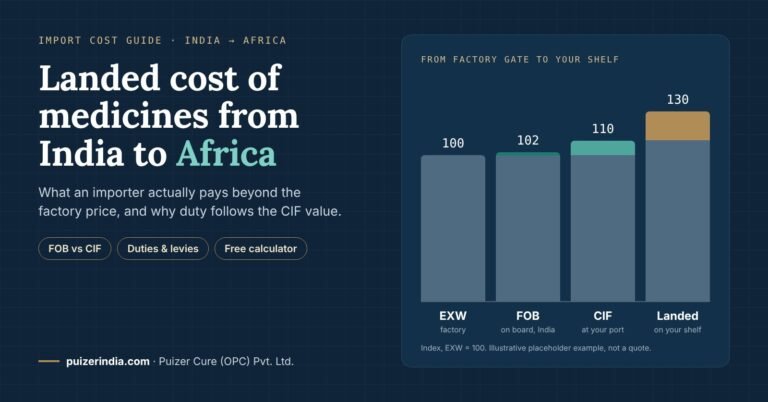
In the African markets we checked, customs value includes freight and insurance, so duty and import VAT grow with the CIF figure rather than the FOB figure.[6][7] In our placeholder example below, the landed cost comes to about 1.30 times the ex-works price. Your multiple will differ by market, order size and route.
Landed cost = EXW + origin charges = FOB
+ freight + insurance = CIF
+ duty + taxes and levies + port and clearing
+ inspection/testing + registration share + inland delivery
01 · The cost stack
The landed cost of medicines from India to Africa: nine costs above the factory price
Price comparisons between Indian suppliers usually go wrong for one reason: two quotes on different Incoterms are compared as if they were the same thing. Build the cost up in layers and the comparison becomes fair.
Ex-works (EXW) price
The product at the factory gate, packed for export. Exports from India are zero-rated for GST and can ship under a Letter of Undertaking without paying integrated tax, so an export quote should not carry Indian GST.[15]
Origin charges
Road haulage to the Indian port or airport, export customs clearance, origin terminal handling and the export document set (COA, CoPP, certificate of origin). Under FOB the seller clears the goods for export.[2]
Main freight
Sea freight (full container or consolidated LCL) or air freight to your port or airport. Landlocked markets add a transit leg from the coastal port.
Cargo insurance
A premium on the insured value. Under CIF the seller must buy only minimum cover, Institute Cargo Clauses (C); under CIP the seller must buy all-risks cover, Clauses (A).[1]
Import duty
A percentage of the customs value. Finished medicines are often duty-free (the EAC tariff puts heading 30.04 at 0%), but you must confirm the line for your HS code.[8]
Port and clearing
Destination terminal handling, the clearing agent’s fee, the medicines regulator’s port inspection fee, and storage or demurrage if documents are late.
Inspection and testing
Pre-shipment sampling and laboratory testing where the market requires it, such as Nigeria’s CRIA for products shipped from India.[13]
Registration share
Registration, GMP inspection and retention fees, spread over the packs you expect to sell while the registration is valid.
Inland delivery
Trucking from the port or bonded warehouse to your licensed premises, with temperature control if the label requires it.
Two further costs sit outside the calculator because they depend on your bank, not the shipment: the cost of financing the order between payment and sale, and exchange-rate movement between the invoice date and the customs assessment date.
02 · Incoterms
FOB vs CIF: what each quote includes, and where risk passes
Incoterms® 2020 are the International Chamber of Commerce (ICC) rules that say who arranges and pays for carriage, insurance and clearance, and when risk moves from seller to buyer. Four of the eleven rules (FAS, FOB, CFR, CIF) are for sea and inland waterway transport only; the other seven work for any mode.[5]
| Rule | Seller pays main freight? | Insurance duty on seller | Risk passes to you | Transport | Use it for medicines when |
|---|---|---|---|---|---|
| EXW | No | None | At the seller’s premises | Any | Rarely. ICC suggests EXW mainly for domestic sales, because the buyer must handle Indian export clearance.[3] |
| FCA | No | None | When handed to your carrier | Any | You have your own forwarder and ship by container or air. ICC treats FCA as the better fit for multimodal container moves than FOB.[2] |
| FOB | No | None | On board the vessel at the Indian port | Sea only | You control sea freight and insurance and want quotes from several lines.[2] |
| CFR | Yes | None | On board at the Indian port | Sea only | The seller has better freight rates, and you insure on your own policy.[16] |
| CIF | Yes | Minimum cover, Clauses (C) | On board at the Indian port | Sea only | Tender documents ask for CIF, or you need a single delivered price for budgeting.[1] |
| CIP | Yes | All-risks cover, Clauses (A) | When handed to the first carrier | Any | Air freight, containers or high-value stock where minimum cover is not enough.[1] |
| DAP | Yes | None | At the named destination, before unloading | Any | The seller delivers to your door but you clear customs. |
| DDP | Yes | None | At the named destination | Any | Seldom for medicines. The seller must clear imports, which ICC cautions can be impractical.[3] In Nigeria, for example, NAFDAC’s clearing guideline asks for the importer’s PCN premises certificate and pharmacist’s licence.[13] |
Scroll sideways on a phone to see every column.
Three points that change the numbers
- CIF does not move the transit risk to the seller. Risk passes once the goods are on board in India under both FOB and CIF. CIF only obliges the seller to buy insurance for your benefit.[1][2] If a pallet is crushed at sea, you claim on that policy.
- CIF cover is the minimum. Clauses (C) is the minimum level of cover, narrower than the all-risks Clauses (A) required under CIP. For medicines, where a water-damaged carton is unsaleable, ask for CIP terms or buy your own all-risks cover. A commentary by a member of the ICC drafting group notes the CIF insured amount must be at least 110% of the invoice value, in the invoice currency.[4]
- Air freight cannot be FOB or CIF. Those rules are sea-only. For air consignments the correct equivalents are FCA (airport) and CIP.[5]
03 · Duties and taxes
Why import duty is usually charged on CIF value, not FOB
The WTO Customs Valuation Agreement leaves each member to decide whether freight, handling and insurance to the port of import go into the customs value.[6] The African markets we checked include them. Uganda’s revenue authority, for example, defines customs value as the price paid plus insurance and freight up to the place of importation, then charges import VAT on the customs value plus import duty.[7] In Côte d’Ivoire, the US International Trade Administration reports duties assessed on CIF value and VAT charged on CIF plus all duties and taxes.[9]
The practical effect is a cascade. Every dollar of freight raises the customs value, every dollar of customs value raises the duty, and both raise the VAT. A cheaper freight quote therefore cuts the landed cost of medicines from India to Africa by more than its face value.
Air freight can be treated differently. Uganda Revenue Authority states that freight is not added to the customs value for goods carried by air.[7] The calculator below lets you switch freight out of the customs value for this reason. Ask your clearing agent how your market treats it.
Zero duty is not zero tax
Finished medicines often carry no customs duty. In the EAC Common External Tariff (2022 version, in force from 1 July 2022), the tariff lines under heading 30.04 that we checked, including 3004.90.00, are at 0%.[8] In Côte d’Ivoire, essential medicines fall in the ECOWAS tariff’s 0% band.[9] Other charges still apply. Côte d’Ivoire levies a 1% statistical duty on nearly all imports.[9]
Not every charge uses the CIF base. Nigeria’s Customs Service Act 2023 funds the service with not less than 4% of the FOB value of imports. Collection of the 4% FOB charge started on 4 August 2025, replacing the 1% CISS fee.[11] It had been suspended once in February 2025, and on 16 September 2025 the Federal Ministry of Finance directed a further suspension.[10][12] Confirm the current position with your clearing agent before you budget. The calculator has a separate field for any levy charged on FOB value.
For the documents Nigerian customs and NAFDAC expect at the port, see our guide on how to import medicines from India to Nigeria.
04 · Inspection
Pre-shipment inspection and testing: which markets add it
Pre-shipment programmes differ more than any other cost line, because medicines are usually controlled by the medicines regulator rather than the national standards bureau.
| Market | Position for finished medicines | Cost effect |
|---|---|---|
| Nigeria | NAFDAC’s clearing guideline requires the original Clean Report of Inspection and Analysis (CRIA) for products coming from China, Egypt and India.[13] Sampling and testing happen in India before shipment, through an accredited agent. | Agent and laboratory fees per consignment, plus time. See how NAFDAC CRIA works in India. |
| Kenya | KEBS’s PVoC manual (version 15, February 2026) lists HS 3003 to 3004 medicaments among products regulated by the Pharmacy and Poisons Board and exempted from PVoC.[14] | No PVoC certificate fee for medicaments, but the medicines regulator’s own import controls apply. |
| Other markets | Check the standards bureau’s exemption list and the medicines regulator’s import guideline together. A product can be exempt from one and still need the other. | Ask your clearing agent for the fee and who books it. |
Scroll sideways on a phone to see every column.
Who pays is a contract term, not a law. Write it into the purchase order, together with who pays for a retest if a sample fails.
05 · Registration amortisation
How to put registration cost into the price of each pack
Registration is paid once (with periodic retention fees), but it only makes sense per pack. Add up what the product will cost to keep on the market for one registration period, then divide by the packs you realistically expect to sell in that period:
Registration share per pack = (registration fee + GMP inspection + retention fees + local agent) ÷ packs sold during validity
The same cost lands very differently on small and large volumes. A placeholder budget of US$12,000 spread over 300,000 packs adds US$0.04 a pack. Spread over 50,000 packs it adds US$0.24, which can decide whether a product is viable in that market. For published regulator fees and timelines across eight markets, see our drug registration fees comparison for Africa.
Agree early who carries this cost. If the manufacturer funds the registration, expect it to be recovered through the price. If you fund it, put it in your own budget, even when the certificate names the manufacturer.
06 · Worked example
Worked example: 20,000 packs from EXW to landed
Placeholder numbers. Every figure below is illustrative. None is a Puizer Cure price, a freight quote or any one country’s tariff. Replace each with your own quotes and your market’s rates in the calculator.
To see how the landed cost of medicines from India to Africa builds up, take an importer who buys 20,000 packs of a 10 × 10 tablet at an ex-works price of US$1.10 a pack, by sea, with an assumed 5% import duty, 2% of other levies on customs value and no import VAT.
| Step | How it is worked out | US$ |
|---|---|---|
| Ex-works goods value | 20,000 × 1.10 | 22,000.00 |
| Origin charges | Haulage, export clearance, documents (placeholder) | 450.00 |
| FOB value | EXW + origin charges | 22,450.00 |
| Sea freight | To the destination port (placeholder) | 1,600.00 |
| Insurance | 0.25% × 110% × (FOB + freight) | 66.14 |
| CIF value = customs value | FOB + freight + insurance | 24,116.14 |
| Import duty | 5% × customs value | 1,205.81 |
| Other levies | 2% × customs value | 482.32 |
| Import VAT | 0% × (customs value + duty) | 0.00 |
| Port and clearing | Terminal, agent, regulator port fees (placeholder) | 950.00 |
| Inspection and testing | Where required (placeholder) | 700.00 |
| Registration share | US$12,000 ÷ 300,000 packs × 20,000 | 800.00 |
| Inland delivery | Port to warehouse (placeholder) | 400.00 |
| Landed cost | US$1.43 a pack | 28,654.27 |
Scroll sideways on a phone to see every column.
Where the money goes in this example:
- Goods 76.8%
- Origin 1.6%
- Freight + insurance 5.8%
- Duty + levies 5.9%
- Port + clearing 3.3%
- Inspection 2.4%
- Registration 2.8%
- Inland 1.4%
What the example shows
- FOB to landed is +27.6% here, CIF to landed +18.8%, EXW to landed +30.2%. A CIF quote that looks 10% dearer than a FOB quote may actually be cheaper once you price your own freight and insurance.
- The fixed costs dominate small orders. Port, inspection and inland charges barely change between 5,000 and 20,000 packs, so halving the order raises the cost per pack noticeably. Test it in the calculator.
- The registration share is invisible in the supplier quote, yet in this example it costs more than inland delivery.
07 · Calculator
Landed cost calculator for medicines from India to Africa
Estimate the landed cost of medicines from India to Africa from the quote you actually hold. Choose its Incoterm and the transport mode, then enter your own figures. The defaults are the placeholder example above. Amounts are in US dollars; any single currency works if you enter every field in it.
Your supplier’s price is quoted
Main transport
Default: an ex-works quote shipped by sea, as in the worked example
You pay Indian origin charges, sea freight, insurance and every destination cost.
| Cost layer | Amount | Per pack | Share |
|---|---|---|---|
| Turn on JavaScript to see the breakdown. The worked example above shows the method. | |||
Indicative estimate only, not a quotation. Duty, tax and levy rates change; confirm them with your clearing agent and the revenue authority’s current tariff.
08 · Checklist
Before you compare two quotes from Indian suppliers
Eight checks keep the landed cost of medicines from India to Africa comparable from one supplier to the next.
- Put both quotes on the same Incoterm and named place (for example “CIF Mombasa”, not just “CIF”).
- Confirm the pack size and shelf life at dispatch; a cheaper pack with less remaining shelf life costs more to sell.
- For CIF quotes, ask for the insurance certificate terms: clauses, insured amount and claims agent in your country.
- Check the packaging and stability data fit your climate zone, see our note on climate-zone stable export packaging.
- Confirm the HS code the supplier will declare, so your duty and levy lines are right.
- Agree who books and pays for pre-shipment testing, and who pays a retest.
- Check every document your regulator needs at the port is in the supplier’s scope, using our pharmaceutical export documentation checklist.
- Add the registration share per pack before deciding which product is cheaper.
09 · FAQ
Questions importers ask about FOB, CIF and landed cost
A FOB price covers the goods loaded on the vessel at the Indian port, with Indian export clearance done. A CIF price adds sea freight and minimum cargo insurance to your named port. Under both rules the risk of loss passes to the buyer once the goods are on board in India, and both are sea-only rules under Incoterms 2020.
Usually on a CIF-type value. The WTO valuation rules let each country decide whether freight and insurance are included, and the African markets we checked include them. Some markets exclude air freight, and some levies are charged on FOB value instead, so confirm the base for each charge with your clearing agent.
Buy FOB or FCA if you or your forwarder can get better freight rates and you want to choose your own insurer. Buy CIF or CIP if you want one delivered price for budgeting or a tender. For air freight and containers, ask for FCA or CIP, and for medicines prefer CIP or your own all-risks policy, because CIF only requires minimum cover.
Often for customs duty, not always for other charges. The EAC Common External Tariff puts the medicament lines under heading 30.04 at 0%, and essential medicines are in the ECOWAS 0% band in Côte d’Ivoire. Statistical duties, processing fees, development levies and in some markets VAT may still apply, so check your exact HS code.
It is agreed between buyer and seller in the contract. NAFDAC requires the original CRIA for medicines shipped from India, China and Egypt, but its guideline does not fix who pays. State in the purchase order who books the agent, who pays the testing fee, and who pays if a retest is needed.
Add the registration fee, GMP inspection fee, retention fees and local agent costs for one registration period, then divide by the packs you expect to sell in that period. Multiply the per-pack figure by the packs in the shipment. Small expected volumes can make this the largest cost after the goods themselves.
It should not. Under section 16 of India’s IGST Act, exports are zero-rated supplies, and exporters can ship under a bond or Letter of Undertaking without paying integrated tax. If an export quote shows Indian GST, ask the supplier to explain it before you compare it with other quotes.
Related on Puizer India
Guides that feed into your landed cost
Published fees and timelines for eight regulators, for the registration share in your budget.
How Nigeria’s pre-shipment sampling and testing works before your goods leave India.
Public tender and private importer routes into a landlocked market.
The batch documents that keep a consignment moving at the port.
Market-by-market starting points for importers sourcing from India.
Get a like-for-like quote for your port
Tell us the products, pack sizes, annual volume and your port or airport. Puizer Cure (OPC) Pvt. Ltd. will quote on the Incoterm you choose, with the export document set listed, so you can run the numbers above against real figures.
Sources
References
- International Chamber of Commerce Academy. CIF & CIP Incoterms® 2020 explained: key differences. Paris: ICC; 2024 Oct 7. Available from: https://academy.iccwbo.org/incoterms/article/incoterms-2020-cip-or-cif/. Accessed Oct 2026.
- International Chamber of Commerce Academy. FCA & FOB Incoterms® 2020 explained: key differences. Paris: ICC; 2024 Nov 19. Available from: https://academy.iccwbo.org/incoterms/article/incoterms-2020-fca-or-fob/. Accessed Oct 2026.
- International Chamber of Commerce. Incoterms® 2020 checklist and flowcharts: how to choose the right Incoterms® (ICC Publication 817E). Paris: ICC; 2022. Available from: https://library.iccwbo.org/content/clp/Others/incoterms_2020_checklist_2024-update.pdf. Accessed Oct 2026.
- Ronai B. Cost, Insurance and Freight (CIF): Incoterms® 2020 commentary. London: Trade Finance Global; 2020. Author’s views as a member of the ICC Incoterms 2020 drafting group, not an official ICC text. Available from: https://www.tradefinanceglobal.com/wp-content/uploads/2020/01/Cost__Insurance__Freight_CIF.pdf. Accessed Oct 2026.
- International Trade Administration, US Department of Commerce. Know your Incoterms. Washington (DC): ITA; [updated 2026 Apr]. Available from: https://www.trade.gov/know-your-incoterms. Accessed Oct 2026.
- World Trade Organization. WTO analytical index: Customs Valuation Agreement, Article 8. Geneva: WTO. Available from: https://www.wto.org/english/res_e/publications_e/ai17_e/cusval_art8_oth.pdf. Accessed Oct 2026.
- Uganda Revenue Authority. Import and export FAQs: how customs value and taxes are computed. Kampala: URA. Available from: https://ura.go.ug/?p=36256. Accessed Oct 2026.
- East African Community. Common External Tariff, 2022 version (in force 1 July 2022), Chapter 30, heading 30.04, pp. 159 to 160. Arusha: EAC Secretariat; 2022. Copy hosted by UNIDO ITPO Tokyo: https://itpo-tokyo.unido.org/files/Tariff_CET_2022_Version_25072022_1.pdf. Accessed Oct 2026.
- International Trade Administration, US Department of Commerce. Côte d’Ivoire country commercial guide: import tariffs. Washington (DC): ITA; 2026 May 26. Available from: https://www.trade.gov/country-commercial-guides/cote-divoire-import-tariffs. Accessed Oct 2026.
- TheCable. Customs suspends implementation of 4% FOB levy. Lagos: TheCable; 2025 Feb 11. Available from: https://thecable.ng/breaking-customs-suspends-implementation-of-4-fob-levy. Accessed Oct 2026.
- AllAfrica. Nigeria: cargo clearance cost to rise as Customs begins 4 percent levy collection. 2025 Aug 6. Available from: https://allafrica.com/stories/202508070485.html. Accessed Oct 2026.
- Federal Ministry of Information and National Orientation, Nigeria. Nigeria Customs Service acknowledges Federal Ministry of Finance directive on 4% FOB implementation. Abuja; 2025 Sep 16. Available from: https://fmino.gov.ng/nigeria-customs-service-acknowledges-federal-ministry-of-finance-directive-on-4-fob-implementation/. Accessed Oct 2026.
- National Agency for Food and Drug Administration and Control (NAFDAC). Guidelines for clearing imported finished pharmaceutical, nutraceuticals and herbal products (human and veterinary) at ports of entry in Nigeria. Doc. Ref. PID-GDL-004-00. Effective 2018 Jun 1; reviewed 2023 May 31. Available from: nafdac.gov.ng (PDF). Accessed Oct 2026.
- Kenya Bureau of Standards. Pre-Export Verification of Conformity (PVoC) programme operations manual, version 15, Annex 2. Nairobi: KEBS; 2026 Feb 19. Available from: https://kebs.org/wp-content/uploads/2026/03/PVoC-Manual-Version-15.pdf. Accessed Oct 2026.
- Central Board of Indirect Taxes and Customs. Integrated Goods and Services Tax Act, 2017, section 16: zero rated supply. New Delhi: CBIC. Available from: taxinformation.cbic.gov.in. Accessed Oct 2026.
- International Chamber of Commerce Academy. CFR & CIF Incoterms® 2020 explained: key differences. Paris: ICC; 2024 Aug 21. Available from: https://academy.iccwbo.org/incoterms/article/incoterms-2020-cfr-or-cif/. Accessed Oct 2026.
Scope and limitations. This guide explains a costing method. It is not a tariff ruling, a freight quotation or legal, tax or financial advice. Duty, VAT and levy rates and their bases change, sometimes at short notice (Nigeria’s FOB charge is an example), and they vary by HS code and by exemption status. The worked example and calculator defaults are placeholders. The EAC tariff was read from a copy of the 2022 version hosted by UNIDO; check the current EAC gazette for any later stay of application on your product line. Incoterms® is a registered trademark of the International Chamber of Commerce; the official rules are in ICC Publication 723E.