
Supplier due diligenceIndia GMP lawLast verified 12 Oct 2026
The short answer for importers
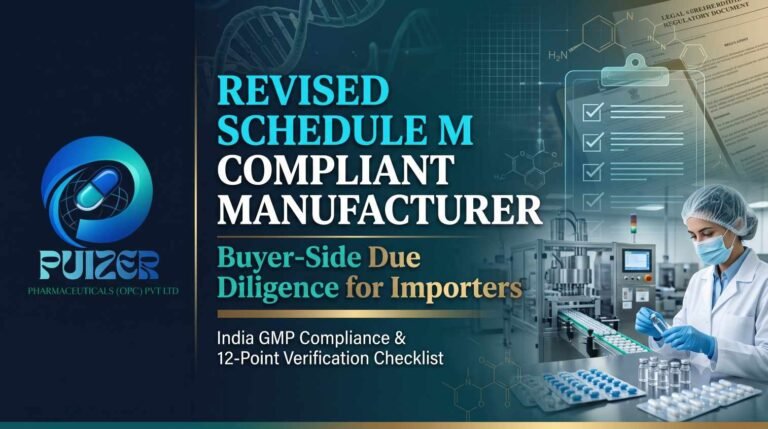
A revised Schedule M compliant manufacturer is one whose licensed site meets India’s current GMP law and can prove it. Revised Schedule M is India’s mandatory good manufacturing practice (GMP) standard, notified as G.S.R. 922(E) on 28 December 2023[1]. Manufacturers with turnover above ₹250 crore had six months to comply; smaller manufacturers had twelve[2]. Smaller units that applied in Form A could stretch that to 31 December 2025, and no later[3]. No further extension has been notified[4], and state regulators have been inspecting since late 2025[5][6].
There is no stand-alone “Schedule M certificate” to collect. Compliance is a condition of the Indian manufacturing licence, checked by inspection. So a buyer should ask for evidence: the licence, the latest inspection outcome, and the quality-system records the revised rule introduced. The 12-point checklist below turns that into a request you can send to any supplier.
- 28 Dec 2023
- Revised Schedule M notified (G.S.R. 922(E))
- ₹250 crore
- Turnover line between the two compliance timelines
- 31 Dec 2025
- Last date for units that obtained an extension
- 2026
- Risk-based and verification inspections under way
What revised Schedule M changed
Schedule M of the Drugs Rules, 1945 sets the GMP and premises requirements every licensed drug manufacturer in India must meet. The 2023 revision replaced the old text[1]. CDSCO’s own summary of what is new lists ten items: a pharmaceutical quality system, quality risk management, product quality review, qualification and validation, a product recall system, change control, self-inspection and quality audits, supplier audit and approval, stability studies, and validation of GMP-related computerised systems. It also adds specific requirements for hazardous, biological, radiopharmaceutical and phytopharmaceutical products[7].
The structure will look familiar to anyone who has audited against WHO GMP. Part I of the revised text runs in almost the same order as WHO’s main GMP principles: quality system, GMP, sanitation, validation, complaints, recalls, contract work, self-inspection and supplier audits, personnel, premises, equipment and materials. The Indian text gives quality risk management and change control their own sections[1][8]. In practice, the evidence a buyer asks for under one maps closely onto the other.
The timeline that decides your supplier’s status
- 28 Dec 2023
Notified. G.S.R. 922(E) publishes the revised Schedule M[1].
- Jun 2024
Large manufacturers due. Six months from notification for firms with turnover above ₹250 crore[2].
- Dec 2024
Original date for smaller manufacturers. Twelve months from notification for firms below ₹250 crore[2].
- 11 Feb 2025
One conditional extension. G.S.R. 127(E) let manufacturers with turnover under ₹250 crore apply in Form A, with a plan of upgradation, within three months. Any extension was capped at 31 December 2025[3].
- 5 Oct 2025
Centre presses states. A Union Health Ministry meeting with states on cough-syrup quality called for strict adherence to revised Schedule M by all manufacturers. Risk-based inspections had begun at 19 units in six states[5].
- Nov 2025
Enforcement instruction. CDSCO asked state drug controllers to inspect and act at once against small units that never applied for an extension. For units that did apply, states were to plan verification inspections from 1 January 2026 and report monthly[9].
- 29 Dec 2025
Conflicting reports. Business Standard reported a further extension was unlikely and inspections would start in January[10]. KNN reported the same day that a one-year extension was under consideration[11].
- 2026
No extension; inspections running. CDSCO’s gazette list shows no Schedule M notification dated 2026 (checked 12 Oct 2026)[4]. In Himachal Pradesh, 270 of 360 units assigned for review had been inspected by April 2026. Some received stop-manufacturing orders, and 10 to 12 firms surrendered licences[6].
Two reports from 29 December 2025 agree that about 6,500 small manufacturers needed to upgrade and about 2,000 were already WHO-GMP certified. They differ on how many had filed upgrade plans: about 1,700 (26%) in one[10] and 1,400 (21.5%) in the other[11]. On either figure, most small units had not filed a plan. That is the population an importer is choosing from.
Why this matters to an importer in Africa
Supply continuity is now a quality question
Units that cannot upgrade are being stopped or are closing[6]. Your product registration names a manufacturing site. Moving to a new site generally needs your regulator’s approval first, so a supplier’s shutdown can interrupt supply long after the purchase order.
Export-only products are in scope
The product quality review clause covers all products, explicitly including those made only for export[1]. A site cannot run one standard for India and a looser one for your market.
A WHO-GMP certificate is necessary, not sufficient
It records a site’s status at the time of inspection. Ask what has been inspected since, and read it alongside the three layers of quality evidence: site, product and batch.
Some markets add their own checks on top. Nigeria’s NAFDAC, for example, requires pre-shipment inspection of consignments in India by its CRIA agents. A supplier that is struggling with Indian GMP will struggle there too.
Where your supplier sits: four situations
Ask every supplier which of these applies to the site that makes your product. The answer tells you what evidence a revised Schedule M compliant manufacturer in that position should already hold.
Firms with turnover above ₹250 crore had six months from 28 December 2023[2]. By now they should be able to describe at least one regulatory inspection against the revised standard.
- Ask for the date and outcome of the latest state or CDSCO GMP inspection, and whether all observations are closed.
- Ask for the site master file and the product quality review summary for your product.
These units applied under G.S.R. 127(E) with an upgrade plan, and their extension ended on 31 December 2025[3]. States were told to verify them by inspection from January 2026[9].
- Ask for the Form A acknowledgement and a summary of what the upgrade changed (for example HVAC, QC laboratory, documentation).
- Ask whether the 2026 verification inspection has happened, and its outcome.
A small unit that did not apply was bound by the original twelve-month timeline[2]. In November 2025 CDSCO asked states to inspect and act against such units immediately[9].
- If it says it complied without an extension, ask for the inspection that confirms it.
- Without that evidence, do not file a dossier naming this site.
Revised Schedule M has a section on contract manufacture and analysis[1]. When a product is made at a third-party site, the site named on the CoPP and in your dossier is the one whose status matters, not the brand owner’s.
- Ask which site makes each product, and apply the first three tabs to that site.
- See how third-party manufacturing models for African markets differ before you sign.
How to verify a revised Schedule M compliant manufacturer: 12-point checklist
Tick what a supplier has already given you. The box at the end builds a request for everything still missing, ready to paste into an email. Nothing you tick leaves this page.
Start by ticking what you already hold.
Your request for the missing itemsRed flags that should pause a purchase order
- A “Schedule M certificate” with no issuing authority, date or inspection behind it.
- The supplier cannot say whether it was above or below ₹250 crore, or whether it filed Form A.
- The only evidence is a WHO-GMP certificate issued before the revised deadlines, with no later inspection the supplier can describe.
- A refusal to share a product quality review summary or stability data, even under a confidentiality agreement.
- Different site addresses on the licence, the CoPP and the CoA.
- Recent production stoppage or licence surrender at the site. Ask directly.
Revised Schedule M, WHO-GMP and ISO 9001: what each one tells you
Scroll the table sideways
| Item | What it is | What it shows a buyer | What it does not show |
|---|---|---|---|
| Revised Schedule M | India’s statutory GMP standard under the Drugs Rules, 1945, binding on every licensed manufacturer[1] | With a live licence and a clean recent inspection, the site operates under India’s current GMP law | Whether your product is registered, or stable, in your market |
| WHO-GMP certificate and CoPP | Certificates issued by Indian regulators for export under the WHO certification scheme | The site met WHO GMP when inspected, and the product is licensed in India | Anything that changed at the site after the inspection date |
| ISO 9001 | A general quality management standard certified by private bodies | The company runs a documented quality management system | GMP compliance. It is not a manufacturing licence or a GMP certificate |
Frequently asked questions
No further extension has been notified. G.S.R. 127(E) capped extensions at 31 December 2025[3], and CDSCO’s gazette list shows no Schedule M notification dated 2026 as of 12 October 2026[4]. Press reports at the end of December 2025 conflicted on whether another extension was being considered, but state inspections continued into 2026.
Not as a stand-alone certification scheme. Revised Schedule M is a condition of the Indian manufacturing licence and is enforced through inspection. Ask for the licence, the date and outcome of the latest GMP inspection, and the WHO-GMP certificate and CoPP for your product. If a supplier shows a document called a Schedule M certificate, ask which authority issued it and after which inspection.
Yes. It applies to the licensed site, whatever market the product is for, and its product quality review clause names export-only products explicitly[1]. An importer can ask for the same evidence an Indian inspector would see.
They are different instruments. Revised Schedule M is Indian law; WHO GMP is a WHO guideline used for the WHO certification scheme. The revised Indian text follows the structure of WHO’s main GMP principles closely[1][8], so a site that genuinely meets one should find the other familiar. Ask for evidence of both.
Your registration names the manufacturing site, so you generally cannot switch to another site without your regulator’s prior approval. Check the variation rules in your registration. This is why the supplier’s Schedule M status belongs in your checks before you file a dossier, and why a second qualified source is worth considering for high-volume products.
Ask for evidence rather than a claim: the manufacturing licence for the exact site, the supplier’s turnover category and Form A status, the date and outcome of its latest GMP inspection, the WHO-GMP certificate and CoPP, and quality-system records such as the product quality review and stability data for your climatic zone. Then confirm the certificates with the authority that issued them.
Keep reading
- WHO-GMP medicine supplier: the QC evidence behind every batchWhat site, product and batch documents each prove.
- Pharmaceutical export documentation checklistCoA, WHO-GMP, CoPP, certificate of origin and free sale certificate.
- Choosing a WHO-GMP pharmaceutical exporter from India for East AfricaHow to vet an exporter for EAC markets.
- Private-label manufacturing for East AfricaYour brand, made at a site you have checked.
Use this checklist on us too
Judge every supplier, including us, by the evidence a revised Schedule M compliant manufacturer should hold. Send Puizer Cure (OPC) Pvt. Ltd. your product list and the checklist items you need. We will tell you what we can share for each product and the site that makes it.
References
- Ministry of Health and Family Welfare (India). G.S.R. 922(E): Notification of Schedule M of the Drugs Rules, 1945 (Good manufacturing practices and requirements of premises, plant and equipment for pharmaceutical products). Gazette of India, Extraordinary. New Delhi; 28 Dec 2023. Available from: cdsco.gov.in. Accessed Oct 2026.
- Lok Sabha. Unstarred Question No. 864: revised GMP framework for small pharmaceutical companies. Answered 29 Nov 2024. New Delhi: Lok Sabha Secretariat; 2024. Available from: eparlib.sansad.in. Accessed Oct 2026.
- Ministry of Health and Family Welfare (India). G.S.R. 127(E): Extension of timeline for implementation of Schedule M. Gazette of India, Extraordinary. New Delhi; 11 Feb 2025. Available from: cdsco.gov.in. Accessed Oct 2026.
- Central Drugs Standard Control Organisation. Gazette notifications [list]. New Delhi: CDSCO. Available from: cdsco.gov.in. Accessed 12 Oct 2026.
- News On AIR. Union Health Ministry advises rational use of cough syrups, especially for children. New Delhi: Prasar Bharati; 5 Oct 2025. Available from: newsonair.gov.in. Accessed Oct 2026.
- Sharma A. Small pharma units in Himachal shut shop as revised Schedule M norms tighten compliance net. The Tribune. 11 Apr 2026. Available from: tribuneindia.com. Accessed Oct 2026.
- Chandrashekar R. Update on Drugs and Cosmetics Act and revised Schedule M [presentation]. Central Drugs Standard Control Organisation; 28 Jun 2024. Available from: ipa-india.org. Accessed Oct 2026.
- World Health Organization. WHO good manufacturing practices for pharmaceutical products: main principles. WHO Technical Report Series No. 986, Annex 2. Geneva: WHO; 2014. Available from: who.int. Accessed Oct 2026.
- Pharmabiz. Revised Schedule M: CDSCO asks State regulators to take action on non-compliant SMEs. Mumbai: Saffron Media; 8 Nov 2025. Available from: pharmabiz.com. Accessed Oct 2026.
- Koul S. Schedule M extension for MSME pharma firms unlikely. Business Standard. 29 Dec 2025. Available from: business-standard.com. Accessed Oct 2026.
- KNN India. Govt considers 1-year extension for small pharma firms ahead of Schedule M 2026 rollout. New Delhi: KNN; 29 Dec 2025. Available from: knnindia.co.in. Accessed Oct 2026.
This article is technical and educational information for pharmaceutical importers. It is not legal, regulatory or medical advice. Indian drug rules and their enforcement change frequently, and state-level practice varies; confirm the current position with the issuing authority and your own regulator before relying on it. Status checked against the sources above on 12 October 2026. Written by Darshan Singh (23+ years in pharmaceutical QC, QA and regulatory affairs) for Puizer Cure (OPC) Pvt. Ltd.