
Export reference · India to Africa
The short answer
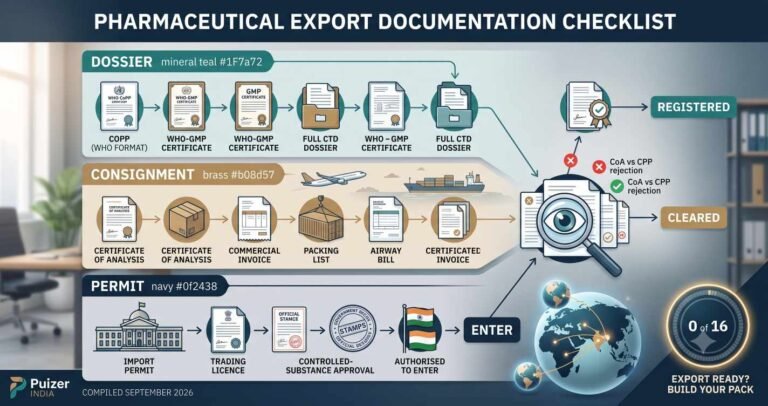
A pharmaceutical export from India to an African market runs on three separate document layers, not one list. The dossier layer gets the product registered and is built around a Certificate of Pharmaceutical Product and a WHO-type GMP certificate. The consignment layer clears one physical shipment and is built around a batch Certificate of Analysis, invoices and a transport document. The permit layer is the destination regulator’s own authorisation, issued before the goods are loaded.
Most rejected consignments are not rejected for missing paperwork. They are rejected because a document from one layer was offered in place of a document from another — a Certificate of Analysis will not register a product, and a Certificate of Pharmaceutical Product will not clear a container.
Regulatory position compiled September 2026 from the primary instruments cited below. Every requirement in this page is attributed; where a regulator’s own document could not be retrieved, that gap is stated rather than filled in.
This page is the reference the country guides point at. If you are working on a single market, start with the PPB Kenya drug registration process, the Tanzania TMDA drug registration process, the Uganda NDA drug registration process, the Rwanda FDA drug registration process, the EFDA Ethiopia drug registration process or the NAFDAC drug registration process. This page covers what every one of them has in common: the documents themselves.
The three document layers
The distinction matters because the documents are issued by different bodies, on different timescales, and expire differently. The Certificate of Pharmaceutical Product is issued under the WHO Certification Scheme on the quality of pharmaceutical products moving in international commerce, and the Scheme itself states that the certificate “is intended to be incorporated into a marketing authorization application to the requesting authority”[1]. It is a registration document. It does nothing at a port.
Layer 01Dossier — registers the product
Submitted once per product per market. Reviewed over months, not days.
- Certificate of Pharmaceutical Product (WHO format)
- Valid manufacturing authorisation
- WHO-type GMP certificate
- Full CTD dossier, Modules 1 to 5
- Letter of Access to a CEP or an APIMF
- Product samples
Layer 02Consignment — clears one shipment
Rebuilt for every shipment. Batch-specific and date-sensitive.
- Certificate of Analysis, per batch
- Proforma invoice
- Commercial invoice
- Packing list
- Airway bill or bill of lading
- Certificate of Origin
Layer 03Permit — authorises the import
Issued by the destination regulator before loading. Time-limited.
- Import permit, licence or verification certificate
- Importer’s own trading licence or competence certificate
- Controlled-substance approval, where applicable
The dossier layer is heavily harmonised across East Africa. Module 1 of the East African Community compendium requires the applicant to “Submit a Certificate of Pharmaceutical Product in format recommended by the World Health Organization together with a valid Manufacturing Authorization for pharmaceutical production”, and separately instructs the applicant to attach a WHO-type certificate of GMP[2]. The consignment layer is not harmonised at all. Tanzania requires a Certificate of Analysis for every batch at the port[3]; Uganda does not ask for one at all when the product is already registered.
Build your export pack
Export document readiness check
Tick what you actually hold today, in your hand, current and signed. The counter is deliberately unforgiving — a certificate that is being renewed does not count. Nothing is saved or transmitted; this runs entirely in your browser.
Layer 01 — Dossier
Layer 02 — Consignment
Layer 03 — Permit and market access
The five certificates buyers name most often
These are the documents an African importer, a tender desk or a regulator will ask for by name. Each is a different instrument with a different issuer, and the differences are where deals stall.
Certificate of Analysis (CoA)
A batch-specific quality-control record for one manufactured lot: every test parameter, the specification, the result obtained, the method reference, the manufacturing and expiry dates, and the signatures of the analyst and the approving quality person. It is issued by the manufacturer’s own quality control function. It is not a government document, which is precisely why regulators cross-check it against everything else in the file.
It is the single most consistently demanded consignment document across the region. Tanzania is explicit: each imported consignment “must be accompanied by an import permit, original proforma invoice, commercial invoice, airway bill or bill of lading and CoA for each batch”[3]. Rwanda requires a certificate of analysis at the import licence stage, and again at the port of entry, where the consignment must carry “a certificate of analysis for each batch or a certificate of conformity”[4]. Rwanda exempts consignments originating from countries with stringent regulatory authorities from providing a certificate of compliance and CoA — India is not on that list, so the exemption does not reach an Indian shipment[5].
Uganda is the exception worth knowing. The National Drug Authority’s import guideline lists the CoA under its export provisions, not under the import of registered drugs; an application to import a registered product asks only for a proforma invoice from the supplier authorised by the local agent, plus donation, medical-camp or narcotics paperwork where those apply[6]. Do not assume symmetry between a regulator’s import and export rules.
Where it fails: batch number on the CoA not matching the packing list or the carton; an expiry date that breaches the destination’s remaining-shelf-life rule; a CoA issued against an in-house specification when the dossier claims a pharmacopoeial one.
WHO-GMP certificate
Certification that the manufacturing site complies with Good Manufacturing Practice, issued in the WHO format. In India it is applied for through the Online National Drugs Licensing System, the joint CDSCO and State portal, where WHO-GMP, Free Sale Certificate and CoPP are separate application types within one workflow[7].
The issuing mechanism is a joint one, and this is the part exporters most often get wrong when briefing a buyer. CDSCO’s own guidance document tasks its zonal and sub-zonal offices “to scrutinize the application and participate in the joint inspection for issuance /revalidation of Certificate of Pharmaceutical Products (COPPs) as per WHO certification scheme”, and instructs the zonal officer to “propose for a joint inspection to the State Licensing Authority”[8]. The State Licensing Authority is a party to the inspection, not a bystander. Goa’s Food and Drugs Administration, for example, lists “Grant of certificates – WHO-GMP COPP” among its own drug functions, and publishes a seven-day service standard for “Grant of Good Manufacturing Practices Certificate” against four documents: the fee challan, a draft of the certificate, a copy of the manufacturing licence granted, and a covering letter[9].
On the buyer’s side, the East African Community compendium requires that for all medicines, irrespective of country of origin, key manufacturing steps be performed in plants complying with EAC GMP guidelines, and instructs the applicant to attach a WHO-type certificate of GMP. A separate, weaker requirement follows for GMP certificates issued by an EAC national authority or a stringent authority, which are to be submitted “If available at the time of submission of application”[2]. Read those two sentences in the right order: the WHO-type certificate is the mandatory one.
At consignment stage the picture inverts. Rwanda’s current import guideline records that for registered products, certificates of compliance to international standards such as GMP, ISO, IEC and CE are not required; they return for unregistered products where the manufacturer is not located in a country with a stringent regulatory authority[4]. Uganda verifies the manufacturer’s current GMP compliance status from its own register rather than asking the importer to attach a certificate[6].
Validity: we could not verify a stated validity period for the Indian WHO-GMP certificate from any primary source. Widely repeated figures circulate online; none of them traced back to a CDSCO or state instrument we could open. Confirm the period on the face of your own certificate rather than quoting a number to a buyer.
Certificate of Pharmaceutical Product (CoPP)
The primary document of the WHO Certification Scheme on the quality of pharmaceutical products moving in international commerce. The governing text is Annex 9 of WHO Technical Report Series No. 1033, adopted in 2021, which describes the Scheme as “an international voluntary agreement to provide assurance to countries participating in the Scheme” and applies it to finished dosage forms[1].
Three points from that text are routinely misstated in Indian export literature, and getting them right is an easy credibility win with a regulator:
- The Scheme now comprises two documents, not three. Section 5.1 states that two documents can be requested within the Scheme’s scope: a certificate of a pharmaceutical product and a batch certificate. The Statement of marketing authorization status and the batch (lot) release certificate are listed as examples of statements issued in connection with the Scheme, with the note that “These are not considered to be part of the Scheme”[1]. The older “Statement of Licensing Status” wording belongs to the superseded edition.
- There is no WHO-mandated validity period. The model certificate carries a field for “Validity of the certificate” marked optional, with the explanatory note that “A period of validity can be provided by the authority on the certificate”[1]. Any flat statement that a CoPP is valid for two years is a national or commercial convention, not a WHO rule.
- The batch certificate is normally issued by the manufacturer, not by the regulator[1]. Importers frequently ask for a government-issued batch certificate that does not exist in that form.
The CoPP is a confidential document, issuable only with the permission of the applicant or the marketing authorisation holder, and it is intended for the requesting authority in two situations: when the product is under consideration for a marketing authorisation that will authorise its importation and sale, and when administrative action is required to renew, extend, modify or review such an authorisation[1].
In India the CoPP is granted and revalidated on the same joint CDSCO and State Licensing Authority route as the WHO-GMP certificate. CDSCO’s published target is 28 working days from submission for scrutiny of a grant or revalidation application, and 21 working days for issuance of CoPPs covering additional products[8]. Those are scrutiny targets, not end-to-end timelines; the joint inspection sits on top.
Planning note: a CoPP names specific products. Adding a molecule to an existing certificate is a separate application, on its own 21-working-day scrutiny target[8]. Sequence your African registrations around the product list you already hold rather than the one you intend to hold.
Certificate of Origin
A customs document, not a medicines document. It states the country in which the goods were produced, and the importer uses it to establish the duty treatment the consignment attracts. It comes in two forms: non-preferential, which simply certifies origin, and preferential, which claims a concessional rate under a trade agreement. For India to East and West Africa the ordinary case is non-preferential.
The filing platform changed, and older guidance is now wrong. The legacy DGFT certificate-of-origin portal carries a notice that, further to Trade Notice No. 13/2024-25 dated 16 August 2024, exporters are “directed to mandatorily file Non-Preferential Certificates of Origin through the new eCoO 2.0 system (www.trade.gov.in) from 6th September 2024”, with submission of new non-preferential applications on the old platform discontinued from 5 September 2024, 10 PM[10]. DGFT Trade Notice No. 24/2024-25 of 20 December 2024 restates that electronic filing of non-preferential certificates on eCoO 2.0 “shall be mandatory from 1st January 2025” and extended the revamped preferential system launch to 17 January 2025[11]. If your SOP still points staff at the old portal, it is two years out of date.
Certificates are issued by designated agencies, which that trade notice identifies as those “listed under Appendix2E of the FTP”[11]. We were unable to retrieve Appendix 2E itself, so this page does not list the agencies. Pharmexcil, the Pharmaceuticals Export Promotion Council, publishes its own certificate of origin service: a charge of Rs 100 per invoice, against four copies of the certificate, an invoice copy, a packing list, an airway bill and a one-time indemnity bond on Rs 100 stamp paper[12].
Where it fails: the importer’s name or address on the certificate not matching the commercial invoice and the import permit; an IEC whose details were changed at DGFT within the previous 24 hours and have not yet propagated to the platform[10].
Free Sale Certificate, and its two cousins
Three short certificates travel together in Indian export practice and are constantly confused: the Free Sale Certificate (FSC), the Market Standing Certificate (MSC) and the Non-Conviction Certificate (NCC). CDSCO’s citizen’s charter lists all three by name, with the form abbreviations FSC, MSC and NCC, and names the issuing departments as “State Licensing Authority, CDSCO Zone, CDSCO HQ” — though that particular row sits under the medical device and in-vitro diagnostics portal rather than the drugs portal[13]. For drugs, the Free Sale Certificate appears as a live application type in the ONDLS workflow alongside WHO-GMP and CoPP[7].
State practice is what you actually deal with. Goa’s FDA publishes a seven-day service standard for both “Grant of Free Sale Certificate” and “Grant of No Conviction Certificate”, and fourteen days for a “Production & Sales Verification Certificate”. The documents it asks for against a Free Sale Certificate are the fee challan, a draft of the certificate, a copy of the permission granted, and a covering letter[9]. Note that the applicant drafts the certificate text; the authority verifies and signs it. That is an opportunity to get the product list and wording right, and a common place to get it wrong.
What each actually proves. A Free Sale Certificate attests that the product is freely sold in India. A Market Standing Certificate speaks to the product having been manufactured and marketed for a stated period. A Non-Conviction Certificate attests that the licensee has not been convicted under the drugs legislation. None of them is a substitute for a CoPP, and a regulator assessing a dossier will say so. They matter most to tender and ministry procurement desks, which frequently ask for an FSC by name and will not accept a CoPP in its place even though the CoPP is the stronger document.
Caution: the Goa figures above are one state’s published position, not a national standard. Service times, fees and even the certificate names vary between state drug control authorities. Verify with the authority that licenses your own site.
Who issues what
| Document | Issued by | What it actually proves | Who asks for it | Layer |
|---|---|---|---|---|
| Certificate of Pharmaceutical Product | The certifying authority of the exporting country; in India via the joint CDSCO and State Licensing Authority route | That the product is authorised in the exporting country and made at a GMP-compliant site, in a format the importing regulator can read | The destination medicines regulator, at registration | Dossier |
| WHO-type GMP certificate | State Licensing Authority with CDSCO participation in the joint inspection | That the manufacturing site complies with GMP | The destination medicines regulator; buyers during vendor qualification | Dossier |
| Batch certificate | Normally the manufacturer | That a specific batch conforms to its specification | Occasionally the destination regulator, under the WHO Scheme | Consignment |
| Certificate of Analysis | The manufacturer’s quality control function | The actual test results for one batch against its specification | The destination regulator at the port; the importer | Consignment |
| Certificate of Origin | A DGFT-designated issuing agency, filed on eCoO 2.0 | Where the goods were produced, for customs and duty purposes | Destination customs; the importer’s clearing agent | Consignment |
| Free Sale Certificate | State Licensing Authority | That the product is freely sold in India | Tender and ministry procurement desks | Dossier or tender |
| Import permit, licence or verification certificate | The destination medicines regulator | That this consignment is authorised to enter, before it is loaded | Destination customs and the regulator at the port | Permit |
Scroll the table sideways on a phone.
What each market asks for at the port
Choose a destination and a product status. Each answer is drawn from the named regulator’s own current guideline; where the guideline could not be retrieved, the answer says so instead of guessing.
Destination requirement selector
Six markets, two product states. Twelve answers, each sourced.
Destination market
Product status in that market
Select a market and a product status
The selector draws on the TMDA importation and exportation guideline[3] and its import and export control page[14], the NDA Uganda verification guideline[6], the Rwanda FDA importation guideline[4] and its 2024 requirements summary[5], EFDA Directive 872/2022[15] and the EFDA e-services description[16], the Pharmacy and Poisons Board import and export guideline record[17], the EAC compendium[2] and NAFDAC’s published guidelines index[18].
Three corrections worth making to your export SOP
An apostille only helps you in one of these six markets
India acceded to the 1961 Hague Apostille Convention on 26 October 2004, in force from 14 July 2005, and the Ministry of External Affairs is the designated competent authority[19]. Of the six markets on this page, only Rwanda is a Contracting Party to that Convention. Kenya has a treaty relationship with the Hague Conference but not under the Apostille Convention, and Tanzania, Uganda, Ethiopia and Nigeria are not parties to it at all[19]. For those five, an apostille is not the instrument; documents follow the consular legalisation route instead. Budget the time accordingly, and do not promise a buyer an apostilled CoPP will satisfy their regulator.
Worth quoting back at a requesting authority that insists: the WHO Scheme itself discourages requesting authorities from imposing notarisation, embassy legalisation and apostillation on certificates issued under it[1].
Medicines are outside SONCAP in Nigeria
The Standards Organisation of Nigeria states that SONCAP covers all imported goods it regulates except a listed set, and that list names “Food products”, “Drugs (Medicines)” and “Medicals other than equipment and machines”[20]. A consignment of finished pharmaceuticals therefore does not need a SONCAP Product Certificate. Medical equipment and machines remain inside the scheme, so a mixed shipment is not exempt in full. SON also cautions that exemption from SONCAP “does not translate to some of these articles not being regulated by SON”[20].
Kenya’s PVoC position is genuinely unsettled — ask your agent
The Kenya Bureau of Standards states that, following a joint KEBS and KRA public notice of 13 November 2015, the requirement for inspection and issuance of a Certificate of Conformity “was expanded to cover ALL IMPORTS” shipped on or after 1 December 2015. Its own definition of exempted goods covers raw materials, machines and spares for registered local manufacturers, Diamond Mark products and Cabinet Secretary waivers — pharmaceuticals are not named in that exemption[21]. The document that would settle the point, the PVoC Manual, returns a 404 on the KEBS server that links to it, so this page does not state a definitive position. India sits in KEBS Zone 2, served by SGS, Intertek, TUV Rheinland and Bureau Veritas[21]; ask your assigned agent in writing before you book the vessel.
Does a regional approval exist yet?
Buyers ask this constantly, and the honest answer saves everyone a wasted quarter. No single approval covers East Africa, and no African approval covers the continent.
The East African Community Medicines Regulatory Harmonization Programme was launched on 30 March 2012 by the EAC Council of Ministers, and works “through harmonization of regulatory requirements, guidelines, standards and tools for the EAC National Medicines Regulatory Authorities”, with an agreed Common Technical Document as its main objective[22]. Its output register is titled a list of medicinal products recommended for marketing authorisation through the joint scientific assessment procedure — the recommendation is regional, the authorisation remains national[22]. In practice a joint assessment can carry one dossier a long way across several partner states, which is a real saving; it is not one licence.
The African Medicines Agency treaty was adopted on 11 February 2019 and entered into force on 5 November 2021 on the deposit of the fifteenth instrument of ratification. As of the African Union’s status list dated 22 May 2026, there are 32 signatures and 31 ratifications out of 55 member states. Rwanda, Uganda, Kenya, Ethiopia and Tanzania have all deposited; Nigeria has neither signed nor ratified[23]. We found no primary evidence that AMA is granting product marketing approvals, and would not plan around it yet.
For the commercial consequence of that fragmentation — one registration per country, held by someone — read the guide to how a PCD pharma franchise actually works in East Africa, which sets out who your local partner must legally be in each market. If you are weighing whether to export under your own label or someone else’s, the guide to third-party manufacturing for African markets covers that decision, and starting a pharmaceutical import business in Nigeria covers the West African case separately.
Frequently asked questions
No. A WHO-GMP certificate speaks to the manufacturing site: it certifies that the plant complies with Good Manufacturing Practice. A Certificate of Pharmaceutical Product speaks to a named product: it records that product’s regulatory status in the exporting country, in the format WHO recommends, so the importing regulator can read it. In India both are applied for through the same joint CDSCO and State Licensing Authority route, which is why they are often bundled in conversation, but they are two certificates and an importing regulator will ask for both.
Not any more. Under Annex 9 of WHO Technical Report Series No. 1033, adopted in 2021, two documents fall within the Scheme: the certificate of a pharmaceutical product and the batch certificate. The Statement of marketing authorization status, which is the renamed successor to the old Statement of Licensing Status, is listed among documents issued in connection with the Scheme but expressly not considered part of it. Export literature still quoting a three-document Scheme is working from the superseded edition.
WHO sets no fixed period. The model certificate carries an optional validity field, with the explanatory note that a period of validity can be provided by the authority on the certificate. So the answer is whatever your issuing authority printed on your certificate, and nothing more. We were not able to verify a stated validity period for Indian WHO-GMP certificates or CoPPs from any primary CDSCO or state instrument, so we do not quote one here. Check the face of your own document.
On the eCoO 2.0 system at trade.gov.in. The older DGFT certificate-of-origin portal stopped accepting new non-preferential applications from 5 September 2024 at 10 PM, and DGFT Trade Notice No. 24/2024-25 of 20 December 2024 confirms that electronic filing of non-preferential certificates on eCoO 2.0 is mandatory. The preferential system moved to the same platform shortly afterwards. Certificates are issued by agencies designated in Appendix 2E of the Foreign Trade Policy, which include export promotion councils such as Pharmexcil.
In Rwanda, yes in principle, because Rwanda is a Contracting Party to the 1961 Hague Apostille Convention, as is India. In Kenya, Tanzania, Uganda, Ethiopia and Nigeria, no: none of them is a party to that Convention, so an apostille has no treaty effect there and documents follow the consular legalisation route instead. It is also worth knowing that the WHO Certification Scheme itself discourages importing authorities from demanding notarisation, legalisation or apostillation of certificates issued under it.
No. The Standards Organisation of Nigeria lists drugs and medicines among the products excluded from the SONCAP scheme, alongside food products and medicals other than equipment and machines. A finished pharmaceutical consignment therefore does not require a SONCAP Product Certificate. Medical equipment and machines are a different matter and remain inside the scheme, so a mixed consignment needs splitting. SON also notes that being outside SONCAP does not mean a product is outside its regulation altogether.
No. The EAC Medicines Regulatory Harmonization Programme, launched in March 2012, harmonises requirements and runs joint scientific assessments and joint GMP inspections, but its register lists products recommended for marketing authorisation. The authorisation itself is still granted by each national medicines regulatory authority. A joint assessment can move one dossier efficiently across several partner states, which is a genuine saving in time and fees, but you still end up holding separate national registrations.
It varies by market and it is a common cause of rejection. Tanzania requires at least 60 per cent of shelf life remaining for products whose total shelf life exceeds 24 months, and at least 80 per cent for products with a shelf life of 24 months or less. Rwanda requires at least two-thirds of shelf life remaining on arrival at the port of entry, with a stricter rule for donations. For Uganda, Kenya, Ethiopia and Nigeria we could not verify a published percentage from the regulator’s own current document, so confirm before shipping rather than assuming the Tanzanian figure applies.
Treating the permit layer as paperwork that can follow the goods. Every regulator covered here issues its consignment authorisation before shipment, and several attach hard lead times to it. Tanzania asks for the application at least six weeks before loading and processes it within seven days. Rwanda runs a two-stage visa and licence process with a three working day target at each stage. A container that sails on the strength of a purchase order and a registration certificate, without the import permit in hand, is a demurrage problem waiting to happen.
Need this pack assembled for a specific market?
Send us the molecule, the dosage form and the destination. We will come back with the document set that market actually requires, the lead time on each, and what we already hold for the site.
References
- World Health Organization. Guidelines on the implementation of the WHO Certification Scheme on the quality of pharmaceutical products moving in international commerce. Annex 9, WHO Technical Report Series, No. 1033. Geneva: WHO; 2021. Available from: https://www.who.int/publications/m/item/annex-9-trs-1033. Accessed September 2026.
- East African Community. Compendium of Medicines Evaluation and Registration for Medicine Regulation Harmonization in the East African Community. Document No. EAC/TF-MED/MER/FD/COM/N1R2. 2nd ed. Arusha: EAC; March 2019. Available from: https://www.eac.int/medicines-regulatory-guidelines. Accessed September 2026.
- Tanzania Medicines and Medical Devices Authority. Guidelines for Importation and Exportation of Pharmaceutical Products and Raw Materials. 4th ed. Dodoma: TMDA; January 2021. Available from: https://www.tmda.go.tz/pages/import-and-export-control. Accessed September 2026.
- Rwanda Food and Drugs Authority. Guidelines for Importation and Exportation of Pharmaceutical Products and Medical Devices. Doc. No. FDSIM/FDIEC/GDL/001, Revision 1, effective 30 November 2022. Kigali: Rwanda FDA; 2022. Available from: https://rwandafda.gov.rw/import-and-export-requirements/. Accessed September 2026.
- Rwanda Food and Drugs Authority. Requirements for acquiring license to import Rwanda FDA regulated products and related applicable fees. Ref. No. ODG/4005/FDA/2024. Kigali: Rwanda FDA; 14 September 2024. Available from: https://rwandafda.gov.rw/import-and-export-requirements/. Accessed September 2026.
- National Drug Authority, Uganda. Guidelines on the Verification of Applications for the Importation and Exportation of Drugs and Pharmaceutical Raw and Packaging Materials. Doc. No. INS/GDL/038, Revision 1, effective 6 September 2023. Kampala: NDA; 2023. Available from: https://www.nda.or.ug/. Accessed September 2026.
- Central Drugs Standard Control Organisation and State Drugs Regulatory Authorities. Online National Drugs Licensing System (ONDLS): User Manual for WHO-GMP / COPP. New Delhi: CDSCO; undated. Available from: https://statedrugs.gov.in/. Accessed September 2026.
- Central Drugs Standard Control Organisation. Guidance Document for Functions and Responsibilities of Zonal, Sub-zonal and Port Offices of CDSCO. Revision 01. New Delhi: CDSCO, Directorate General of Health Services, Ministry of Health and Family Welfare; 2024. Available from: https://cdsco.gov.in/opencms/opencms/en/Acts-and-rules/Guidance-documents/. Accessed September 2026.
- Directorate of Food and Drugs Administration, Government of Goa. Citizen’s Charter. Panaji: Government of Goa; August 2024. Available from: https://www.goa.gov.in/wp-content/uploads/2024/12/CITIZEN-CHARTER-FDA.pdf. Accessed September 2026.
- Directorate General of Foreign Trade. Common Digital Platform for Certificates of Origin: notice on mandatory filing of Non-Preferential Certificates of Origin on eCoO 2.0, further to Trade Notice No. 13/2024-25 dated 16 August 2024. New Delhi: DGFT. Available from: https://coo.dgft.gov.in/. Accessed September 2026.
- Directorate General of Foreign Trade. Trade Notice No. 24/2024-25: Rescheduling of Launch Date for Preferential eCoO 2.0 System. New Delhi: Ministry of Commerce and Industry; 20 December 2024. Available from: https://pharmexcil.com/uploads/Trade_Notice_eCoO_Migration_to_new_Platform-reg.pdf. Accessed September 2026.
- Pharmaceuticals Export Promotion Council of India. Issue of Certificate of Origin. Hyderabad: Pharmexcil. Available from: https://pharmexcil.com/content/certificate-of-origin/354/c43080a28cb18a9c80090f8e469e8e03.html. Accessed September 2026.
- Central Drugs Standard Control Organisation. Citizen’s Charter. Document ID CDSCO/citizen charter/2025/version1. New Delhi: CDSCO; 2025. Available from: https://cdsco.gov.in/opencms/opencms/en/Notifications/Citizens-charter/. Accessed September 2026.
- Tanzania Medicines and Medical Devices Authority. Import and Export Control. Dodoma: TMDA. Available from: https://www.tmda.go.tz/pages/import-and-export-control. Accessed September 2026.
- Ethiopian Food and Drug Authority. Medicine and Medical Device Import, Export and Wholesale Control Directive No. 872/2022. Addis Ababa: EFDA; February 2022. Available from: https://www.efda.gov.et/publication/medicine-and-medical-device-import-export-and-wholesale-control-directive-872-2022/. Accessed September 2026.
- Ethiopian Food and Drug Authority. e-Services: i-Import, i-Register and i-License. Addis Ababa: EFDA. Available from: https://www.efda.gov.et/e-service/. Accessed September 2026.
- Pharmacy and Poisons Board, Kenya. Guideline on Import and Export of Health Products and Technologies. Ref. CEO_EIU_GUD_051. Nairobi: PPB; created February 2022, updated August 2026. Available from: https://web.pharmacyboardkenya.org/download/guideline-on-import-and-export-of-health-products-and-technologies/. Accessed September 2026.
- National Agency for Food and Drug Administration and Control, Nigeria. Guidelines index, including Guidelines for Approval of Authorization to Open Form M 2022 and Guidelines for Clearing Imported Finished Pharmaceutical (Human and Veterinary) Products at Ports of Entry in Nigeria 2022. Abuja: NAFDAC. Available from: https://nafdac.gov.ng/resources/guidelines/. Accessed September 2026.
- Hague Conference on Private International Law. Status table: Convention of 5 October 1961 Abolishing the Requirement of Legalisation for Foreign Public Documents; and India, Competent Authority (Art. 6). The Hague: HCCH; status table last updated 30 June 2026. Available from: https://www.hcch.net/en/instruments/conventions/status-table/?cid=41. Accessed September 2026.
- Standards Organisation of Nigeria. SONCAP: scope and exempted products. Abuja: SON. Available from: https://son.gov.ng/soncapservice/. Accessed September 2026.
- Kenya Bureau of Standards. Pre-Export Verification of Conformity (PVoC) to Standards Programme. Nairobi: KEBS. Available from: https://www.kebs.org/pre-export-verification-of-conformity/. Accessed September 2026.
- East African Community. The East African Community Medicines Regulatory Harmonization (EAC-MRH) Programme, and EAC-MRH Programme Regulatory Scope. Arusha: EAC. Available from: https://www.eac.int/mrh. Accessed September 2026.
- African Union. List of countries which have signed, ratified or acceded to the Treaty for the Establishment of the African Medicines Agency. Status list dated 22 May 2026. Addis Ababa: African Union Commission. Available from: https://au.int/en/treaties/treaty-establishment-african-medicines-agency. Accessed September 2026.
Scope and limitations. This page is technical and educational content for pharmaceutical exporters, importers and distributors. It is not legal, medical, customs or investment advice, and it is not a substitute for the current text of the instruments cited. Regulatory guidelines, fee schedules, platform addresses and statutory instruments in India and in African jurisdictions change frequently and without notice.
Where this page could not verify. The following remain unverified against a primary source and are stated as such above rather than filled in: the validity period of an Indian WHO-GMP certificate or CoPP; the consignment document list, permit validity and remaining-shelf-life rule for Ethiopia, whose governing directive we could open only in part; the consignment document list for Kenya, whose Pharmacy and Poisons Board guideline PDF would not serve; the consignment and registration document lists for Nigeria, whose NAFDAC guideline files were not retrievable; and whether Kenya’s PVoC scheme applies to pharmaceuticals, where the definitive KEBS manual returns an error on the KEBS server. Confirm each of these directly with the relevant authority or your clearing agent before acting.
Compiled and reviewed by Darshan Singh, pharmaceutical quality assurance and regulatory affairs, for Puizer India. Reviewed September 2026.