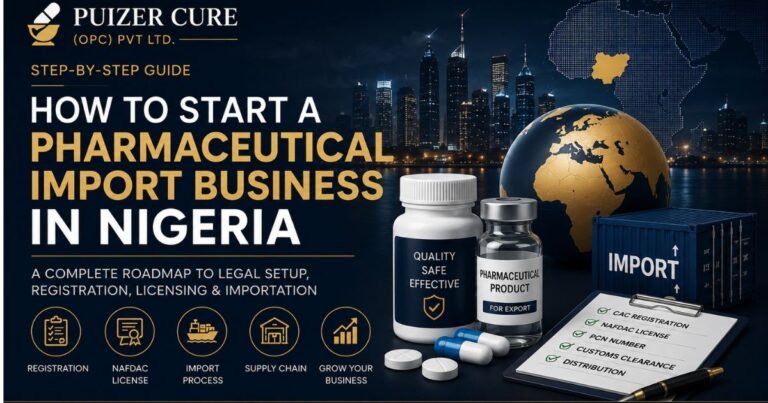

How to Start a Pharmaceutical Import Business in Nigeria: A Step-by-Step Guide
Starting a pharmaceutical import business in Nigeria is not one registration — it’s three separate regulators (CAC, PCN and NAFDAC) plus a customs process, each running on its own clock. This guide walks a first-time entrepreneur through the full sequence, from incorporating a company to clearing a first shipment through port, and flags exactly where newcomers lose the most time and money.
What it actually takes to start
You need three separate approvals, not one. First, incorporate a company with the Corporate Affairs Commission (CAC) and secure a Tax Identification Number. Second, bring on a superintendent pharmacist, fit out a compliant premises, and register it with both the Pharmacists Council of Nigeria (PCN) and NAFDAC. Third, register each product you intend to sell with NAFDAC — a full CTD dossier, a Certificate of Pharmaceutical Product, GMP evidence and, for a first-time imported product, an inspection of your supplier’s manufacturing site. Only once a product is registered can you apply for Form M and clear a shipment through customs. Build a staged plan rather than relying on a fixed timetable. Timing depends on the product category, application completeness, regulator queries, inspections and commercial-import documentation.
Why Nigeria is a serious opportunity — and a serious commitment
With a population above 220 million, Nigeria is West Africa’s largest pharmaceutical market and one of the largest in Africa overall. The country’s roughly 200 registered pharmaceutical companies produce only a fraction of what the population needs, which is why more than NAFDAC Drug registration certificate: 5-year validity under current NAFDAC guidance — active pharmaceutical ingredients as much as finished dosage forms. India and China are consistently the two largest source countries, and Indian pharmaceutical exports to Nigeria alone were valued at over US$300 million in the most recent full trade year.
That gap is real demand, not a loophole — which is exactly why the regulatory system around it is strict rather than casual. Industry guides consistently rank NAFDAC among the more demanding regulators on the continent: it typically requires inspection of a foreign manufacturer’s site (or reliance on an existing WHO-prequalification or stringent regulatory authority approval) before a first imported product is registered, on top of the company- and premises-level licensing every pharmaceutical business needs.
The four approvals you’re actually chasing
“Starting a pharma import business” is not a single application — it’s four separate workstreams, run by three different bodies, on four different clocks. Confuse them and you end up with a licensed premises and nothing registered to sell, or a registered product with no legal entity or licensed pharmacist to move it. Here’s how they actually fit together:
Company registration (CAC)
What it is: Legal permission for a business entity to exist and trade in Nigeria. Establish a Nigerian legal entity and operating structure suitable for the intended activity. Confirm the current company, ownership and sector-specific requirements directly with CAC, PCN, NAFDAC and qualified Nigerian advisers before incorporation.
Ownership sets your capital floor: a wholly Nigerian-owned company needs a minimum share capital of ₦100,000. If there’s any foreign shareholding, that minimum jumps to ₦100 million, and the company must additionally register with the Nigerian Investment Promotion Commission (NIPC).
Board requirement: PCN requirements for proprietors, directors, superintendent pharmacists and premises categories should be verified against the current PCN guideline before filing.
Timeline: largely digital now via the CAC’s online portal — incorporation itself can complete in days once documents are ready. It’s everything downstream that takes the time.
PCN premises license + superintendent pharmacist
What it is: authorization for a specific physical premises to operate as a pharmaceutical wholesale/import business, issued by the Pharmacists Council of Nigeria. A registered company still needs a licensed premises before it can legally handle medicines.
The non-negotiable requirement: a named superintendent pharmacist, registered with PCN and holding a current annual practising license, legally responsible for the premises. You don’t personally need to be a pharmacist to own the business — but you cannot operate without one running it.
Site standards: dispensing/storage layout, controlled-drugs security, and PCN’s minimum-distance rules from other registered pharmaceutical premises shape where you can locate as much as rent does.
Realistic timeline: Timing depends on document completeness, inspections, corrective actions and the applicable PCN category. Request the current process and renewal requirements from PCN rather than relying on a fixed timeline.
NAFDAC premises + product registration
Two separate NAFDAC actions: your warehouse must independently meet NAFDAC’s Good Distribution Practice standards (temperature control, security, record-keeping), registered via the NAPAMS portal and renewed annually. Separately, each individual product you intend to sell needs its own marketing authorization — a full CTD dossier, not a blanket company approval.
For an imported product specifically: a WHO-format Certificate of Pharmaceutical Product, a current GMP certificate, a notarized Power of Attorney from the manufacturer, and — for a site NAFDAC hasn’t previously assessed — an inspection of the foreign facility (or reliance on an existing WHO-PQ / stringent regulatory authority approval instead).
Trademark first: NAFDAC requires a Class 5 trademark filing (or acceptance letter) for the product’s brand name before it will meaningfully progress a dossier — file this early.
Validity: a product’s Certificate of Registration is valid five years, renewable; NAFDAC premises registration renews annually.
Import permit, Form M & customs clearance
What it is: the operational, per-shipment paperwork that physically moves a registered product into the country — separate from, and only available after, product registration.
Form M is the mandatory foreign-exchange/import instrument, issued through a Central Bank of Nigeria–licensed commercial bank, generally valid six months, and integrated with NAFDAC’s e-permit system so a product’s registration status is checked automatically before the form clears.
Pre-Arrival Assessment Report (PAAR) and the customs declaration are processed through Nigeria Customs’ electronic system alongside Form M.
The one earlier route: a separate drug sample import permit exists purely for bringing in product samples during the registration process itself — this is the one thing that can move before full registration. Commercial stock cannot.
Who does what: you vs. your manufacturing partner
For a first-time Nigerian entrepreneur sourcing from an Indian manufacturer, the workload splits cleanly between what happens on the ground in Nigeria and what your supplier provides from the plant. Knowing this split before you sign anything prevents the single most common cause of delay — a dossier stalled waiting on a document only one side can produce.
| Responsibility | You (Nigeria-based entrepreneur) | Manufacturing partner (India) |
|---|---|---|
| Company & structure | CAC incorporation, TIN, NIPC registration if foreign-owned | — |
| Superintendent pharmacist & PCN license | Recruits, appoints, holds the license | — |
| Warehouse & NAFDAC GDP registration | Fits out premises, files with NAPAMS | — |
| Product selection | Reads local demand, picks SKUs | Offers portfolio, formulation options |
| CTD dossier (Modules 1–5) | Compiles Nigeria-specific administrative content | Supplies quality, safety & CMC data |
| Certificate of Pharmaceutical Product & GMP evidence | Files with the dossier | Obtains WHO-format CPP, GMP certificate, site master file |
| Facility inspection readiness | Coordinates timing with NAFDAC | Prepares site, or supplies WHO-PQ/SRA record for reliance |
| Trademark (Class 5) | Files as in-market brand owner | Provides brand authorization/POA |
| Form M, PAAR & customs clearance | Applies via bank, works with clearing agent | Provides invoice, CoA, packing documents |
| Pharmacovigilance | Runs local adverse-event reporting from approval day one | Supplies PSURs & safety data |
Starting your business, step by step
None of the individual steps below is obscure — Nigeria’s registration pathway is well documented. What actually determines your launch date is sequencing — getting company, premises and dossier work moving in parallel instead of one after another.
Choose a private limited company, not a business name — only a properly incorporated company can hold PCN and NAFDAC licenses. Confirm your ownership structure up front, since it fixes your minimum share capital.
A Tax Identification Number is issued alongside incorporation. Open a corporate bank account, and if any part of the company is foreign-owned, register with the Nigerian Investment Promotion Commission as well.
Recruit or partner with a PCN-registered pharmacist for your board seat and premises supervision before you sign a lease — both landlords and PCN inspectors expect this role filled, not promised.
Storage layout, controlled-drugs security, and PCN’s minimum-distance-from-other-premises rule should shape site selection as much as rent and location do.
Submit Form B with your superintendent pharmacist’s licence and company documents. Inspection-driven — budget 2–4 months.
A separate Good Distribution Practice registration via the NAPAMS portal, renewed annually. Run this in parallel with PCN licensing, not after it.
This decision shapes your entire dossier timeline — see the sourcing considerations below before you commit to a supplier.
Do this as early as possible — NAFDAC will not meaningfully progress a product dossier without evidence of a filed or accepted trademark for the brand name.
Full CTD dossier, Certificate of Pharmaceutical Product, GMP evidence and notarized Power of Attorney. Expect a facility inspection unless your supplier already holds WHO-PQ or stringent-regulatory-authority status NAFDAC can rely on.
Only once the product is registered. Work with your bank for Form M and a licensed customs agent for the PAAR and clearance process.
Track all renewal dates, post-marketing obligations and pharmacovigilance responsibilities. NAFDAC states that a successful drug-registration certificate has a five-year validity period; verify current renewal and reporting requirements for your products and premises.
Choosing what — and who — to import
Nigeria’s pharmaceutical demand is concentrated: antimalarials, antibiotics, and medicines for hypertension and diabetes make up a large share of what actually moves, alongside a broad over-the-counter and generics segment that dominates the market by volume. Matching your product list to genuine, high-turnover demand — rather than registering a wide, ambitious catalogue on day one — determines whether your first year is spent selling or spent answering NAFDAC deficiency letters.
The supplier decision matters just as much as the product decision. A manufacturer that already holds WHO-GMP certification, has exported to regulated or semi-regulated markets before, and can readily produce a current Certificate of Pharmaceutical Product and site master file is a fundamentally different proposition to one that can’t — the difference shows up directly in whether NAFDAC can rely on existing approvals or has to schedule a fresh facility inspection.
- Start narrow. Register the two or three SKUs with the clearest demand first — each additional product multiplies fees and query-response load before any of them are earning.
- Ask for the paperwork before you ask for pricing. A supplier who can’t readily produce a WHO-GMP certificate, CPP and stability data will surface that gap as a NAFDAC query, not before.
- Prior African or NAFDAC registration experience is a genuine asset in a supplier — it usually means their documentation is already in the format NAFDAC expects.
- Verify, don’t just trust. Independently confirm a supplier’s WHO-GMP and regulatory credentials rather than relying on their own claims — counterfeit and substandard product remains a well-documented risk in the Nigerian market.
Launch-readiness checklist
Before your first legal shipment can clear Nigerian customs, every item below needs to be in place. Use it as a working checklist against your own launch plan.
Tick what you already have in place to see how launch-ready your business is. Nothing is stored or sent — this runs entirely in your browser.
Indicative checklist for planning only. Confirm the exact, current requirement set with CAC, PCN and NAFDAC before you file — requirements are updated periodically.
Budgeting your launch
Official fees and typical market costs both vary — by ownership structure, product risk category, and who you work with — and change periodically. The honest guidance every credible source agrees on: confirm current figures directly with CAC, PCN and NAFDAC before you commit a budget. What you can plan around is the structure of the cost lines you’ll actually encounter:
| Cost line | When it applies | Notes |
|---|---|---|
| CAC incorporation & stamp duty | At company registration | Scales with declared share capital |
| NIPC registration | If any foreign shareholding | Comes with the ₦100M minimum-capital requirement |
| Superintendent pharmacist salary/retainer | Ongoing, mandatory | Budget as a genuine hire, not a formality |
| PCN premises license & inspection fee | Before opening premises | Renews annually |
| Trademark filing (Class 5) | Before/alongside NAFDAC submission | Official fee plus agent charges |
| NAFDAC product registration fee | Per product | Varies by risk category; imported drugs sit at the higher end |
| NAFDAC facility inspection (foreign site) | If site not previously assessed | Often coordinated with, and partly borne by, your manufacturer |
| NAFDAC premises (GDP) registration | Annual | Keeps your warehouse license active |
| Form M & clearing agent fees | Per shipment | Ongoing cost of doing business |
| Product registration renewal | Every 5 years | File well ahead of expiry |
Model your own budget. Every figure below is an editable assumption in Naira — set them to what your PCN consultant, clearing agent and NAFDAC contact quote. This is a planning aid, not an official tariff.
Illustrative only, in indicative ₦. Excludes CAC share-capital deposit, warehouse fit-out, freight, duties and taxes. Default rates are planning placeholders, not official CAC/PCN/NAFDAC figures — verify every input directly with those bodies and your own advisors. Not financial advice.
A realistic timeline
Build 12–24 months into your launch plan from incorporation to a first legally cleared shipment. The single biggest variable is not any one regulator — it’s how much of the work you run in parallel rather than in sequence.
Mistakes that cost first-time importers the most
- Registering a business name instead of incorporating a company. A business name generally cannot hold the PCN and NAFDAC licenses a wholesale/import operation needs — this gets corrected eventually, but it costs months.
- Treating the superintendent pharmacist as a formality. PCN ties the license to that named individual. Losing them without formally notifying PCN suspends your ability to legally operate.
- Signing a lease before checking PCN’s siting rules. Distance-from-other-premises and storage-layout requirements can rule out a site you’ve already committed to.
- Filing for NAFDAC product registration before the trademark. This stalls the dossier at exactly the point it should be moving fastest.
- Importing commercial stock before registration is complete. Outside the specific drug-sample import permit used strictly for the registration process, commercial shipments without a registered product and valid documentation are held — or seized — at port.
- Choosing a supplier on price alone. A manufacturer who can’t readily produce a WHO-format CPP, current GMP certificate and stability data shows that gap as a NAFDAC query letter, not before you’ve committed.
- Registering a wide catalogue in one pass. Every additional SKU multiplies fees and query load before any of them are generating revenue — lead with the two or three products that fill a genuine gap.
Sourcing medicines for the Nigerian market? Start from a WHO-GMP base.
Whether you need a registration-ready product dossier, a WHO-GMP third-party manufacturing partner, or export documentation built to clear NAFDAC review, our team supports first-time and established importers entering the Nigerian market end to end.
Starting a pharmaceutical import business in Nigeria — FAQ
How do I start a pharmaceutical import business in Nigeria?
Do I need to be a pharmacist myself to own a pharmaceutical import business?
How much capital do I need to start?
How long does it take to legally start importing and selling medicines?
What’s the difference between CAC, PCN, and NAFDAC registration?
Can I import products before NAFDAC registration is complete?
Do I need a separate registration for every product?
What happens if I skip PCN or NAFDAC registration?
Regulatory requirements, fees and timelines described here are indicative and change over time. Always verify the current position with the Corporate Affairs Commission, the Pharmacists Council of Nigeria, NAFDAC, and your own legal/regulatory advisors before acting. Nothing on this page constitutes legal, regulatory or financial advice.