

Product range · B2B export only
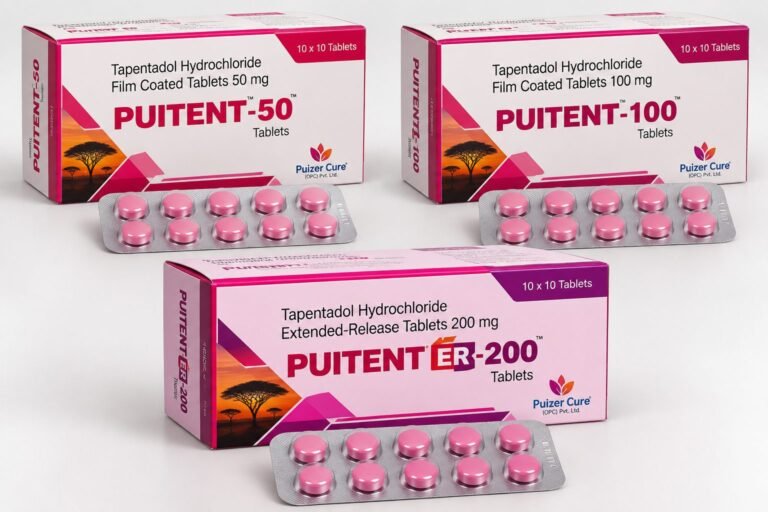
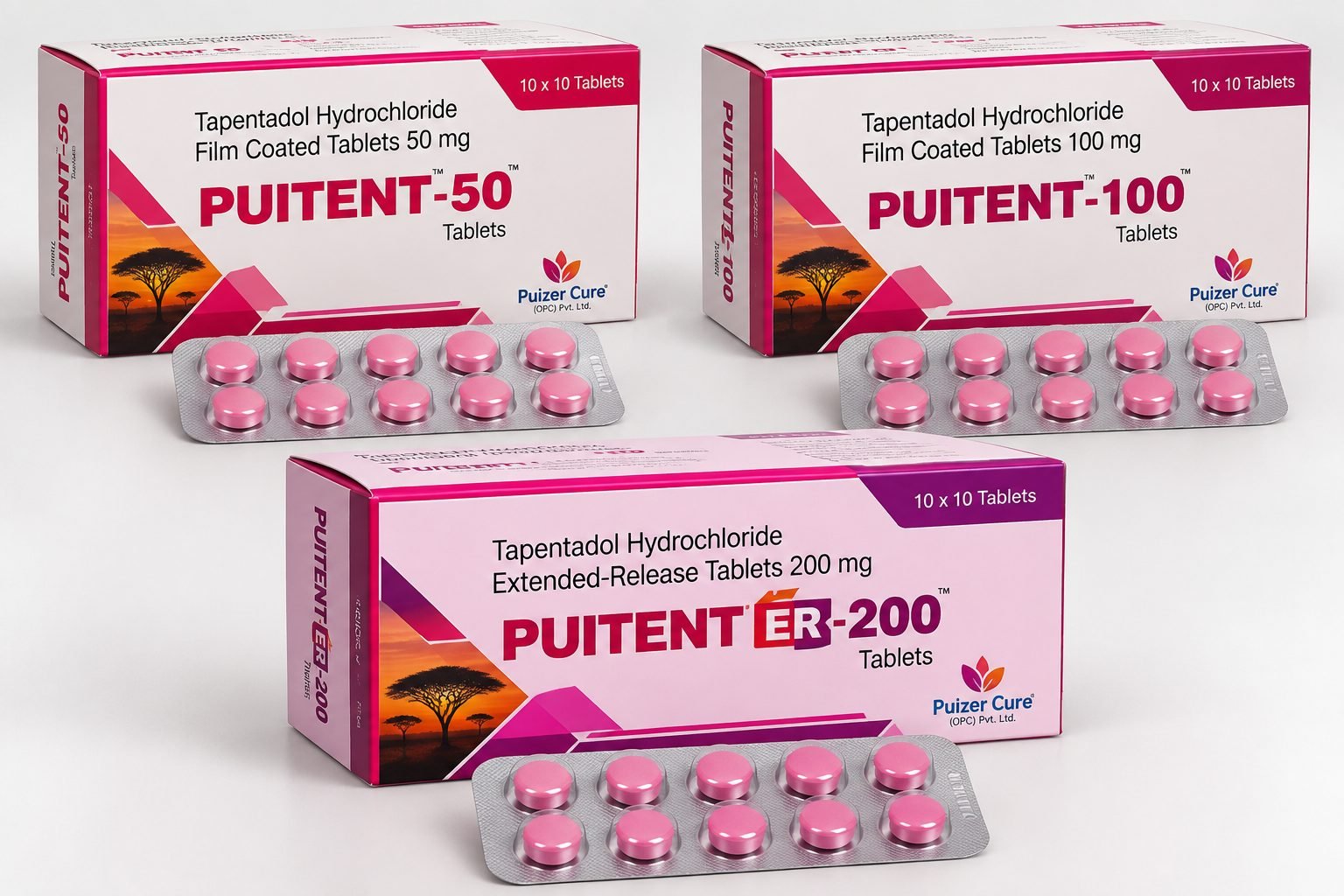
PUITENT is the tapentadol hydrochloride tablet range of Puizer Cure (OPC) Pvt. Ltd., offered to pharmaceutical importers and distributors in Africa in three presentations: PUITENT-50 and PUITENT-100 (film-coated, immediate-release tablets, 50 mg and 100 mg) and PUITENT ER-200 (extended-release tablets, 200 mg), each packed 10 × 10 tablets.
All three strengths sit within the tapentadol strengths approved in India[1]. Tapentadol is a prescription-only opioid analgesic and a controlled medicine in many countries, so we quote only to licensed businesses that can show tapentadol is authorised for import into their market.
Strengths and variants
Tapentadol 50 mg, 100 mg and 200 mg ER: the PUITENT range at a glance
The range covers two different formulations, not just three strengths. The 50 mg and 100 mg products are conventional film-coated tablets that release the dose immediately; the 200 mg product is an extended-release tablet designed to release its dose over a longer period. Importers register, stock and dispense them as separate products.
PUITENT-50
- Tapentadol Hydrochloride Film Coated Tablets 50 mg
- Pack: 10 × 10 tablets
PUITENT-100
- Tapentadol Hydrochloride Film Coated Tablets 100 mg
- Pack: 10 × 10 tablets
PUITENT ER-200
- Tapentadol Hydrochloride Extended-Release Tablets 200 mg
- Pack: 10 × 10 tablets
Composition, formulation and packaging
Product specifications by strength
Select a product. Fields marked to be confirmed are shared with the quotation and the product dossier.
PUITENT-50 — Tapentadol 50 mg film-coated tablets
- Composition
- Each film-coated tablet contains Tapentadol Hydrochloride equivalent to Tapentadol 50 mg. Excipients and colour as per product dossier.
- Dosage form
- Film-coated tablet, immediate release, oral
- Therapeutic category
- Opioid analgesic — ATC N02AX06[4]
- Pack size
- 10 × 10 tablets (10 blister strips of 10 in a carton)
- Primary packing
- [PZR: blister material, e.g. Alu-PVC / Alu-Alu]
- Shelf life and storage
- [PZR: shelf life in months] · [PZR: storage statement as on label]
- Shipper
- [PZR: cartons per shipper, dimensions, gross weight]
PUITENT-100 — Tapentadol 100 mg film-coated tablets
- Composition
- Each film-coated tablet contains Tapentadol Hydrochloride equivalent to Tapentadol 100 mg. Excipients and colour as per product dossier.
- Dosage form
- Film-coated tablet, immediate release, oral
- Therapeutic category
- Opioid analgesic — ATC N02AX06[4]
- Pack size
- 10 × 10 tablets (10 blister strips of 10 in a carton)
- Primary packing
- [PZR: blister material]
- Shelf life and storage
- [PZR: shelf life in months] · [PZR: storage statement as on label]
- Shipper
- [PZR: cartons per shipper, dimensions, gross weight]
PUITENT ER-200 — Tapentadol 200 mg extended-release tablets
- Composition
- Each extended-release tablet contains Tapentadol Hydrochloride equivalent to Tapentadol 200 mg. Excipients, release-controlling polymer and colour as per product dossier.
- Dosage form
- Extended-release tablet, oral
- Therapeutic category
- Opioid analgesic — ATC N02AX06[4]
- Pack size
- 10 × 10 tablets (10 blister strips of 10 in a carton)
- Primary packing
- [PZR: blister material]
- Shelf life and storage
- [PZR: shelf life in months] · [PZR: storage statement as on label]
- Shipper
- [PZR: cartons per shipper, dimensions, gross weight]
Export cartons for tropical sea freight are specified separately from the retail pack. See our note on climate-zone stable pharmaceutical packaging for export.
Formulation comparison
Film-coated vs extended-release tapentadol tablets
Tapentadol is a centrally acting analgesic that combines mu-opioid receptor agonism with noradrenaline reuptake inhibition in a single molecule[5]. Both formulations in the PUITENT range correspond to dosage forms first approved by the US FDA for the originator products: immediate-release tapentadol tablets in November 2008[2] and extended-release tablets in strengths from 50 mg to 250 mg in August 2011[3].
Scroll the table sideways →
| Attribute | PUITENT-50 | PUITENT-100 | PUITENT ER-200 |
|---|---|---|---|
| Formulation | Film-coated tablet | Film-coated tablet | Extended-release tablet |
| Release profile | Immediate | Immediate | Extended (modified) release |
| Strength | 50 mg | 100 mg | 200 mg |
| India-approved strength[1] | Yes — 50 mg tablet | Yes — 100 mg tablet | Yes — 200 mg ER tablet |
| US reference approval | NDA 22-304, 20 Nov 2008[2] | NDA 22-304, 20 Nov 2008[2] | NDA 200533, 25 Aug 2011[3] |
| Pack | 10 × 10 | 10 × 10 | 10 × 10 |
Immediate-release and extended-release tapentadol are separate products. They are not interchangeable on a milligram-for-milligram basis, and each needs its own registration or import authorisation in the destination country.
Controlled prescription medicine
Tapentadol regulatory status buyers should check before ordering
India (country of export)
Tapentadol is approved as 50, 75 and 100 mg tablets and 100, 150 and 200 mg extended-release tablets[1]. It is a Schedule H1 drug under the Drugs Rules, 1945; in April 2025 the Drugs Technical Advisory Board recommended keeping it in Schedule H1 and asked that it also be scheduled as a psychotropic substance under the NDPS Act[6]. It was not yet listed under the NDPS Act as of the latest reports[7][8], so export controls may tighten.
International and reference markets
Tapentadol is not under international control. The WHO Expert Committee on Drug Dependence recommended in 2014 that it be kept under surveillance rather than scheduled[9]. In the United States it has been a Schedule II controlled substance since 2009[10].
Destination country
National rules decide whether tapentadol can be imported, in which strengths, and under what permit. Registration status differs between African markets and some regulators have not registered tapentadol at all. Confirm with your regulator before you request a quote. Our guide to the NAFDAC drug registration process shows what registration evidence typically looks like.
Tapentadol combinations are not supplied. The tapentadol + carisoprodol combination is not approved in India, and in February 2025 the Union Health Ministry ordered export NOCs and manufacturing licences for such combinations withdrawn[1]. Nigeria’s NAFDAC has banned tapentadol–carisoprodol products[11]. Unapproved high-strength tapentadol exports to West Africa have been widely reported[12]. PUITENT is a single-ingredient range, limited to the three strengths on this page.
Export availability
Tapentadol tablets export to Africa: who we supply and what we need
Puizer Cure (OPC) Pvt. Ltd. supplies PUITENT as an Indian pharmaceutical exporter to licensed businesses only. Export availability for each market is confirmed per enquiry, after we review your licences and the tapentadol import status in your country. For the wider process, see our guide to pharmaceutical export to Africa.
Who we supply
- Licensed pharmaceutical importers and distributors
- Licensed wholesalers
- Hospital and institutional procurement
- Government and NGO tenders
What we ask for before quoting
- Your import or wholesale licence
- Proof that tapentadol, in the strength and dosage form requested, is registered or authorised for import in your country
- The consignment import permit, where your regulator issues one
- Consignee details that match the permit
What we provide
- Certificate of Analysis for every batch
- Manufacturing licence and GMP certificate copies for the manufacturing site
- Invoice, packing list and Certificate of Origin
- Technical and registration documents, scoped per market
Document requirements by destination are set out in our pharmaceutical export documentation checklist. For registration routes in East Africa, see the PPB Kenya drug registration guide and the Tanzania TMDA registration guide.
We do not supply individuals, retail consumers or unlicensed traders, and we do not ship tapentadol without matching import authorisation. MOQ: [PZR: MOQ per strength]. Lead time: [PZR: lead time after documents are cleared].
Before you send an RFQ
Check your enquiry readiness
Answer three questions to see whether an enquiry can go ahead and what to attach.
1. What type of business are you?
2. Is tapentadol authorised for import in your country?
3. Which product do you need?
Answer all three questions
Your result will appear here.
B2B enquiry
Request a PUITENT export quotation
Send your country, company licence type, product and strength, and estimated annual volume. Attach the licence and import-authorisation documents listed above. Every enquiry is reviewed by the export desk before a reply is sent.
Related on puizerindia.com
Buyer questions
Frequently asked questions
Three: PUITENT-50 (Tapentadol 50 mg film-coated tablets), PUITENT-100 (Tapentadol 100 mg film-coated tablets) and PUITENT ER-200 (Tapentadol 200 mg extended-release tablets). Each is packed 10 x 10 tablets. We do not offer other strengths or combination products under this brand.
They are different dosage forms, not just different strengths. PUITENT-100 is a film-coated tablet that releases its dose immediately. PUITENT ER-200 is an extended-release tablet designed to release its dose over a longer period. They are not interchangeable milligram for milligram and each needs its own registration or import authorisation.
Yes. According to the Union Health Ministry, tapentadol is approved in India as 50, 75 and 100 mg tablets and as 100, 150 and 200 mg extended-release tablets. All three PUITENT strengths fall within that list. It is a prescription-only Schedule H1 drug.
It depends on the country. It is Schedule II in the United States and Schedule H1 in India, where scheduling under the NDPS Act has been recommended but was not yet in force at the latest reports. It is not under international control. Your national regulator decides its status in your market and whether an import permit is needed.
No. We supply only where tapentadol, in the requested strength and dosage form, is registered or otherwise authorised for import, and only to licensed businesses holding the required import permit. Send your country through the enquiry form and the export desk will confirm whether supply is possible.
No. The tapentadol and carisoprodol combination is not approved in India, and export permissions for it were withdrawn in February 2025. PUITENT contains tapentadol hydrochloride as the only active ingredient.
No. The FDA approvals cited on this page are for the originator tapentadol products. They show that the molecule, both dosage forms and these strengths are recognised by a stringent regulatory authority. Registration of PUITENT in your country is a separate process.
A Certificate of Analysis for each batch, the commercial invoice, packing list and Certificate of Origin, plus copies of the manufacturing licence and GMP certificate for the manufacturing site. Registration documents are agreed per market before the order is confirmed.
References
- Press Information Bureau, Ministry of Health and Family Welfare. Union Health Ministry takes immediate action in response to concerns on export of unapproved drug combination of Tapentadol and Carisoprodol. New Delhi: PIB; 23 Feb 2025. Available from: https://www.pib.gov.in/PressReleasePage.aspx?PRID=2105672. Accessed Sep 2026.
- US Food and Drug Administration. NDA 22-304 (tapentadol tablets): approval letter and correction to approval letter. Rockville (MD): FDA; 2008. Available from: https://www.accessdata.fda.gov/drugsatfda_docs/appletter/2008/022304s000correctedltr.pdf. Accessed Sep 2026.
- US Food and Drug Administration. NDA 200533 approval letter: Nucynta ER (tapentadol) extended-release oral tablets 50, 100, 150, 200 and 250 mg. Silver Spring (MD): FDA; 25 Aug 2011. Available from: https://www.accessdata.fda.gov/drugsatfda_docs/appletter/2011/200533s000ltr.pdf. Accessed Sep 2026.
- WHO Collaborating Centre for Drug Statistics Methodology. ATC/DDD Index: N02AX06 Tapentadol. Oslo: Norwegian Institute of Public Health; 2026. Available from: https://atcddd.fhi.no/atc_ddd_index/?code=N02AX06. Accessed Sep 2026.
- World Health Organization. Tapentadol: critical review report, agenda item 4.1. 36th Expert Committee on Drug Dependence. Geneva: WHO; 2014. Available from: https://ecddrepository.org/sites/default/files/4_1_review.pdf. Accessed Sep 2026.
- Central Drugs Standard Control Organisation. Minutes of the 92nd meeting of the Drugs Technical Advisory Board held on 24.04.2025, agenda no. 6. New Delhi: CDSCO; 2025. Available from: https://cdsco.gov.in/opencms/resources/UploadCDSCOWeb/2018/UploadCommitteeFiles/92nd%20DTAB%20approved%20minutes.pdf. Accessed Sep 2026.
- LiveLaw. ‘Tapentadol Hydrochloride not scheduled psychotropic substance’: Supreme Court grants anticipatory bail in NDPS case. 28 Mar 2025 (secondary report of a Supreme Court of India order). Available from: https://www.livelaw.in/supreme-court/tapentadol-hydrochloride-not-scheduled-psychotropic-substance-supreme-court-grants-anticipatory-bail-in-ndps-case-288366. Accessed Sep 2026.
- The Tribune. Drugs haul raises fresh questions over regulatory gaps, overseas connections. 7 Sep 2026 (secondary). Available from: https://www.tribuneindia.com/news/himachal/drugs-haul-raises-fresh-questions-over-regulatory-gaps-overseas-connections/. Accessed Sep 2026.
- World Health Organization. WHO Expert Committee on Drug Dependence: thirty-sixth report. WHO Technical Report Series No. 991. Geneva: WHO; 2015. Available from: https://www.unodc.org/documents/commissions/CND/Mandate_and_Functions/Report_36th_WHO_ECDD.pdf. Accessed Sep 2026.
- Drug Enforcement Administration. Schedules of controlled substances: placement of tapentadol into Schedule II. Final rule. Fed Regist. 2009 May 21;74(97):23790-3. Available from: https://www.govinfo.gov/content/pkg/FR-2009-05-21/html/E9-11933.htm. Accessed Sep 2026.
- National Agency for Food and Drug Administration and Control. Blacklisting of Aveo Pharmaceuticals and banning of tapentadol and carisoprodol combination (Tafrodol or Royal 225). Abuja: NAFDAC; 28 Feb 2025. Available from: https://nafdac.gov.ng/blacklisting-of-aveo-pharmaceuticals-and-banning-of-tapentadol-and-carisoprodol-combination-tafrodol-or-royal-225/. Accessed Sep 2026.
- Bellingcat. Painkiller pipeline: 300 million tapentadol pills sent from India to West Africa. 17 Apr 2026 (secondary, investigative journalism). Available from: https://www.bellingcat.com/news/2026/04/17/painkiller-pipeline-300-million-tapentadol-pills-sent-from-india-to-west-africa/. Accessed Sep 2026.
Disclaimer. This page is technical and commercial product information for licensed pharmaceutical businesses. It is not medical advice, not an offer to sell to patients or the public, and not a statement that PUITENT is registered in any particular country. Tapentadol is a prescription-only medicine; its regulatory status in India and in destination markets changes, and buyers must confirm current requirements with their national regulator. Status as reviewed: September 2026.