
Regulatory position reviewed September 2026 · Puizer India
Direct answer
Can you run a PCD pharma franchise in East Africa?
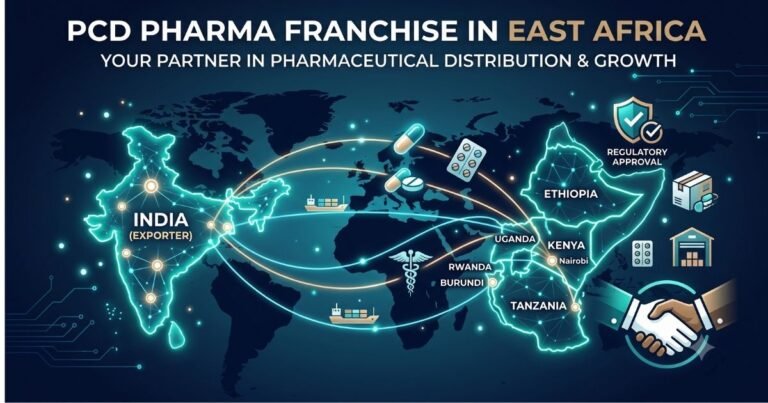
You can run a franchise-style, monopoly-territory distribution business in Kenya, Tanzania, Uganda, Rwanda and Ethiopia. You cannot run the Indian PCD structure, because the licensing layer it rests on does not exist there.
In India a PCD partner needs only a wholesale drug licence; your product permission does the regulatory work. In East Africa, a foreign manufacturer must appoint a named, licensed local entity — a Local Technical Representative or local agent — who is written onto the product registration file and carries regulatory liability for it.[1][4][5]
Choosing a franchise partner in East Africa is therefore also choosing your regulatory agent. Replacing one is a regulatory amendment, not a change of buyer.
- 5 yearsRegistration validity in Kenya, Rwanda and Ethiopia
- 116 daysEAC target to grant a marketing authorisation
- 515–965Reported median days actually taken, by country
- 7 authoritiesIn the EAC harmonisation initiative — Ethiopia is not one
Indian manufacturers arrive in East Africa with a model that works extremely well at home: appoint a partner, grant monopoly rights for a district, ship a starter kit of thirty SKUs, and let the partner’s medical representatives build prescriptions. The model is cheap to start, quick to scale and needs almost no capital from the manufacturer.
Transplanted directly, it fails — not because East African buyers are difficult, but because three of its load-bearing assumptions are false there. Product approval is not portable. Launch is not quick. And the partner is not a commercially neutral buyer; the partner is a regulated person with a name on your file.
A note on the word itself. PCD stands for Propaganda Cum Distribution, an Indian pharmaceutical commercial term for an exclusive, own-brand distribution arrangement built around medical representative promotion. It is an industry label, not a legal category, and it carries little recognition in East African law or with local buyers. When you approach a counterparty in Nairobi, Dar es Salaam, Kampala, Kigali or Addis Ababa, the terms they will recognise are pharmaceutical distributor, local representative or local technical representative, importer and wholesaler, and the document they will expect is a pharmaceutical distribution agreement. This guide uses the search term “PCD pharma franchise East Africa” because that is what Indian manufacturers type, but it uses the local vocabulary throughout, because that is what the paperwork will say.
Who this guide is for. Indian pharmaceutical manufacturers, exporters and brand owners evaluating an Indian pharma export partner in East Africa, and East African import, wholesale and distribution businesses assessing whether a proposed arrangement with an overseas principal is compliant and workable. It assumes you already understand the country registration mechanics — those are covered separately in our guide to the PPB Kenya drug registration process, Tanzania TMDA drug registration process, Uganda NDA drug registration process, Rwanda FDA drug registration process and EFDA Ethiopia drug registration process. What follows sets out what survives the flight, what does not, and how to structure a territory agreement that will still be workable in year three.
Reviewed by Darshan Singh, pharmaceutical professional with 23+ years of experience in manufacturing, quality control and quality assurance. This article is educational and commercial guidance, not legal advice; confirm the current position with the relevant regulator or qualified local counsel before you sign an agreement or file a dossier.
East Africa at a glance: who your partner has to be
Five markets, five different control points. The detail sits in the selector further down; this is the orientation table. All positions are subject to current authority requirements and should be confirmed against each regulator’s published guidance at the time you file.
| Country | Authority | Partner’s legal role | Key operating licence | Registration position | EAC status |
|---|---|---|---|---|---|
| Kenya | Pharmacy and Poisons Board (PPB) | Local representative, required for a foreign applicant[1] | Wholesale dealer’s, poison dealing or manufacturing licence[1] | Certificate valid five years, with retention and renewal[1] | EAC Partner State; in the harmonisation initiative[8] |
| Tanzania (mainland) | TMDA | Local technical representative, recognised on a published TMDA register[9] | Importing wholesale premises licence[6] | Filed with TMDA; storage and distribution under GSDP Regulations 2021[6] | EAC Partner State; in the initiative[8] |
| Zanzibar | Zanzibar Food and Drugs Authority (ZFDA) | Separate appointment from the mainland | Licensed separately by ZFDA | Regulated separately. A mainland Tanzania registration does not automatically cover Zanzibar | Participates in the EAC initiative in its own right[8] |
| Uganda | National Drug Authority (NDA) | Control sits in the import licence; a local agent is accepted in practice[3][10] | Import licence, valid one year; wholesale licence with pharmacist supervision[3] | Filed with NDA; on-site GMP inspection of the manufacturing site[10] | EAC Partner State; in the initiative[8] |
| Rwanda | Rwanda FDA | Local technical representative, required for a foreign applicant[4] | Rwanda-registered company licensed by Rwanda FDA for regulated products[4] | Applicant is the product owner and becomes marketing authorisation holder; valid five years[4] | EAC Partner State; in the initiative[8] |
| Ethiopia | EFDA | Local agent under a signed agency agreement; must be a pharmacist in Ethiopia[5] | EFDA competence certificate plus a Ministry of Trade trading licence[5] | Registration valid five years; re-registration before expiry[5] | Not an EAC Partner State and outside the initiative[8][11] |
Scroll the table sideways on a phone.
What transfers from the Indian PCD model, and what does not
The commercial architecture of PCD travels well. The regulatory architecture does not travel at all. It is worth being precise about which is which, because most failed East Africa franchise arrangements fail on a point in the right-hand column that nobody priced at signing.
| Element | India (PCD franchise) | East Africa (territory franchise) |
|---|---|---|
| Who holds product approval | The manufacturer. The franchise partner needs no product-level approval at all. | The product owner is the marketing authorisation holder, but a licensed local entity is named on the file as representative or agent.[1][4][5] |
| What the partner must hold | Wholesale drug licence and tax registration. | A locally incorporated company, an import or wholesale licence, licensed premises and a named superintendent pharmacist.[3][6] |
| Time to first legal sale | Days to weeks. The product is already approved. | Registration first. Reported median time to grant a marketing authorisation ranged from 515 to 965 calendar days across five authorities.[2] |
| Nature of exclusivity | Contractual monopoly rights. Reversible with notice. | Contractual, plus practical lock-in through the registration file. Reversing it is a regulatory exercise. |
| Changing partner | Appoint a replacement; supply continues. | Variation of the registration, possible re-inspection, and a supply gap while it is processed. |
| Promotion model | Medical representative detailing, largely industry self-regulated. | Promotional material may require regulator approval before use, and prescription-only medicines cannot be advertised to the public.[7][3] |
| Entry cost per SKU | Near zero for the partner; a few boxes of stock. | A registration dossier, fees and a site inspection per product per country — incurred before a single unit is sold. |
| Partner’s regulatory liability | Limited to storage and distribution compliance. | Substantial. The local representative answers to the authority for the product. |
Scroll the table sideways on a phone.
Signing a five-year exclusive territory agreement before the products are registered. The partner has no revenue to lose during the registration wait, so the exclusivity costs them nothing and costs you the whole market for the duration. Exclusivity should begin at first commercial supply, not at signature, and should be conditional on volume from that date.
Your franchise partner’s real legal role, country by country
The single most useful thing an Indian manufacturer can internalise about East Africa is that the commercial role and the regulatory role sit very close together. In practice the pharmaceutical distributor and the regulatory representative are frequently the same company — a distributor who is already licensed and already holds premises is the obvious candidate to be named on the file. But they need not be, and depending on the country, the licensing position and how you structure the filing, they may be separate legal entities: a specialist regulatory agent named on the dossier, and one or more commercial distributors underneath. What does not vary is the consequence: appointing a local partner is a regulatory decision as much as a commercial one, and it should be assessed on both. Kenya requires a foreign applicant to appoint a local representative who is a Kenyan citizen, a permanent resident, or a company incorporated in Kenya.[1] Rwanda requires a foreign applicant to appoint a Local Technical Representative, defined as a Rwanda-registered company licensed by Rwanda FDA.[4] Ethiopia goes furthest: the local agent must be physically present in Ethiopia, must be a pharmacist, and must hold both an EFDA competence certificate and a trading licence.[5]
Use the selector to see what your partner must actually be in each market.
Which market are you appointing a partner in?
Select a market to see what your partner must legally be
Each of these five markets controls foreign supply through a different instrument — a named representative in Kenya, Rwanda and Ethiopia, a licensed importing premises in Tanzania, an import licence in Uganda. Pick one to see the specific requirement, the licence your partner must hold and the registration validity period.
- Partner’s legal role
- Local representative. For Kenya local representative drug registration purposes this is mandatory where the applicant is not a Kenyan citizen or is a company incorporated outside Kenya. The representative must be a Kenyan citizen, a permanent resident, or a company incorporated in Kenya.[1]
- Licence the partner must hold
- Proof of appropriate licensing is part of the registration application — typically a wholesale dealer’s licence, poison dealing licence or manufacturing licence. In practice a pharmaceutical distributor in Kenya will already hold one of these, which is why the roles so often merge.[1]
- Registration validity
- Five years from date of issue, with annual retention and renewal on application.[1]
- Promotion constraint
- Advertising and promotional activity requires prior Board approval, and prescription-only medicines may not be advertised to the general public.[7]
- EAC harmonisation
- Member of the EAC medicines regulatory harmonisation initiative.[8] Reported median time to grant a marketing authorisation: 683 calendar days.[2]
- Partner’s legal role
- Local technical representative. Tanzania is the market where this is easiest to verify: TMDA formally recognises LTRs and publishes a public register of them — several hundred entries nationally, with the largest concentration in Dar es Salaam.[9]
- Licence the partner must hold
- An importing wholesale premises licence from TMDA. Any credible pharmaceutical distributor in Tanzania should be able to produce a current one on request. The application requires a BRELA certificate of registration, a taxpayer identification number, a contract with a superintendent and that superintendent’s professional registration certificate. Storage and distribution are governed by the Good Storage and Distribution Practices Regulations, 2021.[6]
- Legal basis
- Section 18 of the Tanzania Medicines and Medical Devices Act, Cap 219.[6]
- Note on Zanzibar
- Zanzibar is regulated separately by the Zanzibar Food and Drugs Authority, which participates in the EAC initiative in its own right.[8] Mainland registration does not automatically cover it.
- EAC harmonisation
- Member. Reported median time to grant a marketing authorisation: 515 calendar days — the fastest of the five studied.[2]
- Partner’s legal role
- Uganda routes control through the import licence rather than through a statutory representative. The National Drug Policy and Authority Act does not itself impose a local agent requirement; in practice a local agent is accepted in place of a subsidiary. The practical control point is therefore the licence held by your medicine importer in Uganda rather than a statutory designation. This point rests partly on an older secondary source — confirm the current NDA guidance before you rely on it.[3][10]
- Licence the partner must hold
- No person may import drugs into Uganda without a licence from the Authority, and that licence is valid for one year. Wholesale supply requires a licence and pharmacist supervision of the premises.[3]
- Promotion constraint
- Publishing matter calculated to promote a drug for conditions in the Fifth Schedule to the Act is prohibited.[3]
- Site inspection
- On-site GMP inspection of the manufacturing site is part of the approval path for imported products.[10]
- EAC harmonisation
- Member. Reported median time to grant a marketing authorisation: 582 calendar days.[2]
- Partner’s legal role
- Local Technical Representative. Where the applicant is a foreign company it must appoint one. The LTR is defined as a company registered in Rwanda and licensed by Rwanda FDA to deal with regulated products, acting under a mandate from the applicant.[4]
- Who owns the authorisation
- The applicant must be the owner of the product, and on approval becomes the marketing authorisation holder. Your partner represents the authorisation; it does not own it.[4]
- Registration validity
- Five years.[4]
- Reliance pathways
- The guidelines were formulated with reference to the EAC compendium and provide for abbreviated assessment and reliance procedures for eligible products.[4]
- EAC harmonisation
- Member. Reported median time to grant a marketing authorisation: 649 calendar days.[2]
- Partner’s legal role
- Local agent under a signed agency agreement. All foreign manufacturers importing into Ethiopia must identify a local agent or representative.[5]
- What the agent must be
- Physically located in Ethiopia, a pharmacist in the pharmaceutical field, holding a valid EFDA competence certificate and a trading licence from the Ministry of Trade.[5] This is the narrowest partner definition of the five markets.
- Registration validity
- Five years, with re-registration required before expiry.[5]
- Local manufacture
- Fast-track procedures exist for locally produced medicines — a structural advantage for local manufacture that an importer should factor into long-term category selection.[5]
- Outside the EAC
- Ethiopia is not an EAC Partner State and does not sit in the EAC harmonisation initiative.[8][11] Nothing you register in Nairobi or Kampala helps you in Addis Ababa.
- Foreign ownership of the trade
- Foreign participation in import and wholesale trade is now governed by Ethiopian Investment Board Directive 1082/2025, which replaced Directive 1001/2024 and moved from fixed quantitative thresholds to a due-diligence approach.[12] This summary rests on secondary legal analysis rather than the gazetted text, so confirm the current position with qualified Ethiopian counsel before structuring ownership.
The timeline that breaks the PCD business case
The Indian PCD model works because the cash cycle is short. A partner pays for stock, sells it in a quarter, and reorders. Nothing in the model is designed to survive a two-year gap between signing and the first invoice — but that is the gap East Africa presents for a product that is not yet registered.
The East African Community sets a target of 116 calendar days to grant a marketing authorisation. Published analysis of the five participating authorities found that target was exceeded by all of them, with median times as follows.[2]
| Authority | EAC target | Reported median time to grant MA |
|---|---|---|
| TMDA, Tanzania | 116 days | 515 calendar days |
| NDA, Uganda | 116 days | 582 calendar days |
| Rwanda FDA | 116 days | 649 calendar days |
| PPB, Kenya | 116 days | 683 calendar days |
| ABREMA, Burundi | 116 days | 965 calendar days |
Source: reference [2]. These are medians from a published regulatory-performance study, not a guarantee for your dossier.
The joint assessment procedure is real and it helps. In the pilot period, registration timelines for products going through it fell from around 24 months to 8–12 months, and the median joint assessment took 240 working days in 2019.[13] But a joint recommendation is not a regional licence. Each national authority still issues its own marketing authorisation, and delay at that final national step is a documented weakness of the system.[8] Plan for five registrations, not one.
The practical consequence for deal structuring is straightforward. A franchise partner cannot fund two years of silence. Either you carry the registration cost and timeline yourself and appoint the partner near the end of it, or you appoint early and give the partner something to sell in the meantime — typically your already-registered SKUs, or institutional and tender business that does not depend on the new registrations.
Structuring the agreement
Four decisions determine whether the arrangement is still working in year three. Each carries a different failure mode.
Territory and exclusivity
Define the territory as a country, not a region. “East Africa” as a single territory is almost always a mistake: the licences, the registrations and the pharmacist are country-specific, so a partner strong in Kenya has no structural advantage in Ethiopia and will simply sub-appoint people you have never assessed.
- Start exclusivity at first commercial supply, not at signature, so the registration wait does not consume the exclusive term.
- Make exclusivity conditional on volume from that date, with an agreed annual minimum and a clear conversion to non-exclusive on failure.
- Carve out institutional and tender business explicitly, or agree how it is handled. Public procurement in these markets often runs on a different channel from private-market detailing.
- Keep Zanzibar separate from mainland Tanzania — it is regulated by its own authority.[8]
Registration ownership and the exit clause
This is the clause that decides whether you have a market or a hostage situation. In Rwanda the applicant must be the owner of the product and becomes the marketing authorisation holder on approval.[4] Keep it that way everywhere you can.
- Where the applicable rules allow, retain applicant and marketing-authorisation-holder control — you are the marketing authorisation holder in Africa, and the partner is the local representative named on the file rather than the owner of the approval. Where they do not, protect dossier access, variation rights, supply continuity, transfer cooperation and exit obligations contractually instead. Commercial exclusivity and regulatory ownership are separate things, and the second one is the one that is hard to get back.
- Write the transfer obligation into the agreement now. On termination, the partner must sign whatever the authority requires to transfer or vary the representative designation, within a fixed number of days, without further payment.
- Hold the dossier and the site master file yourself. Never let the only complete copy sit with the agent.
- Budget registration per SKU per country before you promise a portfolio. Thirty SKUs across five countries is 150 registrations, each with its own fee, dossier and renewal cycle.
- Diarise renewals. Five-year validity in Kenya, Rwanda and Ethiopia means a wave of renewals arrives together.[1][4][5]
Supply, pricing and payment
PCD in India runs on small, frequent, prepaid orders. Export runs on consignments, letters of credit and customs clearance, and the arithmetic of a starter kit does not survive that change.
- Set a realistic minimum order quantity per SKU based on shipping economics and shelf life, not on what a district-level Indian partner would take.
- Agree the Incoterm explicitly and state who clears, who pays duty and who bears demurrage.
- Agree remaining-shelf-life on arrival in writing. Short-dated arrivals are the most common cause of a first-year dispute.
- Fix artwork and pack change control. Approved artwork is part of the registration; the partner cannot re-label locally to suit a customer.
- Confirm current duty and levy treatment for your HS codes with a licensed clearing agent in each country before you quote a landed price. Tariff and levy positions change and should not be assumed from a previous shipment.
Promotion and compliance
The prescription-generation engine of PCD is medical representative detailing. It exists in East Africa, but it is more tightly framed than in India, and the compliance exposure sits partly with you.
- Kenya: promotional activity requires prior approval from the Pharmacy and Poisons Board, prescription-only medicines may not be advertised to the general public, and inducements that would influence prescribing are prohibited.[7]
- Uganda: promotion of a drug for the conditions listed in the Fifth Schedule to the Act is prohibited outright.[3]
- Approve every claim centrally. Your partner’s locally produced visual aid, carrying an indication your dossier does not support, is your regulatory problem as much as theirs.
- Agree a pharmacovigilance route in the contract — who receives an adverse event report, in what time, and who reports it to the authority.
How to qualify a franchise partner before you sign
In India, a weak PCD partner costs you a district. In East Africa, a weak partner is written onto your registration file, so a weak partner costs you the country and the time it takes to unwind. Qualify accordingly, and treat every requirement below as subject to current authority requirements in the market concerned.
- Verify the licence, not the letterhead. Ask for the current import or wholesale licence and the premises licence, with expiry dates, and check them against the authority’s own records. TMDA, for example, publishes its recognised Local Technical Representatives.[9]
- Verify the superintendent pharmacist. Get the name, the registration number and the professional council registration certificate. In Tanzania this is an explicit premises-licensing requirement,[6] and in Ethiopia the agent must personally be a pharmacist.[5]
- Verify the company registration in-country — BRELA in Tanzania, and the equivalent registry elsewhere.[6]
- Ask which other principals they represent. An agent already carrying a direct competitor in your therapeutic category has a conflict that no exclusivity clause will fix.
- Inspect the warehouse. Temperature mapping, segregation of quarantined stock, and recall records. Good storage and distribution practice is a regulated obligation, not a courtesy.[6]
- Ask for two registration files they have taken to approval, with dates. An agent who has never completed a registration will learn on your dossier and your timeline.
- Establish who funds the registration and what happens to that money if the relationship ends before approval.
Several manufacturers reach this point and conclude that the registration burden argues for a contract manufacturing arrangement rather than a franchise. That is a legitimate answer — the trade-offs are set out in our guide to third party manufacturing for African markets.
Frequently asked questions
Franchise-style exclusive distribution is lawful, but “PCD” — Propaganda Cum Distribution — is an Indian commercial term with no standing in East African law and little recognition among local buyers. What the regulators recognise is a marketing authorisation holder, a local representative or local technical representative, and a licensed importer or wholesaler. Keep the two layers separate in your own thinking: regulatory ownership and control is what the authority recognises, and commercial exclusivity is what your pharmaceutical distribution agreement grants on top of it. Structure it in those terms, subject to current authority requirements in each market.
Avoid it where the rules allow you to. In Rwanda the applicant must be the owner of the product and becomes the marketing authorisation holder on approval, so the natural structure is you as holder and the partner as the Rwanda FDA local technical representative. Granting a partner exclusivity is reversible on notice; letting a partner hold the registration is not, and ending the relationship can then mean losing market access until a fresh registration is obtained. Where local rules or licensing genuinely require the agent to hold the filing, secure dossier access, variation rights, supply continuity, transfer cooperation and exit obligations in the contract instead, and take local counsel on how enforceable those are.
If the products are already registered in that country, as soon as the partner has a valid import or wholesale licence and stock has cleared customs. If they are not, plan around published regulatory performance data rather than optimism: median times to grant a marketing authorisation across five East African authorities ranged from 515 to 965 calendar days, against an EAC target of 116 days. Those are medians from a published study, not a commitment by any authority — confirm current expectations with the regulator or your local counsel before you build a launch plan around them.
No. The East African Community runs a joint assessment procedure that shortens review, but each national authority still issues its own marketing authorisation, and delay at that national step is a known weakness. Zanzibar is regulated separately from mainland Tanzania. Ethiopia is not an EAC member at all and sits entirely outside the initiative.
You can contract that way, but it rarely works. The licences, premises, superintendent pharmacist and registration file are all country-specific, so a single partner will sub-appoint in the countries where they are not licensed — and you will end up with representatives you never assessed carrying regulatory responsibility for your products. You can grant one partner regional commercial exclusivity if you wish; you should still appoint and approve each regulatory representative country by country, because that is the role that carries liability.
Detailing to healthcare professionals is permitted, but it is more tightly framed. In Kenya, promotional activity requires prior approval from the Pharmacy and Poisons Board, prescription-only medicines may not be advertised to the general public, and gifts or benefits intended to influence prescribing are prohibited. In Uganda, promotion of a drug for the conditions listed in the Fifth Schedule to the Act is prohibited outright. Approve all promotional material centrally before it is used in the field, and check the current advertising guidance in each market, as these rules are revised periodically.
The honest answer is that any figure quoted in a blog post will be wrong by the time you act on it. Registration, retention, renewal, GMP inspection and premises licence fees are set by each authority, revised periodically, and often charged per product and per site. Build your budget from each authority’s current published fee schedule at the time you file, and treat the registration cost per SKU per country as the number that decides how wide a portfolio you can afford.
No. Ethiopia is outside the East African Community and its harmonisation initiative, so nothing you have registered elsewhere in the region assists you there. EFDA requires a signed agency agreement with an EFDA local agent who is physically in Ethiopia, is a pharmacist, and holds an EFDA competence certificate and a trading licence. Fast-track procedures for locally produced medicines also make Ethiopia the market where local manufacture has the clearest structural advantage.
At minimum, a pharmaceutical distribution agreement for Africa should deal with each of the following, and should be reviewed by qualified local counsel in the country concerned before signature.
- Territory and channel defined by country, not region, with institutional and tender business addressed explicitly, and mainland Tanzania kept separate from Zanzibar.
- Exclusivity starting at first commercial supply rather than signature, conditional on agreed annual minimums, with a stated consequence if they are missed.
- Regulatory roles stated plainly: who is the applicant, who is the marketing authorisation holder, who is the named local representative, and whether those are the same entity or separate ones.
- Dossier and data ownership, access rights, and an obligation to cooperate on variations, renewals and any transfer of the representative designation.
- Supply terms — minimum order quantity, Incoterm, remaining shelf life on arrival, forecasting and lead times.
- Quality and pharmacovigilance — storage conditions, recall responsibilities, complaint handling, and who reports adverse events to the authority and within what period.
- Promotion controls — central approval of all promotional material, and compliance with local advertising rules and anti-inducement provisions.
- Term, termination and exit — notice, run-off of remaining stock, and the partner’s obligation to sign whatever the regulator requires on exit, within a fixed period and without further payment.
- Governing law, dispute resolution and language, chosen with enforcement in the partner’s jurisdiction in mind.
Planning an East African territory appointment?
Puizer India is a WHO-GMP certified Indian manufacturer supplying African export markets. We can discuss product selection, registration sequencing and the documentation your local representative will need.
Talk to our export teamReferences
- Republic of Kenya. The Pharmacy and Poisons (Registration of Health Products and Technologies) Rules, 2022. Legal Notice No. 100 of 2022. Nairobi: National Council for Law Reporting; 2022. Available from: https://new.kenyalaw.org/akn/ke/act/ln/2022/100. Accessed September 2026.
- Mashingia J, Ngum N, Ndomondo-Sigonda M, Kermad A, Bujar M, Salek S, et al. Regulatory performance of the East African Community joint assessment procedure: the way forward for regulatory systems strengthening. Regul Toxicol Pharmacol. 2023;140:105383. doi:10.1016/j.yrtph.2023.105383. Available from: https://pubmed.ncbi.nlm.nih.gov/36933643/. Accessed September 2026.
- Republic of Uganda. The National Drug Policy and Authority Act, Chapter 206. Kampala: Government of Uganda. Available from: https://ugandatrades.go.ug/media/National-Drug-Policy-Authority-Act-Cap-206.pdf. Accessed September 2026.
- Rwanda Food and Drugs Authority. Guidelines for Registration of Human Pharmaceutical Products. Kigali: Rwanda FDA; 2024. Available from: https://rwandafda.gov.rw. Accessed September 2026.
- Ethiopian Food and Drug Authority. Guideline for Registration of Medicine. Addis Ababa: EFDA; 2024. Available from: https://www.eris.efda.gov.et. Accessed September 2026.
- Tanzania Medicines and Medical Devices Authority. Registration and Licensing of Premises. Dodoma: TMDA. Available from: https://www.tmda.go.tz/index.php/pages/registration-and-licensing-of-premises. Accessed September 2026.
- Pharmacy and Poisons Board. Guideline for Advertisement and Promotion of Health Products and Technologies. Nairobi: PPB. Available from: https://web.pharmacyboardkenya.org. Accessed September 2026.
- Ngum N, Ndomondo-Sigonda M, Habonimana R, Siyoi F, Irasabwa C, Ojukwu J, et al. Evaluation of good review practices in member authorities of the East African Medicines Regulatory Harmonisation initiative: strategies for alignment with African Medicines Agency. Front Med. 2024;11:1437970. doi:10.3389/fmed.2024.1437970. Available from: https://www.frontiersin.org. Accessed September 2026.
- Tanzania Medicines and Medical Devices Authority. List of Local Technical Representatives Recognized by TMDA. Dodoma: TMDA; register dated 26 September 2025. Available from: https://www.tmda.go.tz/pages/list-of-local-technical-representatives-recognized-by-tmda. Accessed September 2026.
- Pharmaceuticals Export Promotion Council of India. Regulatory and Market Profile of Uganda. Hyderabad: Pharmexcil; 2018. Available from: https://pharmexcil.com/uploads/countryreports/uganda.pdf. Accessed September 2026. Note: dated 2018 — confirm current NDA guidance before relying on it.
- East African Community. EAC Partner States. Arusha: EAC Secretariat. Available from: https://www.eac.int/eac-partner-states/. Accessed September 2026.
- Liku Worku Legal Services LLP. Directive 1082/2025: a landmark shift in Ethiopia’s foreign investment policy. Addis Ababa; 2025. Available from: https://www.legalserviceethiopia.com. Accessed September 2026. Note: secondary legal analysis; verify against the gazetted directive.
- Ngum N, Mashingia J, Ndomondo-Sigonda M, Walker S, Salek S. Evaluation of the effectiveness and efficiency of the East African Community joint assessment procedure by member countries: the way forward. Front Pharmacol. 2022;13:891506. doi:10.3389/fphar.2022.891506. Available from: https://www.frontiersin.org. Accessed September 2026.
Disclaimer. This article is technical and educational content for pharmaceutical exporters and is not legal, regulatory, medical or investment advice. Medicines legislation, guidelines, fees and investment directives in Kenya, Tanzania, Uganda, Rwanda and Ethiopia change frequently, and guidance documents are revised without notice. Verify every requirement against the issuing authority’s current published text, and take local legal advice before signing a territory agreement or appointing a local representative.