
DR Congo import guide · updated November 2026
DR Congo import guide: the short answer
This DR Congo import guide covers how a licensed importer in Kinshasa or the provinces can bring medicines in from India. DR Congo lets a medicine in only when three things line up. The product holds a marketing authorisation (AMM) from ACOREP, the national medicines regulator. The buyer is an authorised pharmaceutical establishment with a responsible pharmacist. And every shipment travels under an ACOREP import authorisation obtained before it ships.[1][6] Customs formalities then run through SEGUCE, the Office Congolais de Contrôle (OCC) and a FERI.[2]
Regulator
Who regulates medicines in DR Congo: ACOREP
The Autorité Congolaise de Réglementation Pharmaceutique (ACOREP) regulates medicines, cosmetics, foods and other health products in the Democratic Republic of the Congo. Decree No. 20/002 of 5 March 2020 created it, under Law No. 18/035 of 13 December 2018 on public-health organisation.[1]
ACOREP took over the functions and staff of two bodies: the Ministry of Health’s Direction de la Pharmacie et du Médicament (DPM) and the national quality-control laboratory (LNCQ, formerly LAPHAKI).[1] This matters in practice. Older regulations, buyer emails and some consultants still say “DPM”, and the 2015 commerce order refers to a national regulatory authority. Those functions now sit with ACOREP.
Check a registration before you quote. ACOREP publishes a downloadable register of granted AMMs (the version on its site was added on 4 February 2026).[12] Use it to see what is already authorised, and by whom. Another holder’s AMM for the same molecule does not replace an AMM for your own product.
The route
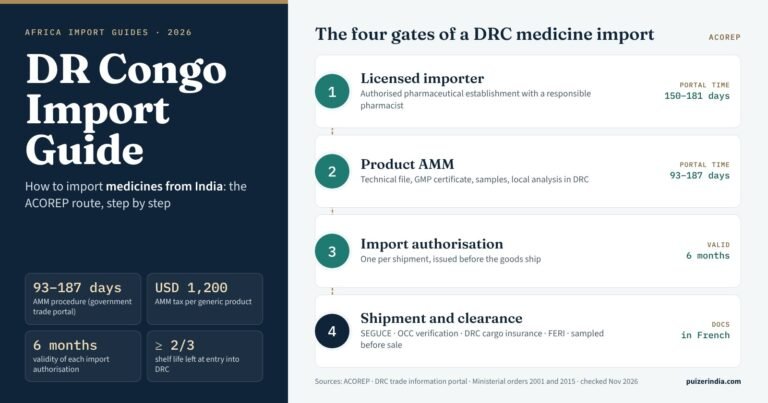
How to import medicines from India to DR Congo: four gates
The government’s trade information portal (run by the Ministry of Foreign Trade) maps the full medicine import procedure as 12 permit steps. Its model case is a shipment through Kinshasa airport.[2] They group into four gates. Each tab shows who files, what it costs, how long it takes, and what your Indian supplier has to provide.
Gate 1: an authorised pharmaceutical establishment
What the importer needs
- Registration of the establishment on ACOREP’s platform, plus a SEGUCE account, an import-export number and an OCC access code[2]
- A certificate authorising the opening of a pharmaceutical establishment. The file includes the RCCM, notarised statutes, the Ordre des pharmaciens’ opinion, a site-visit report, and the responsible pharmacist’s diploma, contract and acceptance of responsibility.[10]
- Only a pharmacist of an authorised establishment, or a recognised organisation with a responsible pharmacist, may apply for import authorisations.[6]
What the Indian supplier provides
- Nothing at this gate. But check it first: an importer without an establishment licence cannot file the AMM or the import authorisation, so no shipment can move.
- Ask for the establishment’s ACOREP authorisation before investing in samples and dossiers.
Gate 2: marketing authorisation (autorisation de mise sur le marché, AMM)
What the importer does
- Files the application. The portal shows 10 steps: apply, pay the dossier-study and analysis fees, deposit samples, then pay the AMM tax and collect the certificate.[3]
- Arranges the local analysis report from a laboratory approved in DRC.[3]
- Tracks renewal: the 2001 order sets a five-year AMM, renewable, with the request due three months before expiry.[5]
What the Indian supplier provides
- The technical file: summary of actives, excipients and manufacturing method, plus analytical, pharmacological, toxicological and clinical sections.[3]
- A GMP certificate and evidence of authorisation in the country of origin or export.[3]
- Registration samples. The 2001 order asks for 50 retail-format and 2 hospital-format samples.[5]
Gate 3: import authorisation (autorisation d’importation), one per shipment
What the importer does
What the Indian supplier provides
- A pro forma invoice whose product names, strengths, pack sizes and quantities match the AMM exactly.
- A dispatch date that fits inside the six-month window, and stock with enough shelf life left (see the two-thirds rule below).
Gate 4: shipment, verification and customs clearance
What the importer does
- Buys a cargo insurance certificate from an insurer in DRC. This is a mandatory step under an order of 17 November 2022.[9]
- Obtains the OCC import verification certificate and the import declaration (model IB).[7][15]
- Obtains the FERI (fiche électronique de renseignement à l’importation), then clears customs.[8]
- Holds the goods in bond while ACOREP’s inspector samples them. They may be sold only after the analysis results comply.[6]
What the Indian supplier provides
- Commercial invoice, packing list, bill of lading or air waybill, freight invoice and certificate of origin.[8][11]
- A certificate of analysis for every batch. Customs asks for them on arrival.[6]
- Access for pre-shipment inspection where it applies. The US trade guide says BIVAC inspects imports worth USD 2,500 or more in the exporting country.[11]
Registration
ACOREP AMM registration: dossier, fees and timeline
Every medicine, whether a branded speciality or a generic, needs an AMM before it can circulate in DR Congo.[5] Only AMM holders’ products may be imported. The one exception is samples sent for registration itself.[6] The government portal lists these documents for an AMM file:[3]
| AMM file item (portal wording) | Who supplies it | Practical note |
|---|---|---|
| Completed product-registration form and product list | Importer (DRC applicant) | Filed by the authorised pharmacist |
| Summary of active ingredients, excipients and manufacturing methods | Manufacturer | Matches Module 2–3 content of a CTD dossier |
| Manufacturer’s analytical file | Manufacturer | Specifications, methods, validation, batch CoAs, stability |
| Pharmacological and toxicological files | Manufacturer | For a generic, usually literature-based |
| Clinical file | Manufacturer | Ask ACOREP what it accepts for your generic (bioequivalence or literature) |
| GMP certificate (BPF) | Manufacturer | WHO-GMP certificate of the actual manufacturing site |
| AMM issued by the country of origin or export | Manufacturer | For an Indian generic, the CoPP and Indian product permission. An export-only product has no Indian approval; see the FAQ |
| Local analysis report from a DRC-approved laboratory | Importer | Uses the registration samples |
| Samples | Manufacturer | 50 retail-format + 2 hospital-format packs (2001 order)[5] |
Scroll sideways to see all columns.
AMM fees listed on the government portal
| Fee | Amount per product | Paid to |
|---|---|---|
| Dossier-study fee | up to USD 2,000 | ACOREP (via bank) |
| Analysis fee | up to USD 1,300 | ACOREP (via bank) |
| AMM tax: generic product | USD 1,200 | DGRAD (via bank) |
| AMM tax: speciality product | USD 2,000 | DGRAD (via bank) |
Source: DRC trade information portal, AMM procedure.[3] The portal shows the study and analysis fees as ranges from zero, so treat the upper figures as ceilings, not quotes. The portal states amounts in CDF and USD; the CDF figures move with the exchange rate.
Plan for a provisional first AMM. The 2001 order, which the portal still cites as the legal basis for the AMM, makes the first AMM a one-year provisional authorisation while clinicians monitor the product. The five-year AMM follows after a favourable review.[5][3] Ask ACOREP how it applies this today before you promise a buyer a five-year horizon.
One packaging rule follows from the AMM: the AMM number must appear on the container and the outer pack.[5] So final private-label artwork is printed after the AMM is granted. Registration samples can go in the submitted artwork.
At the border
DR Congo shipment rules that catch Indian exporters
Any pharmaceutical product entering DRC must have at least two-thirds of its shelf life left.[6] On a 24-month product, that is at least 16 months at entry.
The import authorisation must exist before the goods are shipped, and it lapses after six months.[6] Do not book freight on a promise.
Customs asks for analysis certificates for the different batches, the import authorisation and the final invoice.[6] Missing CoAs stall clearance.
The pharmacist inspector samples the consignment, and products are sold only after compliant results.[6] Build that hold into the buyer’s stock plan.
A cargo insurance certificate from a DRC insurer is a required import step.[9] CIF cover bought in India would duplicate it, which is one reason to price FOB.
OCC and customs require shipping documents in French.[11] Agree the language of invoices and packing lists in the purchase order.
Labels and leaflets: neither DRC order reviewed here sets a labelling language. French is the official language, and buyers routinely ask for French or bilingual French-English artwork. Confirm the label language with ACOREP during the AMM, and read our guide to climate-zone stable packaging for export before fixing the pack.
Buyer tool
DR Congo registration fee, timeline and shelf-life estimator
Enter your plan. The estimator applies the fee ceilings and procedure times published on the DRC trade portal and the two-thirds shelf-life rule.[3][4][6] It leaves out customs duty, VAT, freight and agent fees.
Fixed AMM tax, plus study and analysis fees up to their ceilings.
ACOREP 1% + DGRAD 2% (import authorisation), OCC 2%, FERI 0.5%: up to 5.5% of value.
Portal procedure times, run one after another.
At least two-thirds must remain at entry.
Indicative only. Actual amounts are set by ACOREP and DGRAD notes de perception at the time of filing.
Your Indian supplier
What an Indian manufacturer supplies for a DR Congo order
A DRC buyer carries the licences. The manufacturer carries the evidence. This is how the work splits on a Puizer Cure (OPC) Pvt. Ltd. order. Tablets and capsules are made at our WHO-GMP facility in Sonipat, Haryana. Liquids and topicals are made at a partner facility under a loan licence. We supply finished dosage forms only, not APIs.
| Stage | Supplier deliverable | Read more |
|---|---|---|
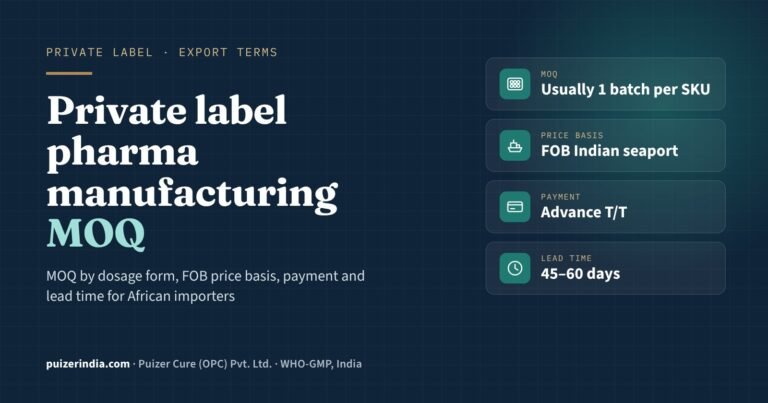
| Quotation | Product list matched to your tender or the LNME; FOB Indian-port price; advance T/T terms | MOQ, lead time and export terms |
| AMM file | Technical dossier where available for that product, GMP certificate, CoPP, stability data, registration samples | Export documentation checklist |
| Export-only products | CDSCO export NOC through the SUGAM portal before manufacture, for products not approved in India[14] | See the FAQ below |
| Artwork | Private-label artwork in French or French-English carrying the DRC AMM number; production 45–60 days after artwork approval | Lead-time planner |
| Dispatch | Commercial invoice, packing list, certificate of origin, batch CoAs, shelf life that clears the two-thirds rule | How to verify medicine quality before import |
| Landed cost | FOB price split so you can add freight, local insurance and DRC charges | Landed cost calculator: FOB vs CIF |
Scroll sideways to see all columns.
Certificates are shared on request with serious enquiries. Browse the full range in our pharmaceutical product catalogue.
Public and NGO buyers
Selling into DR Congo’s public sector: the LNME rule
The Ministry of Health’s 2015 supply guidelines tell both the public and private sectors to buy from the national essential medicines list (LNME).[13] For public supply, products must meet GMP and at least one of three conditions:[13]
- registration in DRC (an ACOREP AMM)
- WHO prequalification
- authorisation by a stringent regulatory authority
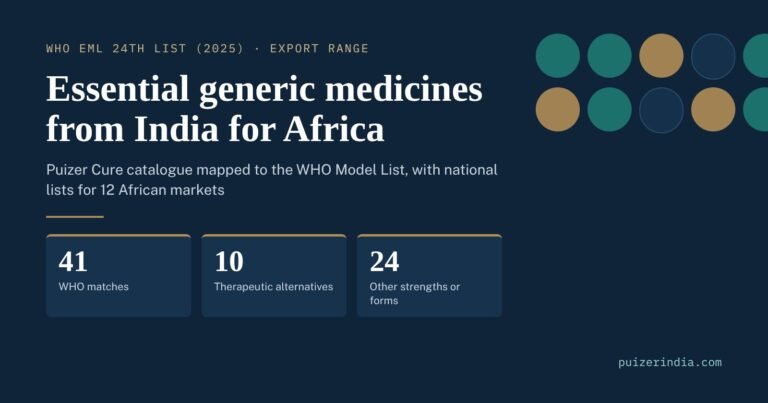
Regional distribution centres (CDRs) buy from purchasing centres, and suppliers are pre-selected on quality, price, service, delivery time and financial standing.[13] For most Indian WHO-GMP generics, the ACOREP AMM is the route that is actually open. Our essential generics range mapped to the WHO EML shows which molecules we can quote against an LNME-based list.
Related on puizerindia.com
Country guides and buyer tools
The NAFDAC route, for buyers comparing West and Central African markets.
EPSS tenders versus the private importer route.
Benchmark ACOREP’s fees against FDA Ghana, NAFDAC, NDA and others.
CoA, WHO-GMP, CoPP, certificate of origin and FSC: who issues what.
Importing into DR Congo?
Send your product list for a DRC quotation
Tell us your city, establishment status and product list (molecule, strength, pack). We reply with FOB prices, MOQ bands, shelf life at dispatch and the documents available for your AMM files.
FAQ
DR Congo medicine import: questions importers ask
Yes. The 2015 commerce order allows only products that hold an AMM to be imported, with an exception for samples submitted for registration. The regulator may waive the import authorisation in emergencies or for small quantities requested by clinicians for identified patients.
The government trade portal puts the AMM procedure at 93.5 to 187 days. Under the 2001 order, the first AMM is a one-year provisional authorisation, followed by a five-year AMM renewable three months before expiry. A new importer also needs its establishment authorisation, which the portal puts at about 150 to 181 days.
Per product, the portal lists a dossier-study fee of up to USD 2,000 and an analysis fee of up to USD 1,300, both paid to ACOREP. The AMM tax is USD 1,200 for a generic or USD 2,000 for a speciality, paid to DGRAD. So a generic costs up to about USD 4,500 in official fees, before dossier, sample and local-agent costs.
Not on its own. The 2001 order requires the application to come from a pharmacist authorised to practise in DR Congo, so the AMM is filed through a licensed local establishment. The manufacturer supplies the technical file, the GMP certificate, the CoPP and the samples.
At least two-thirds of the total shelf life must remain when the product enters the country. For a 24-month product that means at least 16 months, so manufacture, testing, dispatch, transit and clearance together must take no more than 8 months.
DRC rules require a cargo insurance certificate from a DRC insurer for imports, so insurance bought in India under CIF would duplicate it. Puizer Cure quotes FOB at an Indian port, and you add freight, local insurance and DRC charges in your landed-cost calculation.
Only with a no-objection certificate from a CDSCO zonal office, applied for on the SUGAM portal before the export manufacturing licence is granted. Indian customs check that NOC at export. If the NOC is tied to a purchase order and the order changes, a revised NOC is needed. Some fixed-dose combinations sold in DR Congo fall into this group.
The DRC orders reviewed for this guide do not set a labelling language, but French is the official language, and customs and OCC require shipping documents in French. Plan French or bilingual French-English labels and leaflets, and confirm the requirement with ACOREP during the AMM.
Sources
References
- Autorité Congolaise de Réglementation Pharmaceutique (ACOREP). Présentation de l’ACOREP. Kinshasa: ACOREP. Available from: https://acorep.gouv.cd/presentation/. Accessed November 2026.
- Ministère du Commerce extérieur, RDC. Portail d’Informations Commerciales: procédure intégrale d’importation de médicaments via l’aéroport de Kinshasa. Available from: https://portal.commerce.gouv.cd/procedure/258. Accessed November 2026.
- Ministère du Commerce extérieur, RDC. Portail d’Informations Commerciales: obtenir l’autorisation de mise sur le marché (AMM). Available from: https://portal.commerce.gouv.cd/procedure/212. Accessed November 2026.
- Ministère du Commerce extérieur, RDC. Portail d’Informations Commerciales: obtenir l’autorisation d’importation des médicaments et autres produits de santé. Available from: https://portal.commerce.gouv.cd/procedure/143. Accessed November 2026.
- Ministère de la Santé, RDC. Arrêté ministériel n°1250/CAB/MIN/S/AJ/MS/012/2001 du 9 décembre 2001 portant dispositions relatives à l’enregistrement et à l’autorisation de mise sur le marché des produits pharmaceutiques. Via FAOLEX. Available from: https://faolex.fao.org/docs/pdf/Cng189578.pdf. Accessed November 2026.
- Ministère de la Santé Publique, RDC. Arrêté ministériel n°1250/CAB/MIN/SP/008/CPH/OBF/2015 du 28 septembre 2015 portant règlementation du commerce des produits pharmaceutiques. Via FAOLEX. Available from: https://faolex.fao.org/docs/pdf/Cng189563.pdf. Accessed November 2026.
- Ministère du Commerce extérieur, RDC. Portail d’Informations Commerciales: obtenir le certificat de vérification à l’importation (médicaments). Available from: https://portal.commerce.gouv.cd/procedure/225. Accessed November 2026.
- Ministère du Commerce extérieur, RDC. Portail d’Informations Commerciales: obtenir la fiche électronique de renseignement à l’importation (FERI). Available from: https://portal.commerce.gouv.cd/procedure/132. Accessed November 2026.
- Ministère du Commerce extérieur, RDC. Portail d’Informations Commerciales: obtenir le certificat d’assurance marchandise (legal basis: arrêté du 17 novembre 2022 on import cargo insurance). Available from: https://portal.commerce.gouv.cd/procedure/101. Accessed November 2026.
- Ministère du Commerce extérieur, RDC. Portail d’Informations Commerciales: obtenir le certificat d’autorisation d’ouverture d’un établissement pharmaceutique. Available from: https://portal.commerce.gouv.cd/procedure/210. Accessed November 2026.
- International Trade Administration, US Department of Commerce. Democratic Republic of the Congo Country Commercial Guide: Import Requirements and Documentation. Updated 20 February 2026. Available from: https://www.trade.gov/country-commercial-guides/democratic-republic-congo-import-requirements-and-documentation. Accessed November 2026.
- ACOREP. Répertoire des autorisations de mise sur le marché (AMM). Added 4 February 2026. Available from: https://acorep.gouv.cd/repectoire-amm/. Accessed November 2026.
- Direction de la Pharmacie et du Médicament, Ministère de la Santé Publique, RDC. Lignes directrices sur l’approvisionnement en médicaments essentiels en République Démocratique du Congo. Kinshasa; 2015. Via WHO. Available from: extranet.who.int (PDF). Accessed November 2026.
- Office of the Commissioner of Customs (NS-II), Jawaharlal Nehru Custom House, India. Public Notice No. 88/2026: Procedures and documents required for export consignments of drugs and pharmaceuticals. 20 July 2026. Available from: https://www.jawaharcustoms.gov.in/pdf/PN-2026/Public Notice 88.pdf. Accessed November 2026.
- Ministère du Commerce extérieur, RDC. Portail d’Informations Commerciales: obtenir la déclaration d’importation des biens modèle IB. Available from: https://portal.commerce.gouv.cd/procedure/123. Accessed November 2026.
Scope and limits. ACOREP’s own site publishes no registration guidelines or fee schedule (its guideline and procedure pages were empty on 2 November 2026). The procedure steps, fees and times above therefore come from the government trade portal and the ministerial orders it cites. We could not confirm whether a later order has amended the 2001 AMM order. Customs duty and VAT rates are not covered. The US trade guide’s BIVAC pre-shipment rule should be confirmed with your forwarder, because the DRC portal shows verification under the OCC. This page is technical and educational guidance, not legal advice. Regulations change, so confirm each step with ACOREP and your clearing agent before you ship.