
Uganda NDA Drug Registration Process: The Exporter’s Guide to Marketing Authorization & Import Licensing
Getting a medicine legally onto the Ugandan market runs on the same kind of parallel tracks exporters meet in Kenya — a Marketing Authorization for each product from the National Drug Authority (NDA), a Uganda-based Local Technical Representative who holds it, and a per-shipment import/export permit to move it across the border. This guide walks through all three using NDA’s own published service standards, and shows how a Kenya PPB dossier becomes the fastest route in.
What it actually takes to sell a medicine in Uganda
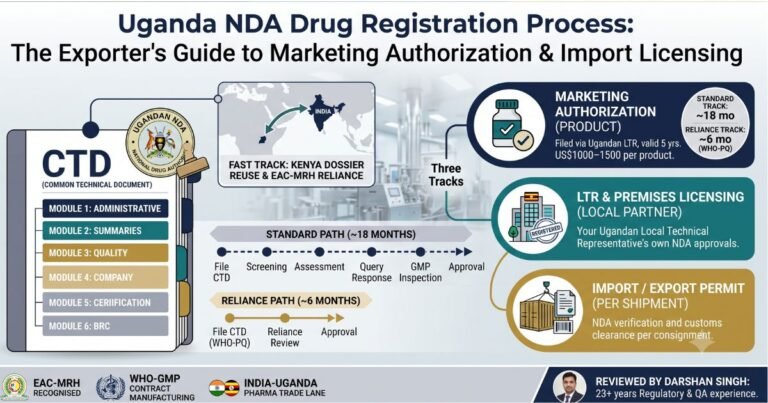
You need three things in place. First, Marketing Authorization from the National Drug Authority (NDA) for each product — filed as a CTD dossier through a Uganda-based Local Technical Representative (LTR), since a foreign manufacturer cannot apply directly. Second, your Ugandan partner’s own premises and import/export registration to legally receive and distribute the product. Third, a per-consignment import/export permit, cleared through NDA’s Directorate of Inspectorate & Enforcement before customs release. Under NDA’s own published service standards, budget up to 18 months for a standard human-medicine assessment — or as little as 6 months if your product already carries WHO-Prequalification or Stringent Regulatory Authority (SRA) approval.2
Why Uganda is the natural second market after Kenya
Uganda is landlocked: the great majority of its imports, pharmaceuticals included, move overland from the port of Mombasa through Kenya along the Northern Corridor. For an exporter who has already built a Kenyan PPB relationship, Uganda is a genuinely adjacent next step rather than a fresh start — the logistics route, the regional regulatory framework, and much of the dossier all carry over from a WHO-GMP manufacturing base.
Uganda’s total pharmaceutical imports were valued at US$507.12 million in 2023 (UN Comtrade).1 India-origin pharmaceutical imports into Uganda are reported at US$246.2 million in Uganda’s own 2023 import data,3 against US$102.75 million in India’s 2024 export data for the same trade lane4 — a mirror-statistics gap that’s common between two countries’ customs records (re-exports, valuation basis and timing all differ), but even on the conservative figure, India is a substantial and growing supplier to the Ugandan market.
Two developments matter for an exporter planning entry now. First, in June 2026 the NDA published a revised Client Charter setting explicit service-delivery timelines for every stage of product assessment — a level of published process transparency most East African regulators don’t offer, and one this guide draws directly from.2 Second, that charter formalises a genuine reliance pathway: products already carrying WHO-Prequalification, or approval from a Stringent Regulatory Authority (SRA), or authorised under Article 58 of EU regulations, get a 6-month decision standard instead of the 18-month standard track.2
The three approvals you’re actually chasing
As in Kenya, “getting registered in Uganda” is not one approval — it’s three workstreams handled by different NDA directorates on different clocks. Confuse them and you end up with a registered product that has nowhere licensed to land it, or a licensed importer with nothing approved to bring in.
| Track | What it is | NDA directorate |
|---|---|---|
| 1 · Marketing Authorization | Product-specific approval, assessed on quality, safety and efficacy from a full CTD dossier | Directorate of Product Assessment & Registration (DPAR) |
| 2 · LTR & premises / import-export registration | Your Ugandan partner’s own licensing to legally receive and distribute product | Directorate of Inspectorate & Enforcement (DIE) |
| 3 · Import / export permit | Per-consignment clearance once the product and the importer are both approved | DIE – Imports and Exports Unit |
Marketing Authorization, in detail
What it is: legal permission for a specific product to be sold in Uganda, assessed on quality, safety and efficacy from a full CTD dossier submitted through NDA’s online system.
Who holds it: a foreign manufacturer cannot apply directly. You appoint a Uganda-based Local Technical Representative (LTR); NDA corresponds with, and issues the certificate to, that representative.
Timeline & validity: the standard human-medicine review-and-query cycle carries an 18-month (396 working-day) service standard, plus a further 3 months (66 working days) for the regulatory decision once you’ve answered NDA’s queries. Products already WHO-Prequalified or SRA-approved qualify for a 6-month (132 working-day) decision standard instead. The certificate is valid five years, per Regulation 40(1) of the National Drug Policy and Authority (Registration) Regulations, 2014.27
The sequencing trap: Marketing Authorization is the long pole in the tent, so start it first and early. Run the LTR/importer relationship (Track 2) in parallel — a registered product with nowhere licensed to receive it stalls at the border. The import/export permit (Track 3) only becomes relevant once the first two are secured.
Who does what: manufacturer vs. Ugandan LTR
For an India-based exporter, the workload splits cleanly between what you supply from the plant and what your Ugandan LTR handles on the ground.
| Responsibility | Manufacturer / exporter (India) | Local Technical Representative (Uganda) |
|---|---|---|
| CTD dossier (Modules 1–5) | Compiles quality, safety & efficacy data; CMC, stability & batch data | Adapts Module 1 (local admin) & submits via NDA’s online system |
| Certificate of Pharmaceutical Product | Obtains WHO-format CPP from CDSCO / national authority | Files it with the application |
| GMP evidence | Supplies WHO-GMP certificate, site master file, WHO-PQ / SRA record if held | Coordinates any NDA GMP inspection — foreign-site inspections carry a 180 working-day standard2 |
| Local Technical Representative | Appoints the LTR | Acts as NDA’s correspondence point; holds the registration paperwork |
| Premises & import/export registration | — | Holds the licensed premises and import/export registration NDA requires |
| Import / export permits | Provides invoice, CoA, packing docs per shipment | Applies for the permit — NDA verification runs 3 working days, port clearance 2 working days, once registered2 |
| Pharmacovigilance | Supplies PSURs & safety data | Runs local ADR reporting — NDA’s own standard is 5 days to acknowledge, 18 days to feedback on serious cases2 |
Where a WHO-GMP contract manufacturer changes the math: if you’re a brand owner or distributor without your own approved plant, sourcing from a WHO-GMP third-party manufacturing partner means the CPP, GMP certificate, site master file, stability data and CoA in the left column arrive as a ready package — and, if that plant already holds WHO-PQ or SRA approval, it’s also the single biggest lever on whether your file gets the 6-month reliance track or the 18-month standard track. See our third-party manufacturing for African markets guide for how that arrangement is typically scoped.
Registration, step by step
NDA’s stages are well defined and, since June 2026, published against explicit day-counts. Getting through them without avoidable delay is mostly about dossier quality and query response speed — not the steps being obscure.
Pre-submission preparation
Appoint your LTR, confirm current NDA dossier requirements, and establish whether your site’s WHO-GMP status also carries WHO-PQ or SRA recognition — the single biggest determinant of which timeline track applies.
Dossier compilation
Build the full CTD across Modules 1–5 in the EAC-harmonised ICH format. Consistency between modules is the most common trigger for deficiency queries later.
Application submission
Submit through NDA’s online application system via your LTR, and pay the applicable statutory fees.
Screening & validation
NDA checks the application is complete and correctly formatted before it enters scientific review. Missing documentation stops the process here.
Scientific assessment
Standard track: 18 months (396 working days). Reliance track (WHO-PQ / SRA / Article 58 EU-approved products): 6 months (132 working days). A stop-clock applies — the timeline pauses whenever NDA issues a query and resumes only once you respond.2
GMP review or inspection
Foreign-site physical inspections carry a 180 working-day service standard.2 Recognised WHO-PQ / SRA status can allow reliance in place of a fresh inspection, saving months.
Query response & decision
Answer deficiency queries within the window given — the clock stays paused while NDA waits on you. Regulatory decision after complete information is received: 3 months (66 working days).2
Registration certificate issued
On approval, a Certificate of Registration is issued, valid five years. Pharmacovigilance obligations begin immediately.
The CTD dossier — and what “complete” really means
NDA accepts the ICH Common Technical Document (CTD) format under the EAC-harmonised structure — the same requirement set covered in our Kenya PPB guide, with only Module 1 (local administrative content) changing per country. That’s what makes a Kenyan dossier reusable here.
| Requirement | What it proves |
|---|---|
| Local Technical Representative | Your correspondence and regulatory point of contact inside Uganda |
| Certificate of Pharmaceutical Product (CPP) | Approval status in the country of origin (WHO format) |
| GMP certificate / evidence | Manufacturing site meets recognised quality standards |
| CTD dossier (Modules 1–5) | Core quality, safety & efficacy documentation |
| Certificate of Analysis (CoA) | Batch-level product quality against specification |
| Stability data | Supports shelf-life & storage claims for tropical climatic zones |
| Product labeling & package insert | Uganda-compliant labeling |
| Interchangeability / BE data (generics) | Therapeutic equivalence, per Module 5 |
| Patent declaration | Intellectual-property status |
Interactive · Dossier readiness check
Indicative checklist for planning only. Nothing is stored or sent — this runs entirely in your browser. Confirm the exact, current requirement set against official NDA guidelines before you file.
Fees & the registration planner
NDA’s own current tariff sets statutory fees by product category; we could not source an official published fee table for this guide, so treat the figures below as planning assumptions, not quoted amounts. What’s verifiable is the structure — the cost lines you’ll encounter:
| Cost line | When it applies | Notes |
|---|---|---|
| Application / registration fee | Per product, at submission | Indicative US$1,000–1,500 per product, per public planning guidance from a Kenya/Uganda regulatory consultancy5 — not an NDA-published figure |
| GMP inspection fee | If NDA inspects an un-assessed foreign site | Foreign inspection carries a 180 working-day service standard;2 often avoidable via WHO-PQ / SRA reliance |
| Annual retention | Yearly, to keep registration live | Recurring across the 5-year validity |
| Variation fee | Post-approval changes | Minor variation: 4-month decision standard. Major variation (no physical verification): 6-month standard2 |
| Renewal fee | Every 5 years | File ahead of expiry |
| LTR retainer | Ongoing (commercial, not NDA) | Negotiated with your Local Technical Representative |
Interactive · NDA registration planner
Illustrative only, in indicative US$. Excludes dossier preparation, CPP / legalisation, lab analysis, freight and taxes. Default rates are planning placeholders, not official NDA figures — verify every input with NDA and your LTR. Not financial advice.
Two realistic timelines, not one
Unlike some East African regulators, NDA publishes its own day-counts. That means an exporter can plan against two clearly different paths rather than a single vague estimate.
What blows the timeline: inconsistencies between CTD modules, unrecognised GMP status (which triggers the 180-day foreign inspection instead of reliance), and slow query responses — the stop-clock keeps the review paused while the ball is in your court.2
EAC-MRH: register once, expand across East Africa
Uganda participates in the same East African Community Medicines Regulatory Harmonization (EAC-MRH) framework referenced in our PPB Kenya guide — launched 30 March 2012 to align registration requirements, assessment standards and post-market surveillance across EAC Partner States, now numbering seven: Kenya, Uganda, Tanzania, Rwanda, Burundi, South Sudan and the Democratic Republic of Congo.6
| Harmonization mechanism | What it means for your submission |
|---|---|
| Common CTD format | One dossier structure accepted across partner states — only Module 1 changes per country |
| Mutual recognition of GMP reports | A GMP inspection outcome can be recognised across the bloc, reducing repeat inspections |
| Joint assessment | Products seeking multi-country registration can be reviewed collaboratively |
| Aligned classification & labeling | Progressively common rules cut per-market rework |
The practical play: register in Kenya first, then reuse the CTD core for Uganda (NDA) — adjusting only local administrative content. Tanzania (TMDA) and Rwanda (Rwanda FDA) are the next logical extensions of the same dossier, and are covered in upcoming guides in this series. This is why Kenya-then-Uganda is a regional platform, not two standalone builds — the same logic behind our pharmaceutical export to Africa approach.
Common delay triggers — and how to avoid them
- Weak or missing stability data. Ensure data supports the claimed shelf life under the correct climatic zone before filing.
- Inconsistency between CTD modules. Figures or claims that don’t reconcile across Modules 1–5 generate deficiency queries.
- An unrecognised or absent GMP status. A site NDA hasn’t assessed, with no WHO-PQ / SRA record to rely on, triggers the 180 working-day physical inspection instead of the reliance track.
- Treating the LTR as a formality. The representative is a legal correspondence role, not a mailbox. A weak or unresponsive LTR slows every query cycle.
- Slow query responses. The stop-clock keeps the timeline paused while NDA waits on you — resource the response function before you file, not after.
- Registering the product but not the import route. A live registration with no licensed importer to receive shipments leaves stock stuck at the border.
Sequencing multiple products: lead with SKUs that have the clearest commercial case or fill a genuine gap in Ugandan supply. Registering a whole catalogue at once multiplies fees and query load without multiplying early revenue.
Planning a Uganda or East Africa launch? Start from a WHO-GMP base.
Whether you need a registration-ready dossier package, a WHO-GMP manufacturing partner, or export documentation built to clear NDA review, our team supports Indian manufacturers and brand owners entering African markets end to end.
NDA Uganda registration — frequently asked questions
Plan for up to 18 months on NDA’s standard track for a human medicine, or around 6 months if your product already carries WHO-Prequalification or Stringent Regulatory Authority approval. Both figures come from NDA’s own published Client Charter service standards — the stop-clock pauses the count whenever NDA is waiting on your response to a query.
No. A foreign manufacturer must act through a Uganda-based Local Technical Representative (LTR), who submits the application, corresponds with NDA, and holds the registration paperwork on your behalf.
Marketing Authorization approves a specific product. Premises and import/export registration authorises your Ugandan LTR’s business and facility to legally receive and distribute pharmaceuticals. You need both, plus a per-consignment import/export permit for each shipment.
A complete application typically needs a CTD dossier (Modules 1–5) in the EAC-harmonised format, a WHO-format Certificate of Pharmaceutical Product, GMP evidence, a Certificate of Analysis, stability data, labeling and package insert, interchangeability/BE data for generics, a patent declaration, and a named Local Technical Representative.
NDA sets fees by its current tariff and product category; we could not source an official published fee schedule for this guide. Budget roughly US$1,000–1,500 per product as an indicative planning figure from third-party regulatory-consultancy guidance, and confirm the exact, current amount directly with NDA and your LTR before committing a budget. Use the planner above to model your own assumptions.
Yes, substantially. NDA’s own service standards give WHO-PQ, SRA-approved, and Article-58-EU-approved products a 6-month decision track against the 18-month standard track, and reliance can also remove the need for a fresh physical GMP inspection.
Substantially. Kenya and Uganda both work to the EAC-harmonised CTD format, so a dossier built for PPB is largely reusable for NDA — only Module 1 administrative content changes per country. Registering in Kenya first, then reusing the dossier core, is the efficient sequence.
Once a product is registered, NDA’s own service standard is 3 working days to verify each import against the drug register, and 2 working days for clearance at the port of entry. Shipments without valid registration and permit documentation are not released.

Reviewed by Darshan Singh
23+ years in pharmaceutical Quality Assurance, Quality Control and Drug Regulatory Affairs. This guide is written for exporting manufacturers and brand owners and reflects hands-on experience with CTD dossiers, GMP compliance and multi-market registration. It is general information, not regulatory or legal advice for a specific product.
- UN Comtrade, via Trading Economics. Uganda Imports of Pharmaceutical Products. Available from: https://tradingeconomics.com/uganda/imports/pharmaceutical-products — accessed August 2026.
- National Drug Authority (Uganda). Service Delivery Timelines / Client Charter 2025–2030. Kampala: NDA; June 2026. Available from: https://www.nda.or.ug/service-delivery-timelines/ — accessed August 2026.
- UN Comtrade, via Trading Economics. Uganda Imports from India, by product. Available from: https://it.tradingeconomics.com/uganda/imports/india — accessed August 2026.
- UN Comtrade, via Trading Economics. India Exports of Pharmaceutical Products to Uganda. Available from: https://tradingeconomics.com/india/exports/uganda/pharmaceutical-products — accessed August 2026.
- The Pharma Partner. Product Registration in Uganda (NDA). Indicative fee guidance only — not an official NDA source. Available from: https://thepharmapartner.co.ke/regulatory/uganda-nda-registration — accessed August 2026.
- AUDA-NEPAD, African Medicines Regulatory Harmonisation (AMRH). Uganda country profile. Available from: https://amrh.nepad.org/amrh-countries/uganda — accessed August 2026.
- National Drug Policy and Authority (Registration) Regulations, 2014, Regulation 40(1) — certificate of registration validity. Uganda. Cited via secondary compilation; primary statutory instrument not independently re-fetched for this build — verify against the Uganda Legal Information Institute (ulii.org) or NDA before relying on it for a filing decision.