
PPB Kenya Drug Registration Process: The Exporter’s Guide to Product Approval & Import Licensing
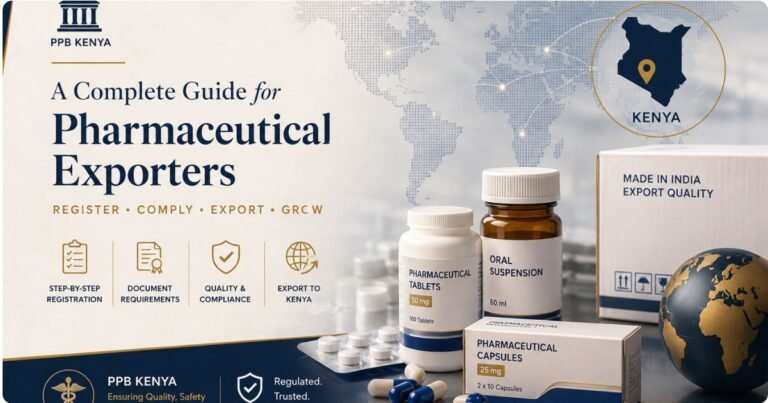
Getting a medicine legally onto the Kenyan market runs on two parallel tracks that most guides blur together — a product marketing authorization for each product, and a separately licensed Kenyan importer with a Wholesale Dealer’s Licence to bring it in. This guide walks an exporting manufacturer through both, sets a realistic 12–18 month expectation, and shows how one Kenyan dossier becomes a springboard into the wider East African market.
What it actually takes to sell a medicine in Kenya
You need two things in place, not one. First, product registration (marketing authorization) from the Pharmacy and Poisons Board (PPB) for each product — filed as a CTD dossier through a Kenya-based Local Authorized Representative (LAR), backed by a Certificate of Pharmaceutical Product and GMP evidence, valid five years. Second, a licensed Kenyan importer — registered premises, a Wholesale Dealer’s Licence and a superintendent pharmacist — to legally bring the product in. Each shipment then needs a per-consignment import permit, cleared through Kenya’s single-window system. Budget 12–18 months for the product side; the importer licensing runs alongside it.
Why Kenya is the natural East African entry point
No other East African market matches Kenya for size, infrastructure or regional pull. Nairobi is the operational headquarters for a large share of the multinational healthcare companies working across the continent, and the country imports well over two-thirds of the medicines it consumes — a structural, ongoing demand for reliable overseas supply rather than a temporary gap. Cardiovascular, diabetes and anti-infective ranges dominate consumption, which maps closely onto the generic portfolios most Indian manufacturers already hold.
Two developments matter for an exporter planning entry now. First, the Pharmacy and Poisons Board (PPB) is actively pushing to move from WHO Global Benchmarking Maturity Level 2 to Level 3 — a stable, integrated regulatory system. That means tighter, more predictable review, but also greater international recognition for products cleared through it. Second, PPB approval carries commercial weight beyond legality: hospital procurement teams, government buyers such as KEMSA, and private distributors treat a PPB registration number as a baseline quality signal. Registration is the price of entry and a trust credential — which is exactly why a WHO-GMP certified manufacturing base shortens the path.
The two licences you’re actually chasing (plus a permit)
This is where most exporters lose time. “Getting registered in Kenya” is not one approval — it is three separate workstreams, governed by the same Act but handled by different PPB departments on different clocks. Confuse them and you end up with a registered product you cannot legally import, or a licensed warehouse with nothing approved to put in it. Here is how they fit together:
Product registration (marketing authorization)
What it is: Legal permission for a specific product to be sold in Kenya. Every medicine needs its own marketing authorization before it can enter the market — no exceptions. Assessed on quality, safety and efficacy from a full CTD dossier.
Who holds it: A foreign manufacturer cannot register directly. You appoint a Kenya-based Local Authorized Representative (LAR) under a general Power of Attorney; the registration certificate is issued in the LAR’s name and they are your legal and regulatory point of contact with PPB.
Timeline & validity: Roughly 12–18 months; valid five years, then renewable (apply at least three months before expiry). This is the long pole in the tent.
Premises registration + Wholesale Dealer’s Licence
What it is: Permission for a business and its premises to trade in pharmaceuticals as an importer/wholesaler. A registered product still needs a licensed entity to bring it in and distribute it. This is the workstream almost every product-focused guide skips.
What it requires: Kenyan-registered premises (with a premises registration certificate), a designated superintendent pharmacist who holds a valid annual practising licence, and the Wholesale Dealer’s Licence itself. Under the Pharmacy and Poisons Act, financial interest in the business must sit with a qualified pharmacist or enrolled pharmaceutical technologist — where a company holds it, the superintendent must be the majority shareholder. Wholesale and retail cannot share one premises.
Renewal cycle: These licences expire on 31 December each year regardless of issue date and must be renewed annually — a recurring compliance date, not a five-year one. In practice, exporters partner with an established Kenyan importer/distributor who already holds this licence rather than building it from scratch.
Per-consignment import permit
What it is: A permit issued by PPB for each individual shipment of medicines entering Kenya — separate from, and additional to, product registration. Registration says the product is allowed to exist on the market; the import permit clears a specific consignment through the border.
How it flows: Permits are applied for through the PPB online portal and processed alongside the customs declaration via the Kenya National Electronic Single Window (TradeNet) operated by KenTrade, working with the Kenya Revenue Authority. PPB authorises the medicine; the single window clears the box. A consignment without valid import documentation will not be released.
Frequency: Ongoing and operational — this is the routine step your Kenyan partner repeats for every order once the product is registered.
Who does what: manufacturer vs. Kenyan partner
For an India-based exporter, the workload splits cleanly between what you supply from the plant and what your Kenyan LAR / importer handles on the ground. Knowing the split up front prevents the most common cause of delay — a dossier waiting on a document only one side can produce.
| Responsibility | Manufacturer / exporter (India) | Local Authorized Representative & importer (Kenya) |
|---|---|---|
| CTD dossier (Modules 1–5) | Compiles quality, safety & efficacy data; provides CMC, stability & batch data | Adapts Module 1 (local admin) & submits via PPB portal |
| Certificate of Pharmaceutical Product (CPP) | Obtains WHO-format CPP from CDSCO / national authority | Files it with the application |
| GMP evidence | Supplies WHO-GMP certificate, site master file, WHO-PQ / SRA approvals if held | Coordinates any PPB GMP inspection of the site |
| Local Authorized Representative | Appoints the LAR by general Power of Attorney | Acts as PPB’s legal contact; holds the registration certificate |
| Wholesale Dealer’s Licence & premises | — | Holds the licence, premises & superintendent pharmacist |
| Import permits & customs | Provides invoice, CoA, packing docs per shipment | Applies for permit; clears via KenTrade / KRA |
| Pharmacovigilance | Supplies PSURs & safety data | Runs local adverse-event reporting from day one of approval |
Product registration, step by step
The PPB pathway is well defined. Getting through it without avoidable delay is mostly about dossier quality and responsive query handling — not about the steps themselves being obscure.
Appoint your LAR, confirm the current PPB dossier requirements, and verify your site holds a GMP certificate PPB will recognise. WHO-prequalification or an SRA (EMA/US-FDA) approval behind the product materially de-risks this stage.
Build the full CTD across Modules 1–5 in ICH format. Consistency is everything — gaps or contradictions between modules are the single most common trigger for deficiency queries later.
Submit through the PPB online portal (PRIMS) and pay the applicable fees. Incomplete applications are returned at this point, costing weeks that are hard to recover.
PPB checks the application is complete and correctly formatted before it enters scientific review. Missing documentation stops the process here.
Reviewers evaluate quality, safety and efficacy in depth. This takes the longest, and the depth of review varies by product category. A stop-clock applies — the timeline pauses whenever PPB issues a query and restarts only when you respond satisfactorily.
Sites not previously assessed by PPB may be inspected. Recognised WHO-PQ / SRA status can allow reliance in place of a fresh physical inspection, saving months and inspection cost.
Answer deficiency letters within the window given. Slow or partial responses are the most avoidable cause of timeline blow-out — the clock stays paused while PPB waits on you.
On approval, a PPB product licence number is generated and the product can be legally imported, distributed and sold. Pharmacovigilance obligations begin the moment authorization is granted.
The CTD dossier — and what “complete” really means
PPB accepts the standard ICH Common Technical Document (CTD) format. The core requirements below travel across East Africa with only Module 1 (local administrative content) changing per country — which is what makes a Kenyan dossier reusable.
| Requirement | What it proves |
|---|---|
| Local Authorized Representative | Your legal / regulatory point of contact inside Kenya |
| Certificate of Pharmaceutical Product (CPP) | Approval status in the country of origin (WHO format) |
| GMP certificate / evidence | Manufacturing site meets recognised quality standards |
| CTD dossier (Modules 1–5) | Core quality, safety & efficacy documentation |
| Certificate of Analysis (CoA) | Batch-level product quality against specification |
| Stability data | Supports shelf-life & storage claims (a top delay driver) |
| Product labeling & package insert | Kenyan labeling compliance |
| Interchangeability / BE data (generics) | Therapeutic equivalence, per Module 5 |
| Patent declaration | Intellectual-property status |
Tick what you already hold to see how submission-ready your file is. Nothing is stored or sent — this runs entirely in your browser.
Indicative checklist for planning only. Confirm the exact, current requirement set against official PPB guidelines before you file — requirements are updated periodically.
Fees & the registration planner
PPB charges fees at several points in the lifecycle. Published amounts change periodically and vary by product category, so the honest guidance from every credible source is the same: confirm current figures directly with PPB before you commit a budget. What you can plan around is the structure — the cost lines you will encounter:
| Cost line | When it applies | Notes |
|---|---|---|
| Application / registration fee | Per product, at submission | Non-refundable — payable even if later rejected |
| GMP inspection fee | If PPB inspects an un-assessed site | Often avoidable via WHO-PQ / SRA reliance |
| Pre-registration lab analysis | Product-sample testing | CoA from a recognised lab required |
| Annual retention | Yearly, to keep registration live | Recurring across the 5-year validity |
| Variation fee | Post-approval changes | Classified by change type |
| Renewal fee | Every 5 years | File ≥ 3 months before expiry |
| Local rep / agent retainer | Ongoing (commercial, not PPB) | Negotiated with your LAR |
Model your own budget and timeline. Every rate below is an editable assumption — set them to the figures your LAR quotes and PPB confirms. This is a planning aid, not a fee schedule.
Illustrative only, in indicative US$. Excludes dossier preparation, CPP/legalisation, lab-analysis, freight and taxes. Default rates are planning placeholders, not official PPB figures — verify every input with PPB and your LAR. Not financial advice.
A realistic 12–18 month timeline
Build 12–18 months into pre-launch planning for most product categories. The single biggest variable is not PPB — it is dossier quality and how fast you answer queries, because the review clock stops every time the ball is in your court.
EAC-MRH: register once, expand across East Africa
Kenya operates within the East African Community Medicines Regulatory Harmonization (EAC-MRH) framework, launched in 2012 to align registration requirements, assessment standards and post-market surveillance across the bloc — Kenya, Uganda, Tanzania, Rwanda, Burundi and South Sudan (with the Community since expanded). For an exporter, this converts a single-country cost into a regional platform.
| Harmonization mechanism | What it means for your submission |
|---|---|
| Common CTD format | One dossier structure accepted across partner states — only Module 1 changes per country |
| Mutual recognition of GMP reports | A GMP inspection outcome can be recognised across the bloc, reducing repeat inspections |
| Joint assessment | Products seeking multi-country registration can be reviewed collaboratively |
| Aligned classification & labeling | Progressively common rules cut per-market rework |
Common rejection triggers — and how to avoid them
- Weak or missing stability data. The most cited delay driver. Ensure data supports the claimed shelf life under the correct climatic zone before filing.
- Inconsistency between CTD modules. Figures or claims that don’t reconcile across Modules 1–5 generate deficiency letters. Run an internal cross-check before submission.
- An unrecognised or absent GMP status. A site PPB hasn’t assessed — with no WHO-PQ / SRA record to rely on — triggers inspection and adds months.
- Treating the LAR as a formality. The representative is a legal role, not a mailbox. A weak or unresponsive LAR slows every query cycle.
- Slow query responses. The stop-clock keeps the timeline paused while PPB waits on you. Resource the response function before you file, not after.
- Registering the product but not the import route. A live registration with no licensed importer to receive shipments leaves stock stuck at the border.
Planning a Kenya or East Africa launch? Start from a WHO-GMP base.
Whether you need a registration-ready dossier package, a WHO-GMP manufacturing partner, or export documentation built to clear PPB review, our team supports Indian manufacturers and brand owners entering African markets end to end.
PPB Kenya registration — frequently asked questions
How long does PPB Kenya drug registration take?
Can a foreign manufacturer register a medicine in Kenya directly?
What’s the difference between product registration and a Wholesale Dealer’s Licence?
What documents are required for the dossier?
What are the PPB registration fees?
Does WHO prequalification or FDA/EMA approval help?
Does a Kenyan registration help elsewhere in East Africa?
How are medicines cleared through customs after registration?
Regulatory requirements, fees and timelines described here are indicative and change over time. Always verify the current position against official Pharmacy and Poisons Board guidance and your appointed Local Authorized Representative before acting. Nothing on this page constitutes legal, regulatory or financial advice.