
Regional hub · West & Central Africa · Francophone markets
One hub for UEMOA homologation, CEMAC and DR Congo registration
For importers in Dakar, Abidjan, Ouagadougou, Douala or Kinshasa, and for Indian exporters of generics: which regulator grants the AMM in each country, what UEMOA harmonisation does and does not do, what goes into a French CTD dossier, and what changed after Mali, Burkina Faso and Niger left ECOWAS.
Pharmaceutical registration in Francophone Africa means getting a national marketing authorisation (autorisation de mise sur le marché, AMM) in every country you sell to. In the eight UEMOA states the procedure is harmonised by Regulation n°04/2020/CM/UEMOA of 28 September 2020[1], which replaced Regulation n°06/2010[2]. The rules are shared, but you still file with each national regulator, and each AMM covers one country only[3]. Cameroon and the other CEMAC states follow their own regional framework[4]. DR Congo belongs to neither bloc and registers through ACOREP[5].
Expect a CTD dossier with Module 1, the summary of product characteristics (RCP) and the labels in the country’s official language[6][7]. That is French everywhere in this hub except Guinea-Bissau, where it is Portuguese. You will also need a CPP, GMP evidence, certificates of analysis and samples.
1 · Map the region
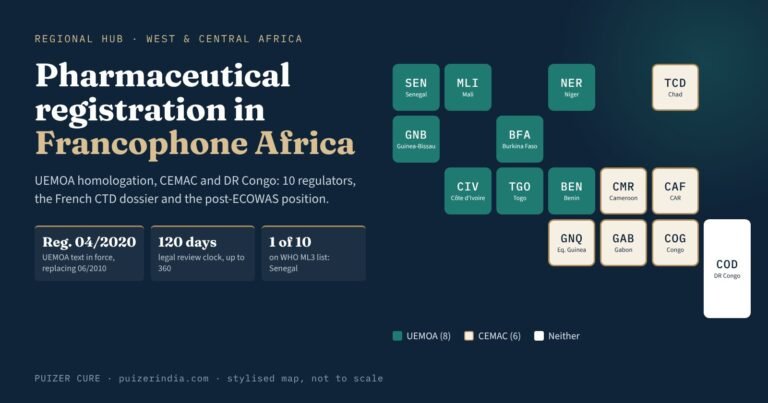
Drug registration in UEMOA countries, CEMAC and DR Congo at a glance
“Francophone Africa” covers three different regulatory situations. Tap a country to jump to its row in the regulator table.
- UEMOA (8)
- CEMAC (6)
- Neither bloc
Stylised tile map. Positions are approximate and not to scale.
UEMOA (WAEMU): 8 states, one homologation regulation
Benin, Burkina Faso, Côte d’Ivoire, Guinea-Bissau, Mali, Niger, Senegal and Togo. They share Regulation 04/2020 and the CFA franc (XOF)[1][10]. The dossier format and the clock are harmonised. The licence is not: each state grants its own AMM.
CEMAC: 6 states, a separate framework
Cameroon, Central African Republic, Chad, Congo, Equatorial Guinea and Gabon. A 2013 CEMAC regulation (n°5/13-UEAC-OCEAC-CM-SE-2) sets a harmonised reference for homologation procedures[4]. UEMOA texts do not apply here. This hub profiles Cameroon only. For the other five, confirm the national regulator before you file. Equatorial Guinea works mainly in Spanish.
DR Congo: national route through ACOREP
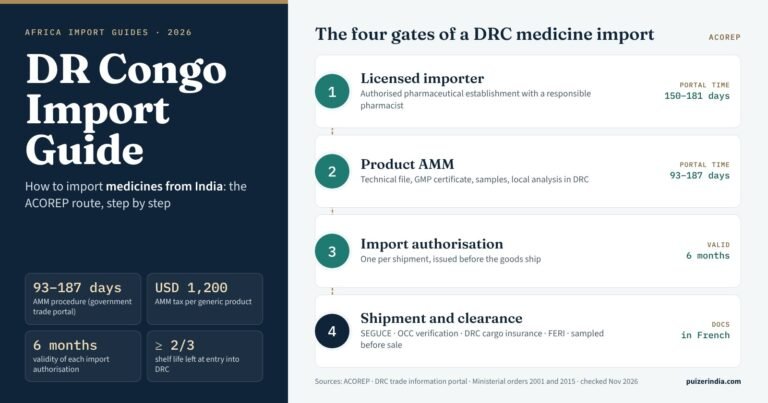
DR Congo is in neither UEMOA nor CEMAC. ACOREP took over medicines regulation from the former DPM on 5 March 2020[5]. You need an AMM and then an import authorisation for each shipment. See our DR Congo import guide for ACOREP registration and shipment rules.
2 · Homologation des médicaments UEMOA
What UEMOA harmonised homologation means in practice
A common error: many guides still name Regulation n°06/2010/CM/UEMOA as the governing text. That includes WAHO’s June 2018 CTD guideline, which was written before 2020[6]. Regulation 04/2020 repealed it[2], and national regulators such as Benin’s now apply 04/2020 by their own decision[11].
Regulation n°04/2020/CM/UEMOA: what changed
- The text. Regulation n°04/2020/CM/UEMOA of 28 September 2020 on homologation procedures for human medicines in UEMOA member states[1]. Benin put it into effect by Decision n°2021-023 of 28 June 2021[11].
- Who grants the AMM. The national pharmaceutical regulatory authority now takes the place of the health minister for applications and grants[2].
- Stricter changes. The regulation adds penalties and turns several minor variations into major ones[2].
- Harmonised does not mean one licence. Under the 2010 regulation each member state issued its own AMM[3]. Regulation 04/2020 kept the same bodies in the procedure[2]. So plan on one AMM per country.
- Why the regulators keep changing names. Directive n°06/2020/CM/UEMOA sets the status of national regulatory authorities[12]. Member states are moving the job from ministry directorates to agencies, which is why Senegal, Côte d’Ivoire, Benin, Niger and Burkina Faso have new regulator names.
The CTD dossier: WAHO’s French guideline and the UEMOA annex
- Format. WAHO’s guideline (OOAS, June 2018) sets the Common Technical Document format for ECOWAS states[6]. Module 1 is regional. Modules 2 to 5 follow the ICH structure.
- Language rule. Regional ECOWAS dossiers are submitted in English. For a national submission, Module 1 must be in that country’s official language, and the applicant answers for the accuracy of any translation[6].
- For a generic. The core of the file is quality data (Module 3) plus bioequivalence data or comparative dissolution tests (Module 5)[3].
- Module 1 essentials. A cover letter stating the number of samples, the signed application form, proof of fee payment, the CPP, GMP status, and the product information: RCP, patient leaflet and label mock-ups[6].
- After the ECOWAS exit. WAHO produced its guideline for ECOWAS[6]. For Mali, Burkina Faso and Niger, the binding text is the UEMOA regulation and its annex. The WAHO layout is still a useful template.
French labelling and product information
- Official language of the member state. The UEMOA annex requires the RCP to be written in the official language of the state where you apply, and applies the same rule to primary-pack information[7]. That means French in seven UEMOA states and Portuguese in Guinea-Bissau.
- Mandatory mentions. They must be legible, understandable and indelible. They include the product name, INN, strength, dosage form, batch number, expiry date, and the names and addresses of the manufacturer and the AMM holder[7].
- VerifyWe read these rules in the 2010 annexes. We could not open the 2020 annex to confirm that the wording is unchanged.
- Outside UEMOA. Cameroon has two official languages, French and English, so confirm which the DPML wants on the pack. In DR Congo the AMM number must appear on the pack, so final private-label artwork follows the AMM (see the DR Congo guide).
Documents an Indian exporter supplies
Scroll sideways on a phone →
| Document | What the texts ask for | Where files get stuck |
|---|---|---|
| CPP (WHO format) | An AMM from the country of origin, or a CPP showing the holder’s identity and full address[7]. WAHO asks for a CPP from the competent authority where the product is not registered in the country of manufacture[6]. | The manufacturing site named on the CPP must match Module 3 and the GMP certificate. |
| GMP certificate | A GMP certificate issued by the competent authority[7], plus GMP status and site information in Module 1[6]. | An expired certificate, or one for a different site or dosage-form block. |
| Certificate of analysis | A CoA for the commercial presentation (“modèle vente”) you submit[7]. | CoA batches that differ from the stability and sample batches. |
| Samples | The 2010 annex asked for 30 unit packs (or 10 hospital packs) of a generic, with an expiry of at least 18 months[7]. VerifyConfirm the 2020 quantities with each regulator. | Short-dated samples, or samples in artwork that does not match Module 1. |
For the full pre-shipment set, use our pharmaceutical export documentation checklist (CoA, WHO-GMP, CoPP, FSC, certificate of origin). To check what a supplier sends you, see how to verify medicine quality before import.
How long UEMOA homologation takes, and how long an AMM lasts
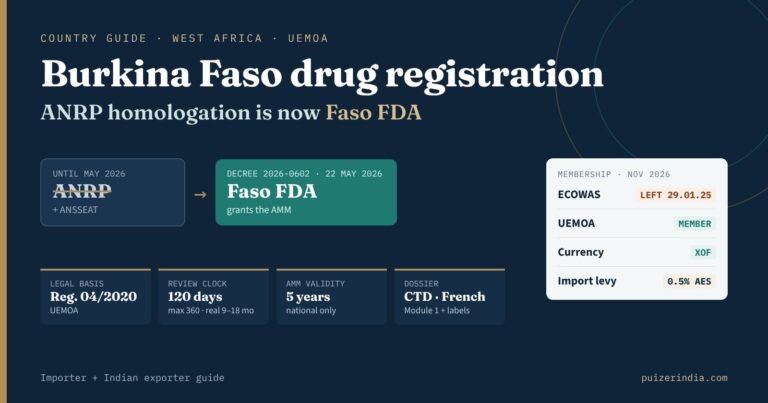
- Review clock. 120 days under Regulation 04/2020. It can reach 360 days while the regulator’s questions are open[2].
- Validity. Five years under the 2010 regulation (Art. 16)[3]. VerifyWe could not open the 2020 text to confirm the article is unchanged.
- Renewal. The 2010 annex required renewal applications 3 months before expiry[7]. The 2020 text adds penalties for late renewal[2], so confirm the current deadline with each regulator.
- In practice. Real timelines run longer than the legal clock. Our Burkina Faso drug registration guide cites a consultancy reporting 9 to 18 months. To compare fees and timelines with Anglophone regulators, see drug registration fees across 8 African regulators.
3 · Regulators, country by country
Francophone Africa regulator table: who grants the AMM (Nov 2026)
Each regulator’s name was checked against a government, WHO or legal source. “WHO list” means WHO’s list of authorities at maturity level 3 or 4, as of August 2026[8].
Scroll sideways on a phone →
| Country | Bloc | Regulator (Nov 2026) | Dossier and label language | WHO list (Aug 2026) | What to know | Puizer guide |
|---|---|---|---|---|---|---|
| Benin | UEMOA | ABMed: Agence béninoise du Médicament et des autres produits de santé. It was the ABRP until October 2023[13]. | French | Not listed | Applies Regulation 04/2020 by Decision 2021-023[11]. | Not yet |
| Burkina Faso | UEMOA | Faso FDA (Faso Food and Drug Administration), formed by merging ANRP and ANSSEAT[14]. The founding decree is dated 22 May 2026. | French | Not listed | Left ECOWAS in 2025 and stayed in UEMOA. Send files to Faso FDA, not “ANRP”. | Burkina Faso guide |
| Côte d’Ivoire | UEMOA | AIRP: Autorité ivoirienne de régulation pharmaceutique, created by Law n°2017-541 of 3 August 2017[15]. | French | Not listed | Preparing for WHO benchmarking with ML3 as the target (July 2026)[16]. | Not yet |
| Guinea-Bissau | UEMOA | UnverifiedWe could not confirm the current regulator. Ask the Ministry of Public Health. | Portuguese | Not listed | Lusophone: French artwork alone will not meet the official-language rule[7]. | Not yet |
| Mali | UEMOA | DPM: Direction de la Pharmacie et du Médicament (Ministry of Health), which has an AMM office[17]. | French | Not listed | Left ECOWAS in 2025. In May 2026 Mali began transposing Directive 06/2020 on regulator status[12]. We found no separate agency yet. | Not yet |
| Niger | UEMOA | Agence nigérienne de règlementation du secteur pharmaceutique. Its statutes were approved by Decree n°2022-915 of 30 November 2022[18]. | French | Not listed | Left ECOWAS in 2025. Confirm which body signs AMMs today. | Not yet |
| Senegal | UEMOA | ARP: Agence sénégalaise de Réglementation pharmaceutique, created by Decree n°2022-824 of 7 April 2022[19]. | French | ML3 Medicines and non-producing vaccines, 2024[8][20] | The only regulator in this hub on WHO’s list. | Not yet |
| Togo | UEMOA | DPML: Direction de la Pharmacie, du Médicament et des Laboratoires (Ministry of Health)[21]. | French | Not listed | A decree creating an autonomous medicines agency was approved on 7 September 2026[22]. Confirm who receives dossiers. | Not yet |
| Cameroon | CEMAC | DPML: Direction de la Pharmacie, du Médicament et des Laboratoires, Ministry of Public Health[4]. | French. English is also an official language, so confirm with the DPML. | Not listed | Follows the 2013 CEMAC homologation framework, not UEMOA texts[4]. | Not yet |
| DR Congo | Neither | ACOREP: Autorité Congolaise de Réglementation Pharmaceutique. It took over from the DPM on 5 March 2020[5]. | French | Not listed | An AMM plus an import authorisation for each shipment. | DR Congo guide |
“Not listed” means the authority is not on WHO’s August 2026 ML3/ML4 list[8]. It does not mean the authority has a lower maturity level, because WHO publishes only ML3 and ML4.
4 · 2025 to 2026 context
ECOWAS exit, UEMOA membership: what changed for drug registration
Mali, Burkina Faso and Niger stopped being ECOWAS members on 29 January 2025[9]. They did not leave UEMOA. Medicine registration in all three has always run on UEMOA texts, so the legal route to an AMM did not change. Some 2026 market overviews still list them as ECOWAS states. Don’t copy that into tenders or dossiers.
- 29 Jan 2025ECOWAS confirms the withdrawal of the three states has taken effect[9].
- Oct 2025A widely shared news item reports an “immediate and irreversible” exit from the CFA franc[23]. We found no follow-up change in UEMOA membership or currency.
- Mar 2026Mali’s finance ministry calls claims of an imminent common AES currency false. The three remain UEMOA members[24].
- Sep 2026The AES confederal parliament has been installed, but the AES still uses the CFA franc inside the WAEMU monetary union[10].
Conflicting sources. The October 2025 item does not name its outlet and is not borne out by later reporting. We rely on the later sources, March and September 2026[24][10]. Recheck before a large tender, because the AES has said it wants its own currency and central bank.
Scroll sideways on a phone →
| Topic | Position, Nov 2026 | What it means for an exporter |
|---|---|---|
| ECOWAS membership | Ended 29 Jan 2025[9] | Don’t describe the three as ECOWAS states. |
| UEMOA membership | Unchanged (Sep 2026)[10] | Regulation 04/2020 governs the dossier, the clock and the AMM. |
| Currency | CFA franc (XOF); no AES currency in place[24][10] | Price in USD or EUR, FOB Indian port. |
| ECOWAS joint-assessment routes | UnverifiedWe could not confirm whether the three can still use them. | Plan on a national AMM in each country. |
5 · Export medicines to French-speaking Africa
Practical route: translation, French artwork, tenders vs private market
Dossier translation into French
Budget a professional French translation of Module 1, the RCP, the leaflet and the labels. The applicant answers for its accuracy[6]. Ask each regulator whether it accepts Modules 2 to 5 in English before you translate the whole file.
Artwork in French
Build French artwork with every mandatory mention (Portuguese for Guinea-Bissau). Where the AMM number must be printed, as in DR Congo, approve final artwork after the AMM. Private-label production starts 45 to 60 days after artwork approval.
Tender vs private market
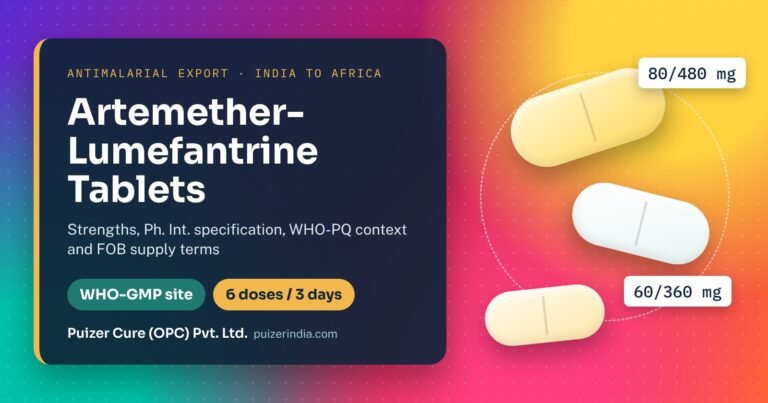
Public supply runs through national central medical stores and donor-funded tenders, which usually want an AMM. In DR Congo, WHO prequalification or a stringent-authority approval is accepted instead (see the DR Congo guide). Public tenders typically buy essential medicines, for example antimalarials such as artemether-lumefantrine tablets. The private market runs through licensed wholesalers, who often hold the AMM.
Two real Francophone enquiries, mapped to registration work
Scroll sideways on a phone →
| Buyer | What they asked for | Registration work it triggers |
|---|---|---|
| Kinshasa distributor, DR Congo | 21 essential generics in 10×10 blisters (co-trimoxazole, metronidazole, amoxicillin, doxycycline, folic acid, methyldopa and others) plus own-brand fixed-dose combinations. Asked for MOQ, FOB/CIF price, shelf life and lead time. | An ACOREP AMM for each product and strength. Shelf life is checked against DR Congo’s two-thirds rule at entry. We quote FOB only. See our essential generic medicines range for Africa. |
| Importer, Burkina Faso | Private-label price, MOQ, CTD dossier, CPP/FSC, WHO-GMP certificate and CoA. | A Faso FDA dossier under Regulation 04/2020: French Module 1 and labels, CPP, GMP evidence and samples. |
What Puizer Cure supplies
- Tablets and capsulesOur own WHO-GMP facility in Sonipat, Haryana.
- Liquids and topicalsA partner facility under loan licence. The CPP and GMP certificate name that site.
- InjectionsMade by a third party, not in-house.
- CertificatesCPP, WHO-GMP and CoA shared on request. No HALAL certification.
- TermsAdvance T/T only. FOB Indian port.
- Lead time and MOQ45 to 60 days after artwork approval. MOQ as typical ranges, confirmed per quote.
Abuse-prone products (tramadol, pregabalin, gabapentin, tapentadol) are handled on enquiry only. Check each country’s controlled-substance rules first.
Registering in a Francophone market? Send us your product list
Tell us the country, molecules, strengths, pack sizes and who will hold the AMM. We will reply with private-label pricing, MOQ ranges, and which products we can support with a CTD dossier, CPP and WHO-GMP evidence. Read our MOQ and commercial terms first if you are new to private label.
FAQ
Pharmaceutical registration in Francophone Africa: questions importers ask
It is the harmonised procedure for registering human medicines in the eight UEMOA states, set by Regulation n°04/2020/CM/UEMOA. The rules, dossier content and review clock are shared, but each national regulator grants its own marketing authorisation (AMM) for its own territory.
Regulation n°04/2020/CM/UEMOA of 28 September 2020, with its annexes. It repealed Regulation n°06/2010/CM/UEMOA, which many older guides and WAHO’s 2018 CTD guideline still cite.
No. Harmonisation covers the procedure, not the licence. You file with each national regulator and receive an AMM valid only in that country, so plan the dossier once and adapt Module 1 for each market.
Module 1, the summary of product characteristics and the labels must be in the official language of the country. That is French in every country in this hub except Guinea-Bissau, which uses Portuguese. Ask each regulator whether it accepts Modules 2 to 5 in English.
No. They left ECOWAS on 29 January 2025 but stayed in UEMOA and the CFA franc zone as of September 2026, so UEMOA Regulation 04/2020 still governs registration. Whether they can still use ECOWAS joint-assessment routes is unconfirmed.
Of the ten regulators in this hub, only Senegal’s ARP appears on WHO’s August 2026 list of ML3 and ML4 authorities. It reached ML3 for medicines and non-producing vaccines in 2024. Côte d’Ivoire’s AIRP is preparing for benchmarking.
The legal review clock is 120 days, extendable to 360 days while questions are open. Real timelines are longer: one consultancy reports 9 to 18 months for Burkina Faso, depending on dossier quality and response speed.
Yes, for products made at our Sonipat WHO-GMP facility and at our loan-licence partner site, with certificates shared on request. Injections are made by a third party. We hold no HALAL certification and quote FOB Indian port on advance T/T terms.
Related on Puizer Cure
Country guides and buyer tools
References
- Union Économique et Monétaire Ouest Africaine (UEMOA). Bulletin officiel de l’Union n°113, deuxième trimestre 2022 (visas citing Règlement n°04/2020/CM/UEMOA du 28 septembre 2020 relatif aux procédures d’homologation des produits pharmaceutiques à usage humain dans les États membres de l’UEMOA). Ouagadougou: Commission de l’UEMOA; 2022. Available from: https://www.uemoa.int/sites/default/files/bibliotheque/bulletin-officiel-ndeg113-de-luemoa-deuxieme-trimestre-2022.pdf. Accessed Nov 2026.
- Boka Alloukou PM, Amonkou AC, Minyem Ngombi-Afuh AP, Amari AS. Révision des procédures d’homologation des médicaments à usage humain au sein de l’UEMOA : quelles évolutions ? J Afr Technol Pharm Biopharm. 2026;5(1):1-12. doi:10.57220/jatpb.v5i1.222. Available from: https://soapgi-jatpb.org/index.php/jatpb/article/view/222. Accessed Nov 2026.
- UEMOA. Règlement n°06/2010/CM/UEMOA du 1er octobre 2010 relatif aux procédures d’homologation des produits pharmaceutiques à usage humain dans les États membres de l’UEMOA (repealed by Règlement n°04/2020). Ouagadougou: UEMOA; 2010. Via Ministère de la Santé du Bénin. Available from: https://new.sante.gouv.bj/bibliotheque/document/DO00001042/download. Accessed Nov 2026.
- Health Sciences and Disease. Évaluation de la performance du processus d’homologation des produits de santé au Cameroun : bilan de la période 2016-2023 (DPML, Ministère de la Santé Publique; cites Règlement n°5/13-UEAC-OCEAC-CM-SE-2 du 26 juin 2013, référentiel d’harmonisation des procédures d’homologation dans l’espace CEMAC). Yaoundé: Health Sci Dis; 2025. Available from: https://hsd-fmsb.org/index.php/hsd/article/view/7721. Accessed Nov 2026.
- National Institute of Allergy and Infectious Diseases (NIAID). ClinRegs: Democratic Republic of the Congo, Congolese Pharmaceutical Regulatory Authority (ACOREP), assets of the DPM transferred from 5 March 2020. Bethesda: NIH; 2026. Available from: https://clinregs.niaid.nih.gov/country/drc. Accessed Nov 2026.
- Organisation Ouest Africaine de la Santé (OOAS/WAHO). Enregistrement des produits pharmaceutiques à usage humain au sein de la CEDEAO : lignes directrices pour la préparation et la soumission des dossiers en format Document Technique Commun (CTD). Bobo-Dioulasso: OOAS; juin 2018. Available from: https://www.wahooas.org/web-ooas/sites/default/files/appels-doffres/2003/ctdfr-lignes-directrices-pour-la-preparation-et-la-soumission-des-dossiers.pdf. Accessed Nov 2026.
- UEMOA. Annexes au Règlement n°06/2010/CM/UEMOA relatif aux procédures d’homologation des produits pharmaceutiques à usage humain (contenu du dossier technique; procédure). Ouagadougou: Commission de l’UEMOA; octobre 2010. Via Ministère de la Santé du Bénin. Available from: https://new.sante.gouv.bj/bibliotheque/document/DO00001030/download. Accessed Nov 2026.
- World Health Organization. List of National Regulatory Authorities (NRAs) operating at maturity level 3 (ML3) and maturity level 4 (ML4), as of August 2026. Geneva: WHO; 2026. Available from: https://cdn.who.int/media/docs/default-source/medicines/regulatory-systems/wla/list-of-nras-operating-at-ml3-and-ml4.pdf. Accessed Nov 2026.
- ECOWAS Commission. Burkina Faso, Mali and Niger’s withdrawal from ECOWAS is now a reality [press release]. Abuja: ECOWAS; 30 Jan 2025. Available from: https://www.ecowas.int/burkina-faso-mali-and-nigers-withdrawal-from-ecowas-is-now-a-reality/. Accessed Nov 2026.
- The Rio Times. Mali, Burkina Faso, Niger launch AES Sahel confederation parliament as currency plans lag. 6 Sep 2026 (secondary source). Available from: https://www.riotimesonline.com/sahel-aes-confederation-economy-2026/. Accessed Nov 2026.
- République du Bénin. Demande d’homologation des produits de santé (legislation: Règlement n°04/2020/CM/UEMOA and annex; Décision n°2021-023/MS/ABRP du 28 juin 2021 portant mise en application du Règlement n°04/2020/CM/UEMOA). Cotonou: service-public.bj. Available from: https://service-public.bj/public/services/service/PS00045. Accessed Nov 2026.
- APA News. Mali : la réforme pharmaceutique de l’UEMOA toujours en attente (workshop of 20 May 2026 on Directive n°06/2020/CM/UEMOA on the status of national pharmaceutical regulatory authorities). 2026 (secondary source). Available from: https://fr.apanews.net/integration/mali-la-reforme-pharmaceutique-de-luemoa-toujours-en-attente/. Accessed Nov 2026.
- Gouvernement de la République du Bénin. Secteur santé : les membres du Conseil d’administration de l’ABMed installés (ABRP becomes Agence Béninoise du Médicament et des autres produits de santé). Cotonou; 17 Oct 2023. Available from: https://www.gouv.bj/article/2409/secteur-sante-membres-conseil-administration-abmed-installes/. Accessed Nov 2026.
- Gouvernement du Burkina Faso. Compte rendu du Conseil des ministres n°009 du 12 mars 2026 (décret portant création de Faso Food and Drug Administration par fusion de l’ANSSEAT et de l’ANRP). Ouagadougou; 2026. Available from: https://burkina24.com/wp-content/uploads/2026/03/CONSEIL-DES-MINISTRES-N%C2%B0009-DU-12-MARS-2026.pdf. Accessed Nov 2026.
- World Health Organization, Constitutions and Public Health Legislation Database. Côte d’Ivoire: Loi n°2017-541 du 3 août 2017 relative à la régulation du secteur pharmaceutique (establishes the AIRP). Geneva: WHO. Available from: https://extranet.who.int/cpcd/health-legislation/loi-ndeg-2017-541-du-3-aout-2017-relative-la-regulation-du-secteur. Accessed Nov 2026.
- allAfrica / Fraternité Matin. Côte d’Ivoire : régulation pharmaceutique, l’AIRP s’inspire du modèle nigérian pour franchir un nouveau cap. 27 Jul 2026 (secondary source). Available from: https://fr.allafrica.com/stories/202607270162.html. Accessed Nov 2026.
- Mali Trade Portal. Direction de la Pharmacie et du Médicament (Ministère de la Santé), Bureau d’Autorisation de Mise sur le Marché. Bamako. Available from: https://mali.tradeportal.org/Contacts/55?l=en. Accessed Nov 2026.
- World Health Organization, Constitutions and Public Health Legislation Database. Niger: Décret n°2022-915/PRN/MSP/P/AS du 30 novembre 2022 portant approbation des statuts de l’Agence nigérienne de règlementation du secteur pharmaceutique. Geneva: WHO. Available from: https://extranet.who.int/cpcd/health-legislation/countries/NIG/legislation-repository. Accessed Nov 2026.
- Ndiaye S. La réforme du secteur pharmaceutique : évolution ou révolution ? Seneweb; 2026 (secondary source citing décret n°2022-824 du 7 avril 2022 portant création de l’ARP). Available from: https://seneweb.com/en/news/Contribution/la-reforme-du-secteur-pharmaceutique-evolution-ou-revolution-par-samba-ndiaye-_n_425096.html. Accessed Nov 2026.
- World Health Organization. Senegal and Rwanda achieve WHO maturity level 3 in medicines regulation [news release]. Geneva: WHO; 5 Dec 2024. Available from: https://www.who.int/news/item/05-12-2024-senegal-and-rwanda-achieve-who-maturity-level-3-in-medicines-regulation. Accessed Nov 2026.
- allAfrica. Togo : retrait de deux médicaments défectueux des pharmacies (order of the Direction de la Pharmacie, du Médicament et des Laboratoires). 28 Aug 2025 (secondary source). Available from: https://fr.allafrica.com/stories/202508280694.html. Accessed Nov 2026.
- MyJoyOnline. Togo establishes autonomous agency to regulate medicines and health products. 9 Sep 2026 (secondary source). Available from: https://www.myjoyonline.com/togo-establishes-autonomous-agency-to-regulate-medicines-and-health-products/. Accessed Nov 2026.
- allAfrica. Afrique de l’Ouest : Franc CFA, les États du Sahel officialisent leur « retrait immédiat… ». Oct 2025 (no originating outlet named; claim not borne out by later sources). Available from: https://fr.allafrica.com/stories/202510030140.html. Accessed Nov 2026.
- Currency News. No new currency for West African states. Mar 2026 (secondary source reporting a clarification by Mali’s Ministry of Economy and Finance). Available from: https://prod.currency-news.com/news/2026/mar/05/no-new-currency-for-west-african-states/. Accessed Nov 2026.
Disclaimer. This hub is technical and educational information for importers and exporters. It is not legal, regulatory or medical advice. UEMOA, CEMAC and national texts change, and several regulators in this region were restructured in 2022 to 2026. Confirm the regulator, fees, sample quantities and labelling rules with each authority before you file or ship. Items marked Unverified or Verify could not be confirmed from a primary source on 16 November 2026.
Written by Darshan Singh, pharmaceutical QA and regulatory affairs consultant with 23+ years in pharmaceutical quality control, quality assurance and drug regulatory affairs, for Puizer Cure (OPC) Pvt. Ltd. Published 2026-11-16 · Facts checked 2026-11-16.