
Tanzania TMDA Drug Registration Process: The Exporter’s Guide to Premises, Product & Import Licensing
Tanzania is the one East African market where the sequence itself trips up first-time exporters: TMDA registers your premises before it will touch your product, and only then issues the import permit that actually lets a shipment cross the border. This guide walks through all three using TMDA’s own published Client Service Charter timelines, and shows why Tanzania rewards exporters who already hold WHO-PQ or SRA approval more generously than any other East African regulator covered in this series.
What it actually takes to sell a medicine in Tanzania
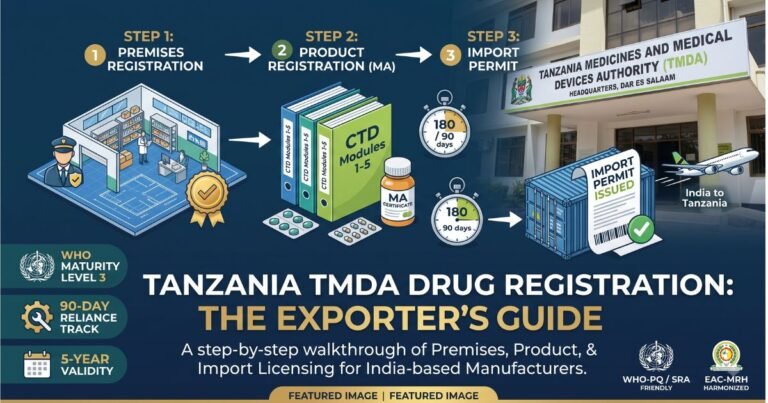
Tanzania runs on a strict sequence most guides gloss over. First, your Tanzanian partner’s premises must be inspected and issued a Premises Registration Certificate — TMDA will not evaluate a product application from an unregistered premises. Second, the product itself goes through Marketing Authorization: for a foreign manufacturer, TMDA’s own published standard is 180 working days, or 90 working days if the product is already authorized by a Reference Regulatory Authority (WHO-Prequalified or SRA-approved) under TMDA’s reliance guidelines, finalized July 2025.2,3 Third, once both are in place, TMDA issues a Business Permit to your partner and a per-shipment import permit — which, once the product is registered, TMDA’s own standard turns around in as little as one working day.2
Why Tanzania, and why now
Tanzania imported an estimated US$358.8 million in pharmaceutical products in 2024, with India supplying roughly US$205.3 million of that — over half the total, from a single country of origin.1 With a population above 68 million and a healthcare system that remains heavily import-dependent, Tanzania is one of the largest single-country opportunities covered in this series.
Two things distinguish TMDA from its regional neighbours. First, in 2018 TMDA became the first regulatory authority in Africa to attain WHO Global Benchmarking Tool Maturity Level 3 (ML3) — a stable, well-functioning regulatory system — and retained that status after a full WHO reassessment in 2023.5 That is a materially more mature starting point than the “Level 2 moving toward Level 3” position described for Kenya’s PPB in our companion guide, and it shows up directly in TMDA’s willingness to publish exact day-counts for almost every service it offers, not just headline figures.
Second, TMDA finalized new Guidelines on Regulatory Reliance for Marketing Authorization of Human Medicinal Products in July 2025, and issued a public notice on 30 June 2026 confirming the pathway is live: applications for products already authorized by a Reference Regulatory Authority are evaluated within 90 working days of acceptance — against 180 working days on the standard track.3 That is the newest, most exporter-relevant regulatory development in this entire series, and as of this writing it isn’t reflected in most third-party guides to the Tanzanian market.
The sequence: premises → product → permit
This is where Tanzania differs most sharply from Kenya and Uganda, and where generic guides tend to blur the picture. TMDA does not run “product registration” as a single track alongside a separate importer-licensing track — it runs them sequentially. Your Tanzanian partner’s premises must be registered before TMDA will progress a product application tied to that premises, and the import permit only becomes available after both are done.
| Step | What TMDA issues | TMDA’s own published standard |
|---|---|---|
| 1 · Premises registration | Premises Registration Certificate (after physical inspection) | Inspection: 5–7 working days · certificate issuance: 3 working days2 |
| 2 · Product registration | Marketing Authorization / Products Registration Certificate | 180 working days standard · 90 working days reliance pathway2,3 |
| 3 · Business permit | Business Permit for the registered premises | Issued once premises and at least one product are registered |
| 4 · Import permit | Per-consignment import permit | 1 working day once the product is registered2 |
For manufacturers, TMDA also inspects the plant itself: once samples are submitted and pass testing, the Products Registration Certificate is issued. For a foreign manufacturer’s site specifically, TMDA’s overseas GMP inspection carries its own standard — a report and compliance certificate within 45 working days of the inspection.2 Dealers and importers who don’t manufacture receive a Business Licence at the premises-registration stage instead.
Why the sequencing matters more here than elsewhere in this series
In Kenya and Uganda, an exporter can realistically start the product dossier and the local-partner relationship in parallel with only moderate risk. In Tanzania, a product application submitted before your partner’s premises is registered simply has nowhere to attach — TMDA’s own process description ties product registration to an already-registered premises.6 Get your Tanzanian LTR’s premises registered first, or run it hard in parallel from day one; treating it as an afterthought is the single most common reason Tanzania timelines blow past the published standard.
Who does what: manufacturer vs. Tanzanian LTR
TMDA maintains a public list of recognised Local Technical Representatives (LTRs) — the same concept used in Kenya and Uganda, under the same name.7 For an India-based exporter, the split looks like this:
| Responsibility | Manufacturer / exporter (India) | Local Technical Representative (Tanzania) |
|---|---|---|
| CTD dossier (Modules 1–5) | Compiles quality, safety & efficacy data; CMC, stability & batch data | Adapts Module 1 (local admin) & submits via TMDA’s online system (IMIS) |
| Premises registration | — | Registers premises with TMDA before product filing; holds Premises Registration & Business Permit |
| GMP evidence | Supplies WHO-GMP certificate, site master file, WHO-PQ / SRA record if held | Coordinates overseas GMP inspection where required — 45 working-day standard2 |
| Local Technical Representative | Appoints the LTR | Acts as TMDA’s correspondence point on the application |
| Import permits | Provides invoice, CoA, packing docs per shipment | Applies for the permit — 1 working day once the product is registered2 |
| Fees | — | Pays TMDA fees in TZS or USD equivalent via GEPG (Government e-Payment Gateway), against a Control Number from a TMDA Proforma Invoice8 |
| Retention & renewal | — | Files annual retention; renewal ≥3 months before the 5-year expiry4 |
Where a WHO-GMP contract manufacturer changes the math: if you’re a brand owner or distributor without your own approved plant, sourcing from a WHO-GMP third-party manufacturing partner means the CPP, GMP certificate, site master file and stability data arrive as a ready package — and, if that plant also holds WHO-PQ or SRA approval, it is what qualifies the file for TMDA’s 90-day reliance track rather than the 180-day standard track. See our third-party manufacturing for African markets guide for how that arrangement is typically scoped.
Registration, step by step
Every figure below is TMDA’s own published standard from its Clients’ Service Charter (4th Edition, 2020) and its July 2026 reliance-pathway notice — not a third-party estimate.
Appoint your LTR and register premises
Your Tanzanian LTR’s manufacturing, storage or distribution premises is inspected (5–7 working days) and, if compliant, issued a Premises Registration Certificate and Business Permit (3 working days).2
Dossier compilation
Build the full CTD across Modules 1–5 in the EAC-harmonised ICH format, first codified by TMDA in January 2015.9 Consistency between modules is the most common trigger for query cycles later.
Application submission
Submit through TMDA’s online system via your LTR, tied to the now-registered premises, and pay statutory fees via GEPG.
Screening & validation
TMDA checks the application is complete before it enters evaluation. Incomplete files are returned at this stage.
Evaluation
Standard track for an imported medicinal product: 180 working days. Reliance track for WHO-PQ / SRA / other RRA-authorized products: 90 working days from acceptance.2,3 Query-response evaluation on the standard track: 80 working days.2
Overseas GMP inspection, where required
TMDA’s standard for sending the inspection report and issuing the GMP compliance certificate for an imported product’s manufacturing site: 45 working days each.2
Marketing Authorization issued
Valid five years from first issue. Renewal must be filed at least three months before expiry.4
Import permit, per shipment
Once the product is registered, TMDA’s own standard for issuing an import permit for a registered product is 1 working day — rising to 7 days for a special permit.2
The CTD dossier — and what “complete” really means
TMDA’s Guidelines on Submission of Documentation for Registration of Human Pharmaceutical Products, first published January 2015, adopt the ICH Common Technical Document (CTD) format across five modules — the same EAC-harmonised structure covered in our Kenya PPB guide, with only Module 1 (local administrative content) changing per country.9
| Requirement | What it proves |
|---|---|
| Local Technical Representative | Your correspondence and regulatory point of contact inside Tanzania |
| Registered premises | The premises the product application is tied to must already hold a Premises Registration Certificate |
| Certificate of Pharmaceutical Product (CPP) | Approval status in the country of origin (WHO format) |
| GMP certificate / evidence | Manufacturing site meets recognised quality standards |
| CTD dossier (Modules 1–5) | Core quality, safety & efficacy documentation |
| Certificate of Analysis (CoA) | Batch-level product quality against specification |
| Stability data | Supports shelf-life & storage claims for tropical climatic zones |
| Product labeling & package insert | Tanzania-compliant labeling |
| Interchangeability / BE data (generics) | Therapeutic equivalence, per Module 5 |
Interactive · Dossier readiness check
Indicative checklist for planning only. Nothing is stored or sent — this runs entirely in your browser. Confirm the exact, current requirement set against official TMDA guidelines before you file.
Fees & the registration planner
TMDA’s fees are set under the Tanzania Medicines and Medical Devices (Fees and Charges) Regulations and are payable in Tanzanian shillings or US$ equivalent, processed through the Government e-Payment Gateway (GEPG) against a Control Number issued on a TMDA Proforma Invoice — accepted at Citibank, CRDB, NMB and NBC.8 We could not source an official, published USD figure specifically for imported human-medicine Marketing Authorization within this build; treat any number you’re quoted elsewhere as unverified until your LTR confirms it against the current Fourth Schedule.
| Cost line | When it applies | Notes |
|---|---|---|
| Premises registration & business permit | Once, before product filing | Fee set by TMDA’s Fees and Charges Regulations |
| Product / Marketing Authorization fee | Per product, at submission | Confirm current figure directly with TMDA and your LTR — not independently verified for this guide |
| GMP inspection fee | If TMDA inspects an un-assessed foreign site | Overseas inspection carries a 45 working-day reporting standard;2 reliance may reduce the need for a fresh visit |
| Annual retention | Yearly, to keep registration live | Recurring across the 5-year validity |
| Variation fee | Post-approval changes | Major variation: 45-day standard. Minor variation: 30-day standard2 |
| Renewal fee | Every 5 years | File ≥3 months before expiry; imported-product renewal evaluated within 30 working days2,4 |
| LTR retainer | Ongoing (commercial, not TMDA) | Negotiated with your Local Technical Representative |
Interactive · TMDA registration planner
Illustrative only, in indicative US$. Every fee input here is a placeholder for you to overwrite — none of them are sourced from TMDA’s published tariff, unlike the day-count figures elsewhere on this page. Excludes dossier preparation, CPP/legalisation, lab analysis, freight and taxes. Not financial advice.
Two realistic timelines, not one
TMDA publishes exact working-day standards for almost every step, which makes Tanzania one of the more plannable East African markets in this series — provided the premises-first sequence is respected.
What blows the timeline: filing the product application before the premises registration is complete, inconsistent CTD modules, and slow responses to TMDA queries during the 80-day evaluation window on the standard track.2
EAC-MRH: register once, expand across East Africa
Tanzania was one of the five founding states when the East African Community Medicines Regulatory Harmonization (EAC-MRH) programme launched on 30 March 2012, alongside Kenya, Uganda, Rwanda and Burundi — the same framework referenced in our PPB Kenya guide.10 TMDA maintains a dedicated East African Community Mutual Recognition Procedures (EAC-MRP) function, and the July 2025 reliance guidelines explicitly extend the same logic to WHO-PQ and SRA-authorized products, not only EAC joint assessments.3
| Harmonization mechanism | What it means for your submission |
|---|---|
| Common CTD format | One dossier structure accepted across partner states — only Module 1 changes per country |
| Priority procedure, 90-day standard | Products from EAC and SADC partner states, WHO collaborative procedure, orphan medicines, and WLA-approved products all qualify for TMDA’s 90-day track2 |
| Reliance guidelines, July 2025 | Extends the 90-day track to any product authorized by a Reference Regulatory Authority, independent of EAC joint assessment3 |
| Mutual recognition of GMP | A GMP inspection outcome can be recognised across the bloc, reducing repeat inspections |
The practical play: register in Kenya first, then reuse the CTD core for Uganda (NDA) and Tanzania (TMDA) — adjusting only local administrative content and, in Tanzania’s case, sequencing the premises registration ahead of the product filing. This is the same logic behind our pharmaceutical export to Africa approach.
Common delay triggers — and how to avoid them
- Filing the product before the premises is registered. TMDA’s product-registration process assumes a registered premises is already in place — this is the single most Tanzania-specific mistake in this series.6
- Weak or missing stability data. Ensure data supports the claimed shelf life under the correct climatic zone before filing.
- Inconsistency between CTD modules. Figures or claims that don’t reconcile across Modules 1–5 generate queries during the 80-day response-evaluation window.2
- An unrecognised or absent GMP status. A site TMDA hasn’t assessed, with no WHO-PQ / SRA record to rely on, means the standard 180-day track and a fresh 45-day overseas inspection instead of the 90-day reliance track.2,3
- Treating the LTR as a formality. The representative is a legal correspondence role, not a mailbox — and in Tanzania, also the party who must get your premises registered before anything else can move.
- Registering the product but not the import route. Import permits move fast (1 working day) once a product is registered, but only once — not before.2
Sequencing multiple products: once premises registration is done, lead with the SKUs that have the clearest commercial case. Registering a whole catalogue at once multiplies query load without multiplying early revenue.
Planning a Tanzania or East Africa launch? Start from a WHO-GMP base.
Whether you need a registration-ready dossier package, a WHO-GMP manufacturing partner, or export documentation built to clear TMDA review, our team supports Indian manufacturers and brand owners entering African markets end to end.
TMDA Tanzania registration — frequently asked questions
TMDA’s own published standard is 180 working days for an imported medicinal product on the standard track, or 90 working days if the product is already authorized by a Reference Regulatory Authority (WHO-Prequalified or SRA-approved) under TMDA’s reliance guidelines finalized in July 2025. Query-response evaluation on the standard track adds up to a further 80 working days.
TMDA’s process ties a product application to an already-registered premises, unlike Kenya and Uganda where the two tracks can run more independently in parallel. Getting your Tanzanian Local Technical Representative’s premises registered first — or at minimum started very early — is the single biggest lever on your overall timeline.
No. A foreign manufacturer must act through a Tanzania-based Local Technical Representative, drawn from TMDA’s own recognised list, who submits the application and corresponds with TMDA on your behalf.
A CTD dossier across Modules 1–5 in the EAC-harmonised format, a WHO-format Certificate of Pharmaceutical Product, GMP evidence, a Certificate of Analysis, stability data, labeling, interchangeability or BE data for generics, and a named Local Technical Representative operating from an already-registered premises.
TMDA fees are set under its Fees and Charges Regulations and paid in Tanzanian shillings or US$ equivalent via the Government e-Payment Gateway. We could not source an official published USD figure specifically for imported-medicine Marketing Authorization for this guide — confirm the exact, current amount directly with TMDA and your LTR before budgeting.
Yes, substantially. TMDA’s July 2025 reliance guidelines give WHO-Prequalified, SRA-approved, and other Reference-Regulatory-Authority-approved products a 90-working-day evaluation standard against 180 working days on the standard track, and can reduce the need for a fresh overseas GMP inspection.
Substantially. Tanzania was a founding EAC-MRH state alongside Kenya, and both work to the EAC-harmonised CTD format, so a dossier built for PPB is largely reusable for TMDA — only Module 1 administrative content changes per country, and the premises-first sequence still applies.
Once a product is registered, TMDA’s own published standard is 1 working day to issue an import permit for a registered product, or 7 working days for a special permit. Shipments without valid registration and permit documentation are not released at the port of entry.

Reviewed by Darshan Singh
23+ years in pharmaceutical Quality Assurance, Quality Control and Drug Regulatory Affairs. This guide is written for exporting manufacturers and brand owners and reflects hands-on experience with CTD dossiers, GMP compliance and multi-market registration. It is general information, not regulatory or legal advice for a specific product.
- UN Comtrade, via Trading Economics. Tanzania Imports of Pharmaceutical Products, and India Exports of Pharmaceutical Products to Tanzania. Available from: https://tradingeconomics.com/tanzania/imports/pharmaceutical-products and https://tradingeconomics.com/india/exports/tanzania/pharmaceutical-products — accessed August 2026.
- Tanzania Medicines and Medical Devices Authority. Clients’ Service Charter, 4th Edition, 2020. Section 8, Service Standards. Available from: https://www.tmda.go.tz/pages/client-service-charter — accessed August 2026.
- Tanzania Medicines and Medical Devices Authority. Public Notice: Regulatory Reliance Pathways for Marketing Authorisation of Human Medicinal Products, 30 June 2026, referencing the Guidelines on Regulatory Reliance for Marketing Authorization of Human Medicinal Products, July 2025. Available from: https://www.tmda.go.tz/announcements/regulatory-reliance-pathways-for-marketing-authori — accessed August 2026.
- Tanzania Medicines and Medical Devices Authority. Procedures for Marketing Authorization — validity and renewal. Available from: https://www.tmda.go.tz/pages/procedures-for-market-authorization — accessed August 2026.
- TMDA retains WHO Maturity Level 3 status following 2023 reassessment; first African NRA to attain ML3 in 2018. Available from: https://allafrica.com/stories/202510200245.html — secondary news source reporting a TMDA announcement, not independently cross-checked against a WHO primary publication for this build.
- Tanzania Investment Centre (TIC). TMDA premises and product registration sequence. Available from: https://www.tic.go.tz/pages/tmda — accessed August 2026.
- Tanzania Medicines and Medical Devices Authority. List of Local Technical Representatives Recognized by TMDA. Available from: https://www.tmda.go.tz/pages/list-of-local-technical-representatives-recognized-by-tmda — accessed August 2026.
- ClinRegs (NIH/NIAID). Tanzania profile — TMDA fee payment via GEPG. Available from: https://clinregs.niaid.nih.gov/country/tanzania — accessed August 2026. Cites TMDA’s own fee schedule (TMMDAFees) for payment mechanism only; specific figures shown there relate to clinical trial fees, not Marketing Authorization, and are not used in this guide.
- AUDA-NEPAD, African Medicines Regulatory Harmonisation (AMRH). Tanzania country profile — CTD guidelines first published January 2015. Available from: https://amrh.nepad.org/amrh-countries/tanzania — accessed August 2026.
- East African Community. EAC Medicines Regulatory Harmonization (EAC-MRH) Programme — launched 30 March 2012. Available from: https://www.eac.int/mrh — accessed August 2026.