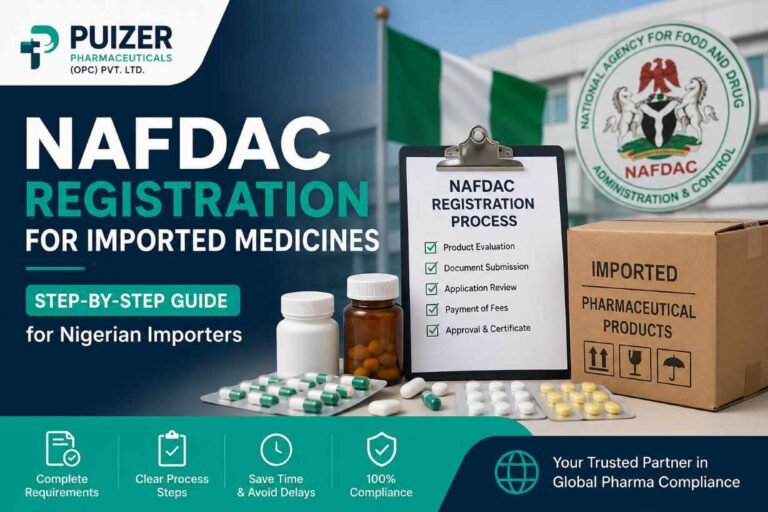

NAFDAC Registration for Imported Medicines: Step-by-Step Guide for Nigerian Importers
A complete walkthrough of the NAFDAC drug registration process — written from both sides of the transaction, covering what your Nigerian entity must handle and what your manufacturing partner should already have prepared.
1. Product Registration vs. Drug Dealer Registration — Don’t Confuse These
Before starting the NAFDAC drug registration process, it’s worth clearing up a distinction that trips up a lot of first-time importers. NAFDAC operates two separate registration systems that sound similar but serve entirely different purposes:
- Product Registration — this is what this guide covers. It registers a specific drug product (a particular brand, strength, and formulation) and results in a unique NAFDAC Registration Number for that product.
- Drug Dealer / Premises Registration — a separate business license required to legally operate as a wholesaler, distributor, or retailer of pharmaceutical products in Nigeria, tied to your physical premises rather than a specific product.
You generally need both if you’re building an import and distribution business — but they’re applied for separately, follow different timelines, and are easy to conflate when researching online. This guide focuses specifically on registering the product itself.
2. Who Can Actually Apply: The Local Representative Requirement
Here’s a detail that catches foreign manufacturers off guard: a foreign manufacturer cannot apply to NAFDAC directly. Product registration for an imported drug must be initiated by a Nigerian local representative — a Nigerian entity or individual in whose name the registration certificate is ultimately issued.
In practice, this means the relationship between an exporting manufacturer and a Nigerian importer isn’t just commercial — the importer becomes the legal applicant of record with NAFDAC, and typically holds the resulting registration certificate. This is worth clarifying explicitly in any manufacturing or supply agreement before registration work begins, since it affects who legally controls the registration going forward.
3. The NAFDAC Drug Registration Process, Step by Step
Applications are processed through NAFDAC’s Automated Product Administration and Monitoring System (NAPAMS), the agency’s official online registration portal. Broadly, the process runs as a two-stage sequence: first, approval to import registration samples; then, the full product registration review. Here’s how it breaks down in practice.
4. How Long Does It Actually Take?
This is where you’ll find genuinely conflicting information across different sources — worth addressing directly rather than picking one number and hoping it’s right.
The gap between these figures isn’t a contradiction so much as different starting points: official processing-day figures count only the formal review clock once an application is accepted — they don’t include the earlier sample-import authorization stage, document preparation time, or any delay triggered by queries from NAFDAC that a slow response can extend indefinitely. The realistic planning number for a first-time registration is 6 to 12 months from initial application to certificate issuance, and building that timeline into your business planning from day one avoids unpleasant surprises.
5. Documents You’ll Need — Checklist
Click through this list to track what you have in hand versus what still needs to be gathered from your manufacturing partner.
6. Understanding the Costs Involved
NAFDAC publishes a detailed tariff schedule covering application, inspection, and facility fees, which vary by product category and whether the manufacturing site is local or foreign. The categories below give a general sense of what’s involved — treat these as illustrative, and confirm exact current figures directly against NAFDAC’s published tariff before budgeting.
Foreign-site facility inspections are notably more expensive than local inspections, which is a cost worth factoring into your total registration budget early — particularly if you’re registering multiple products manufactured at the same facility, where the inspection cost is generally a one-time facility-level cost rather than a per-product charge.
7. What a Manufacturer Should Have Ready Before You Apply
Most guides on this topic are written entirely from the importer’s side. But a meaningful share of registration delays actually originate on the manufacturer’s end — documentation that should have been prepared and readily available, but wasn’t. If you’re evaluating a manufacturing partner, or already working with one, confirm they can produce the following without a lengthy internal scramble:
- A current, valid Certificate of Manufacture and Free Sale for the specific product, not just the company generally
- Batch-specific Certificates of Analysis available on short notice for sample shipments
- A GMP certificate that is current and hasn’t lapsed — an expired certificate is a common, entirely avoidable cause of delay
- Willingness and logistical readiness to accommodate a facility inspection within a reasonable timeframe, including English-language documentation on hand for the inspection team
- A designated contact who can respond quickly to NAFDAC queries relayed through the local representative — slow internal response is one of the most common reasons applications stall
This is precisely the kind of readiness we maintain as standard practice — our regulatory and export documentation support is built around keeping these documents current and available before a partner ever needs to ask.
8. Common Reasons Applications Get Delayed
Beyond the process itself, a handful of recurring issues account for most of the delays importers actually experience:
- Incomplete or inconsistent documentation — mismatched details between the dossier, labels, and certificates trigger queries that reset review time.
- Slow response to NAFDAC queries — under NAFDAC’s own guidelines, failing to respond promptly can result in automatic closure of the application, not just a pause.
- Assuming foreign facilities are exempt from inspection — they aren’t, and assuming otherwise leads to late-stage scheduling scrambles.
- Label non-compliance — labels prepared for a different market rarely meet NAFDAC’s specific formatting requirements without adjustment.
- Underestimating the sample import stage — treating this as a formality rather than a genuine prerequisite step delays everything downstream.
9. Frequently Asked Questions
No. Registration for an imported product must be initiated through a Nigerian local representative, who becomes the named applicant and typically holds the resulting registration certificate.
Five years from the date of issuance, and renewable for subsequent five-year periods on application.
Yes. Facility inspection applies to both local and foreign production sites — there’s no exemption based on location, and foreign-site inspections generally carry a higher fee.
No. Product registration covers a specific drug product and results in a NAFDAC number for that product. Operating as a wholesaler, distributor, or retailer requires a separate Drug Dealer / Premises registration tied to your business location.
Preparing a NAFDAC Application?
Our export team keeps documentation current and ready for exactly this process — talk to us about what your registration will need from the manufacturing side.
📩 Discuss Your Requirement